
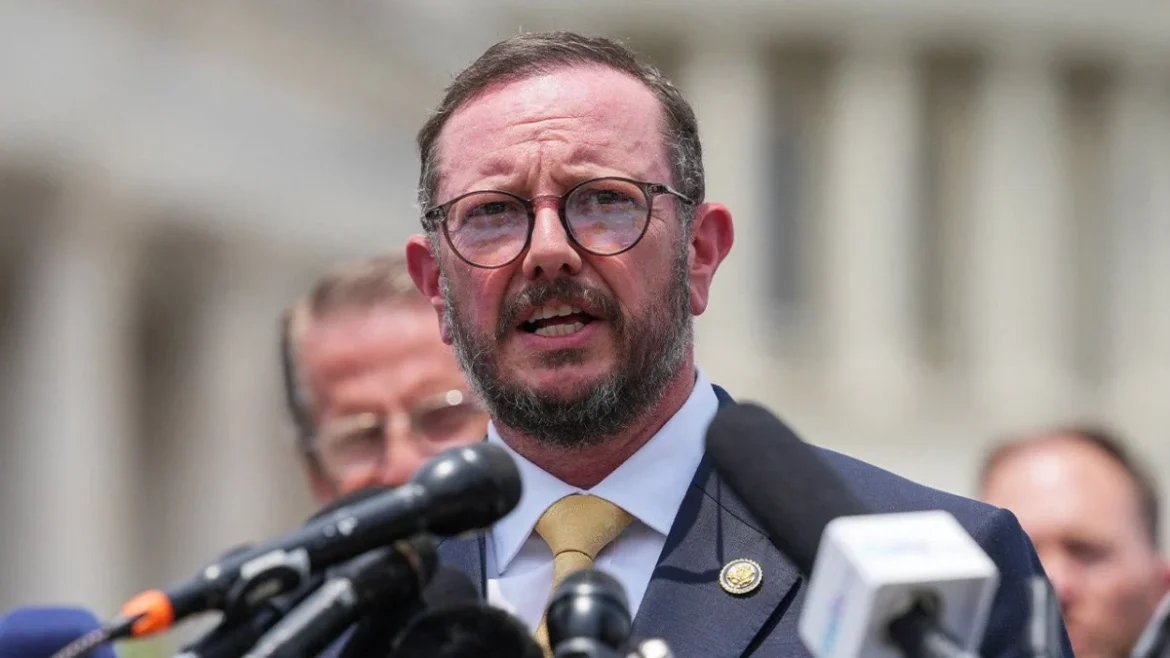
As the United States national debt surpasses the historic threshold of $40 trillion, the debate over fiscal responsibility has reached a fever pitch within the halls of Congress. Representative Eric Burlison (R-MO) has emerged as a vocal critic of the current legislative trajectory, arguing that a bipartisan culture of unchecked spending is actively eroding the economic stability of the American middle class. With midterm elections just six weeks away, Burlison’s assessment of the nation’s fiscal health offers a stark perspective on the challenges facing lawmakers as they navigate inflation, healthcare costs, and energy pricing.
The Fiscal Landscape: A $40 Trillion Reality
The national debt, a metric that has ballooned over the past decade due to a combination of emergency pandemic-era stimulus, consistent deficit spending, and rising interest obligations, currently stands at a level that many economists categorize as unsustainable. For Representative Burlison, the issue is not merely one of accounting but of political will. He contends that members of both the Republican and Democratic parties have become "drunk on spending," suggesting that the addiction to federal expenditure has blinded legislators to the long-term consequences of mounting liabilities.
Burlison’s critique extends beyond the executive branch, targeting the internal legislative processes that frequently lead to omnibus spending packages. He asserts that the resistance to fiscal restraint is pervasive, noting that even within the GOP, there is significant pushback against meaningful budget cuts. This internal friction, he argues, has hindered the party’s ability to present a cohesive and disciplined economic platform to voters.
Chronology of the Legislative Standoff
The current frustration regarding federal spending can be traced back through several key legislative milestones:
- 2023-2024: Persistent debates over appropriations bills, where conservative members of the House Freedom Caucus consistently pushed for "hard caps" on discretionary spending to offset the growing deficit.
- Early 2025: The emergence of the Department of Government Efficiency (DOGE) initiative, spearheaded by Elon Musk, created a wave of optimism among fiscal conservatives. Many lawmakers, including Burlison, initially viewed this as a catalyst for sweeping budgetary reforms.
- Mid-2025: The "Big, Beautiful Bill" became a focal point of legislative contention. While proponents lauded the bill as a victory for the second-term agenda, critics like Burlison argued that it lacked the necessary, deeper structural spending reductions required to address the systemic debt crisis.
- Late 2025 – Early 2026: The failure of multiple appropriations amendments to gain traction on the House floor highlighted a deepening divide between establishment lawmakers and those advocating for radical austerity measures.
Healthcare Costs and the Affordability Crisis
A central pillar of Burlison’s economic critique is the escalating cost of healthcare, which he describes as the primary driver of the current "affordability crunch." Drawing a direct comparison between the year 2000 and the present, Burlison highlights a stark disparity in insurance premiums. In 2000, the average annual premium for a family of four was approximately $6,000. Today, that figure has reached $27,000.
Burlison emphasizes that if healthcare inflation had tracked with standard consumer price index (CPI) growth, the cost today would be closer to $11,000. This $16,000 gap, he argues, represents "crowded-out" capital—money that households would otherwise spend on housing, education, or local economic stimulation. According to his analysis, the failure to reform the healthcare system is not just a policy oversight; it is the root cause of the housing affordability crisis and the general decline in discretionary spending power for the average American.
The Promise and Pitfalls of the DOGE Initiative
When the DOGE initiative was introduced in 2025, it was marketed as a potential "silver bullet" for federal waste. Representative Burlison expressed initial enthusiasm for the project, noting that it provided a rare opportunity to engage the private sector in the process of streamlining government bureaucracy. However, his optimism was tempered by the behavior of his peers.
Burlison observed a paradoxical trend: while many of the "swampiest" members of Congress were eager to publicly align themselves with the DOGE effort to capture media attention, those same individuals frequently voted against the very spending cuts that experts and efficiency advocates suggested. This performative support for fiscal discipline, he claims, has contributed to a deep-seated skepticism among voters regarding the sincerity of congressional reform efforts.
The Economic Implications of Global Conflict
Beyond domestic spending, Burlison has identified the geopolitical climate as a critical factor in the economic burden placed on working-class families. With tensions in the Middle East impacting global energy markets, he has proposed a specific tax policy aimed at providing immediate relief: the temporary suspension of federal fuel taxes.
"We should be cutting the fuel taxes during this period of time," Burlison stated, noting that a repeal of taxes on diesel alone could save consumers approximately 40 cents per gallon. He argues that during times of conflict, the federal government should prioritize the immediate financial survival of its citizens over the collection of revenue from energy taxes.
Broader Impact and Future Outlook
As the midterm elections approach, the messaging problem within the Republican Party has become a subject of intense internal debate. Burlison suggests that simply running "against" the opposition’s platform is insufficient. Instead, he advocates for a proactive, visionary approach that centers on transparency and free-market healthcare reform.
Independent political analysts suggest that Burlison’s focus on the "affordability crisis" aligns with polling data indicating that voters are increasingly prioritized economic security over partisan culture wars. However, the challenge remains: can a party that is internally divided on the mechanics of spending cuts present a unified front to the electorate?
The implications of the current trajectory are significant. If current spending patterns continue, economists warn of increased volatility in interest rates, which could further dampen investment and increase the cost of capital for small businesses. Furthermore, as the national debt interest payments consume an increasingly large portion of the federal budget, the government’s ability to respond to future crises—whether economic, environmental, or military—will be severely constrained.
Conclusion: A Call for Fiscal Accountability
Representative Burlison’s message is one of urgency. He warns that the current economic "party" is nearing its end, and the inevitable "hangover" will be painful for a nation that has relied too heavily on debt-fueled growth. Whether his call for fiscal prudence will resonate with his colleagues in the final weeks before the midterms remains to be seen.
What is clear is that the debate over the $40 trillion debt is no longer an academic exercise reserved for economists; it has become a central kitchen-table issue. As lawmakers look toward the next legislative session, the pressure to demonstrate not just intent, but tangible results in curbing federal expenditure and lowering the cost of living, will be the defining metric of their performance in the eyes of the American public. The path forward, Burlison insists, requires a willingness to perform the "difficult things"—the hard choices that Washington has historically been loath to make.
