
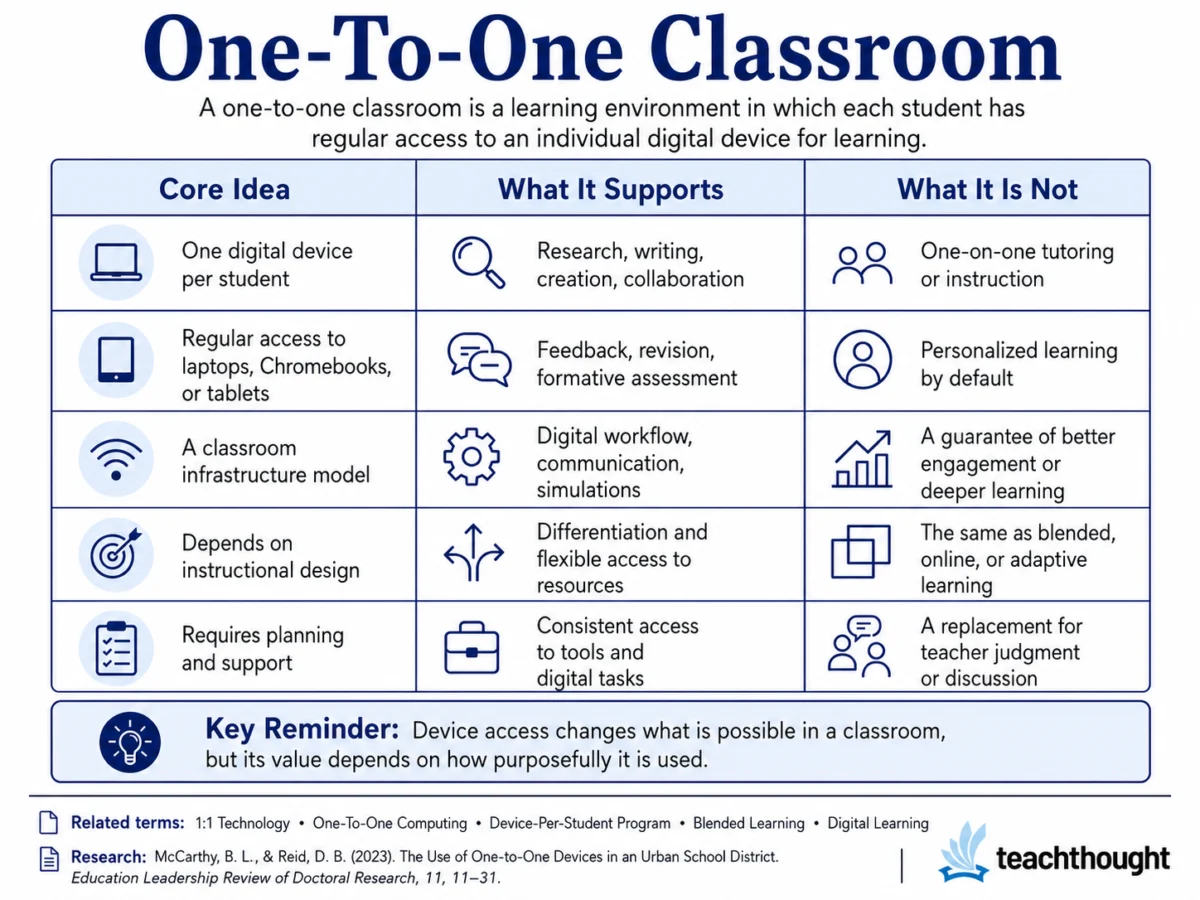
The modern educational landscape has undergone a profound transformation over the past two decades, shifting from shared computer labs and library carts to ubiquitous, individual student technology access. Central to this evolution is the "one-to-one classroom"—an instructional environment where every student is equipped with a dedicated digital device, such as a laptop, Chromebook, or tablet, for regular use. While this model has become a standard benchmark of modern school infrastructure, educators, administrators, and researchers continue to debate its true impact on student achievement. Hardware deployment, advocates argue, does not automatically guarantee pedagogical enhancement. Instead, the true value of a one-to-one computing program relies heavily on intentional instructional planning, robust teacher training, and the thoughtful integration of technology into everyday learning goals, student collaboration, and formative assessments.
Defining the One-To-One Learning Model
At its core, a one-to-one classroom is defined strictly by device availability: one functional digital device per student. These tools may be provided directly by the school district, assigned to individual learners for the duration of the academic year, or integrated through "bring-your-own-device" (BYOD) policies. Regardless of the acquisition method, the hardware must be accessible whenever instructional activities demand it.
However, educational experts emphasize that one-to-one computing should not be confused with broader or more specialized educational frameworks. For instance, it is distinct from "blended learning," which systematically combines face-to-face instruction with online delivery modalities. While blended learning frequently utilizes one-to-one devices, the pedagogical approach can exist without them. Similarly, one-to-one computing is not synonymous with "personalized learning"—a strategy tailored to individual student paces, interests, and readiness levels. While digital devices can serve as powerful conduits for personalized instruction, hardware access alone does not inherently adapt curriculum to a student’s unique needs. Finally, one-to-one classrooms must be distinguished from "one-on-one instruction," a traditional teaching ratio referring to a single educator or tutor working directly with an individual learner.
Chronology and Evolution of 1:1 Computing in Schools
The trajectory of student computing has matured through distinct phases, mirroring broader advancements in consumer technology, wireless networking, and cloud computing.
In the late 1990s and early 2000s, student access to technology was predominantly communal. Schools established centralized computer laboratories or managed mobile carts containing a limited number of laptops that teachers had to reserve weeks in advance. This friction-heavy model restricted technology integration to specific computer-class periods or isolated research projects.
By the mid-2000s, early-adopter school districts began experimenting with pioneering one-to-one initiatives, often driven by federal grants, state programs, or corporate partnerships with hardware manufacturers. These initial rollouts frequently relied on bulky laptops or early-generation tablets, presenting significant logistical hurdles regarding battery life, weight, and network bandwidth.
The 2010s marked a tipping point with the proliferation of cloud-based ecosystems and low-cost hardware options, most notably the Google Chromebook. These lightweight, affordable devices drastically reduced the financial barrier to entry for cash-strapped school districts, catalyzing widespread adoption across both urban and rural districts.
The movement accelerated exponentially between 2020 and 2022. Driven by global health emergencies and the sudden mandate for remote and hybrid learning, school systems rushed to achieve true one-to-one parity. Billions of dollars in federal relief funds were channeled into hardware procurement, transforming what was once an innovative luxury into an absolute educational utility. Today, the conversation has shifted away from mere procurement toward sustainability, equitable home-internet access, cybersecurity, and meaningful instructional integration.
Comparative Overview of Related Educational Terms
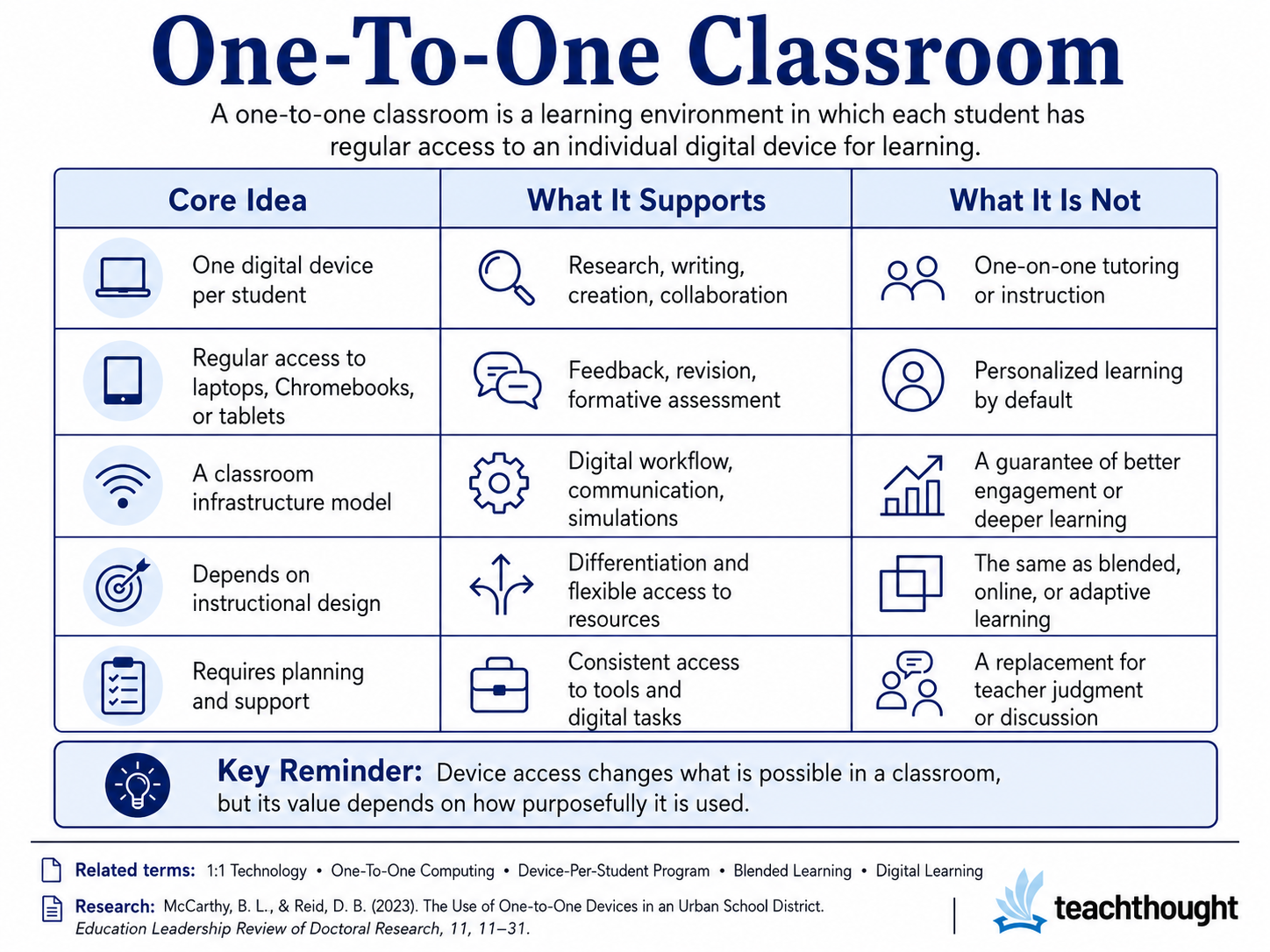
To understand the operational mechanics of modern schools, educators frequently delineate between overlapping technological and pedagogical concepts.
| Term | Meaning | Relationship To 1:1 Computing |
|---|---|---|
| One-To-One Computing | One digital device permanently or semi-permanently allocated per student. | The foundational standard defining a one-to-one classroom environment. |
| Blended Learning | A deliberate combination of traditional face-to-face instruction and online digital learning experiences. | Frequently utilizes 1:1 devices, but the pedagogical strategy does not strictly require them. |
| Personalized Learning | Instruction adapted dynamically to variations in student readiness, learning pace, pathway, or interest. | Digital devices can effectively support personalization, but hardware access alone does not create it. |
| One-On-One Instruction | An instructional ratio featuring a single educator or tutor working directly with one learner. | A distinct human-to-human teaching dynamic, entirely separate from the device-to-student ratio of 1:1 classrooms. |
Expectations Versus Reality: What 1:1 Is and Is Not
School administrators frequently market one-to-one initiatives as silver bullets for academic engagement and modernization. Yet, educational researchers urge stakeholders to maintain a clear distinction between technological infrastructure and instructional efficacy.
A one-to-one classroom undeniably establishes a robust infrastructure for digital workflows, seamless feedback loops, expanded research capabilities, and student media creation. It expands the physical boundaries of the classroom, allowing continuous access to digital archives, simulations, and collaborative platforms. However, researchers and practitioners caution that a device-per-student model does not automatically equate to a personalized-learning environment. Furthermore, simply placing a laptop in front of a student is no guarantee of heightened engagement or deeper cognitive learning.
Moreover, one-to-one computing programs cannot replace foundational human elements of education, such as structured class discussions, direct teacher-led instruction, holistic human feedback, and professional teacher judgment. Successful implementation requires extensive instructional planning, established classroom routines, ongoing technical support, and robust device maintenance protocols.
Empirical Insights and Research Context
As educational institutions invest heavily in maintaining these device ecosystems, academic researchers continue to evaluate their actual impact on classroom dynamics. A notable 2023 empirical study conducted by B. L. McCarthy and D. B. Reid examined the operational realities of one-to-one computing within a large urban school district.
Published in the Education Leadership Review of Doctoral Research, McCarthy and Reid’s research highlighted that teachers generally held positive perceptions regarding classroom technology. Educators acknowledged that having individual devices streamlined assignment collection, facilitated digital communication, and diversified media creation. However, the study heavily emphasized that the success of these implementations was fundamentally tethered to non-hardware variables: specifically, the availability of preparation time, regular peer practice, comprehensive professional development, and sustained administrative support. Because the scope of the McCarthy and Reid study was limited to a single urban district, educational analysts note that its findings cannot be universally generalized across every rural, suburban, or private school implementation context.
Complementing this research, organizations like the International Society for Technology in Education (ISTE) and the K20 Center for Educational and Community Renewal at the University of Oklahoma have published extensive frameworks to guide districts post-implementation. Their findings universally stress that the true challenge of the one-to-one era begins after the devices are unboxed. Without intentional curriculum design, schools risk turning expensive laptops into glorified digital textbooks rather than tools for active creation and critical thinking.
Implications for the Future of K-12 Education
The long-term implications of widespread one-to-one computing stretch far beyond daily lesson plans, influencing budget allocations, IT department expansions, and teacher preparation programs. As artificial intelligence, adaptive software, and cloud-based learning management systems become deeply embedded in school curricula, the demand for reliable individual hardware will only intensify.
Nevertheless, the enduring lesson of the one-to-one movement is that technology must remain a servant to pedagogy, not its master. As school districts draft strategic plans for the coming decade, the primary focus is transitioning from quantitative metrics—such as the total number of devices purchased—to qualitative outcomes. Policymakers, superintendents, and classroom teachers are increasingly recognizing that the transformative power of a one-to-one classroom is unlocked not by the silicon inside the device, but by the intentional teaching strategies guiding its use.

