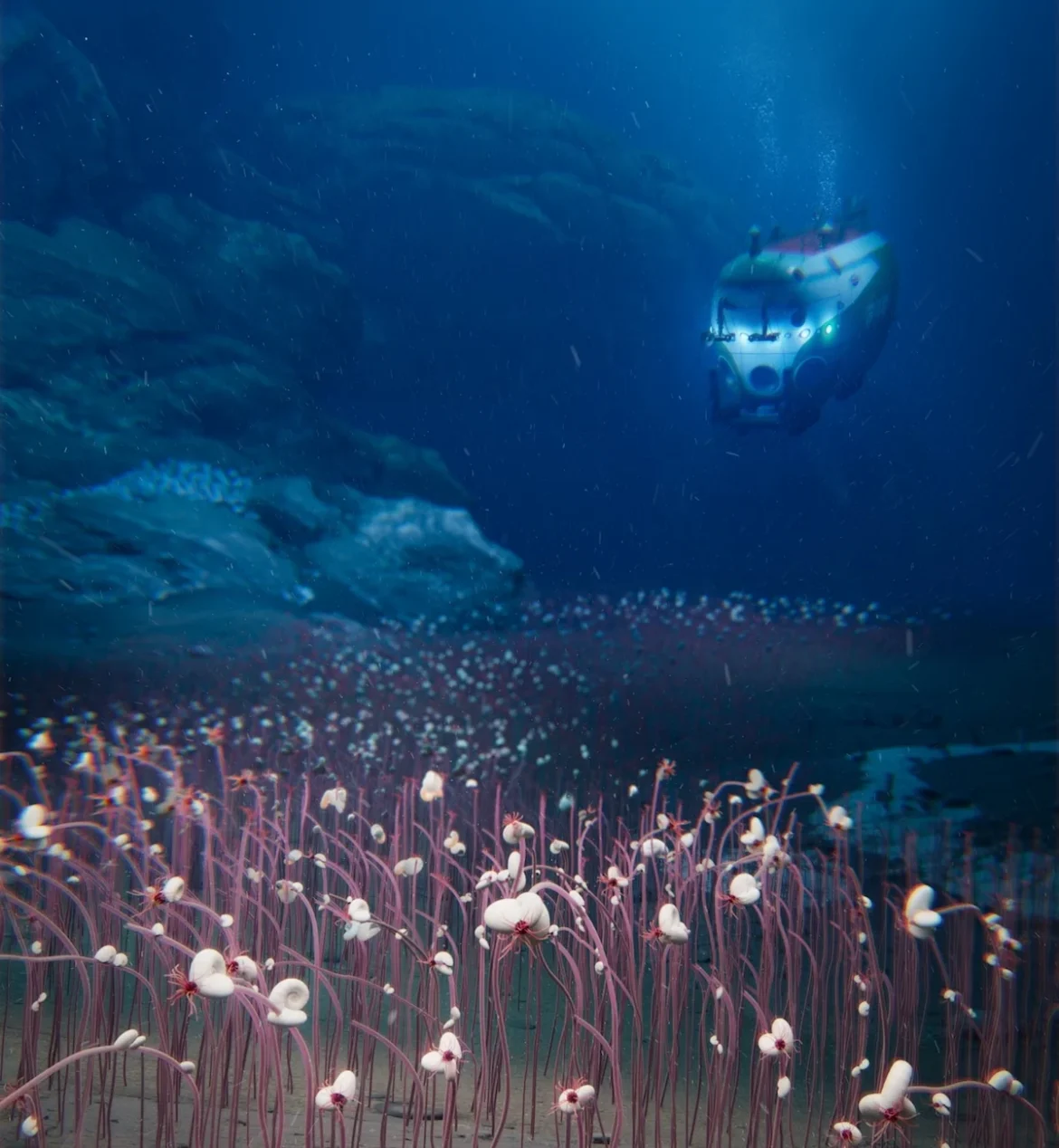
A team of researchers from the Chinese Academy of Sciences has documented the deepest and most extensive animal communities ever observed on Earth, thriving nearly six miles beneath the surface of the Pacific Ocean. Utilizing the state-of-the-art manned submersible Fendouzhe, scientists identified flourishing colonies of mollusks, tubeworms, and other invertebrates at depths ranging from 5.8 to 9.5 kilometers (approximately 3.6 to 5.92 miles). This discovery, centered in the Mariana Trench as well as the Kuril–Kamchatka and western Aleutian Trenches, challenges long-held assumptions about the biological desolation of the "hadal zone"—the deepest region of the ocean.
The findings, published in the journal Nature, reveal a "vibrant oasis" of life in an environment previously characterized as a desolate, alien desert. These communities do not rely on sunlight for energy but instead depend on chemosynthesis, a process where organisms derive energy from chemical reactions. The discovery suggests that complex life is far more resilient and widespread in the Earth’s deep-sea trenches than scientific models had previously predicted.
A Breakthrough in Hadal Exploration
The expedition, led by the Institute of Deep-sea Science and Engineering (IDSSE), focused on the western Pacific’s hadal trenches, which are among the least explored environments on the planet. While earlier research had identified single-celled organisms and occasional scavengers in these depths, the sheer density and diversity of the newly discovered communities have stunned the global scientific community.
The Fendouzhe (which translates to "Striver") conducted 23 dives into the Mariana Trench over the course of the last year. During these descents, researchers observed thousands of bivalves and siboglinid polychaetes (tubeworms) clustered along the seafloor. These animals were found inhabiting a vast geographical range, spanning approximately 1,553 miles (2,500 kilometers).
"What makes our discovery groundbreaking is not just its greater depth—it’s the astonishing abundance and diversity of chemosynthetic life we observed," said study co-author Mengran Du, a marine geochemist with the IDSSE. "Unlike isolated pockets of organisms, this community thrives like a vibrant oasis in the vast desert of the deep sea."
The Mechanism of Survival: Chemosynthesis in the Dark
At the depths where these colonies reside, the pressure is over 1,000 times that at sea level, and temperatures hover just above freezing. Most importantly, no sunlight can penetrate these waters, making photosynthesis—the foundation of most life on Earth—impossible.
Instead, these ecosystems are fueled by methane-rich and hydrogen sulfide-rich fluids. These chemicals seep through geological faults that traverse the deep sediment layers of the trenches. According to isotopic analysis conducted by the research team, the methane is produced microbially from organic matter deposited in the trenches over millennia.
Microbial mats, described by the researchers as "snow-like" in appearance, serve as the primary producers in this ecosystem. The larger animals, such as the foot-long tubeworms and various species of clams, cluster around these mats to feed. This discovery provides "compelling evidence" that high-pressure, deep-ocean environments can host self-sustaining biological systems that operate entirely independently of the solar-driven food chain.
Chronology of Deep-Sea Discovery
The exploration of the Mariana Trench has a storied but sparse history due to the extreme technological challenges of reaching the ocean floor.
- 1875: The HMS Challenger first recorded the depths of the Mariana Trench using a weighted sounding line, identifying it as the deepest point in the world’s oceans.
- 1960: The bathyscaphe Trieste, carrying Jacques Piccard and Don Walsh, became the first manned vessel to reach the bottom of the Challenger Deep (the deepest point of the trench). They stayed for only 20 minutes and reported seeing a "flatfish," though this was later debated by biologists.
- 2012: Filmmaker and explorer James Cameron made the first solo descent in the Deepsea Challenger. He described the environment as "desolate" and "lunar," observing very few large organisms.
- 2020–Present: The Chinese submersible Fendouzhe began a series of systematic dives. Unlike previous "touch-and-go" missions, these expeditions focused on prolonged observation and sample collection, leading to the current discovery of extensive animal colonies.
The contrast between James Cameron’s 2012 observations and the current findings highlights the importance of sustained, high-resolution exploration. While Cameron’s site may have been biologically sparse, the Fendouzhe team’s broader survey across multiple trenches revealed that life is not just present, but flourishing in specific geological corridors.

Supporting Data and Biological Diversity
The communities discovered primarily consist of two groups: siboglinid Polychaeta (tubeworms) and Bivalvia (mollusks). However, the biodiversity extended beyond these dominant species. Video footage and samples retrieved by the submersible documented:
- Tubeworms: Reaching lengths of up to 12 inches (30 centimeters).
- Bivalves: Dense mounds of clams and mollusks.
- Invertebrates: Sea lilies (crinoids), sea cucumbers, and spiky crustaceans.
- Free-floating worms: Various polychaete species adapted to the extreme pressure.
The researchers noted that these communities are strategically located along fault lines. These faults act as conduits for the chemical "fuel" needed for chemosynthesis. The study suggests that as tectonic plates shift and grind in these subduction zones, they create the very conditions necessary for life to thrive in the abyss.
Scientific Implications and Global Reactions
The discovery has profound implications for our understanding of the global carbon cycle. Current models often treat the deep ocean as a "sink" where organic matter simply settles and decomposes slowly. However, the presence of massive chemosynthetic communities suggests a much more active biological processing of carbon at extreme depths.
"Given geological similarities with other hadal trenches, such chemosynthesis-based communities might be more widespread than previously anticipated," stated lead author Xiatong Peng. This suggests that the "Hadal Zone" may play a significantly larger role in Earth’s biosphere than previously calculated.
The international scientific community has reacted with a mixture of awe and caution. Marine biologists not involved in the study have noted that these findings may require a rewrite of textbooks regarding the "limits of life." Furthermore, the discovery has sparked renewed interest in astrobiology. If life can flourish in the high-pressure, chemically-driven environments of Earth’s trenches, it increases the likelihood that similar life forms could exist in the subsurface oceans of icy moons like Jupiter’s Europa or Saturn’s Enceladus.
The Threat of Deep-Sea Mining
While the discovery is a triumph for science, it arrives at a time of intense geopolitical and environmental debate regarding the future of the seabed. The International Seabed Authority (ISA) is currently in the process of drafting regulations for deep-sea mining. Many nations and corporations are eager to harvest "polymetallic nodules"—rocks rich in cobalt, nickel, and manganese—found on the ocean floor.
Oceanographers and environmentalists warn that the mining process could be catastrophic for these fragile, newly discovered ecosystems. The plumes of sediment stirred up by mining equipment could smother chemosynthetic colonies, while the removal of geological structures could destroy the very habitats these animals rely on.
"Diving in the submersible was an extraordinary experience—like traveling through time," said Mengran Du. "Each descent transported me to a new deep-sea realm, as if unveiling a hidden world and unraveling its mysteries." Environmental advocates argue that these "mysteries" should be protected before they are commodified, emphasizing that we are only just beginning to understand the complexity of the deep-sea web of life.
Future Research and Exploration
The IDSSE plans to continue its exploration of the western Pacific, with a focus on mapping the full extent of these chemosynthetic "highways." Future missions will likely utilize autonomous underwater vehicles (AUVs) alongside the manned Fendouzhe to provide a more comprehensive view of the trench floors.
Researchers are also interested in the genetic makeup of these hadal creatures. How do their cells resist being crushed by the immense pressure? How do their metabolic pathways process methane and sulfide so efficiently? Answering these questions could lead to breakthroughs in biotechnology and a deeper understanding of evolutionary biology.
As human technology continues to peel back the layers of the ocean’s deepest trenches, it is becoming clear that the abyss is not a void. Instead, it is a complex, living frontier that holds the secrets to the resilience of life on Earth and, potentially, beyond. The discovery of these flourishing communities serves as a powerful reminder that even in the darkest, most hostile corners of our planet, life finds a way to thrive.