

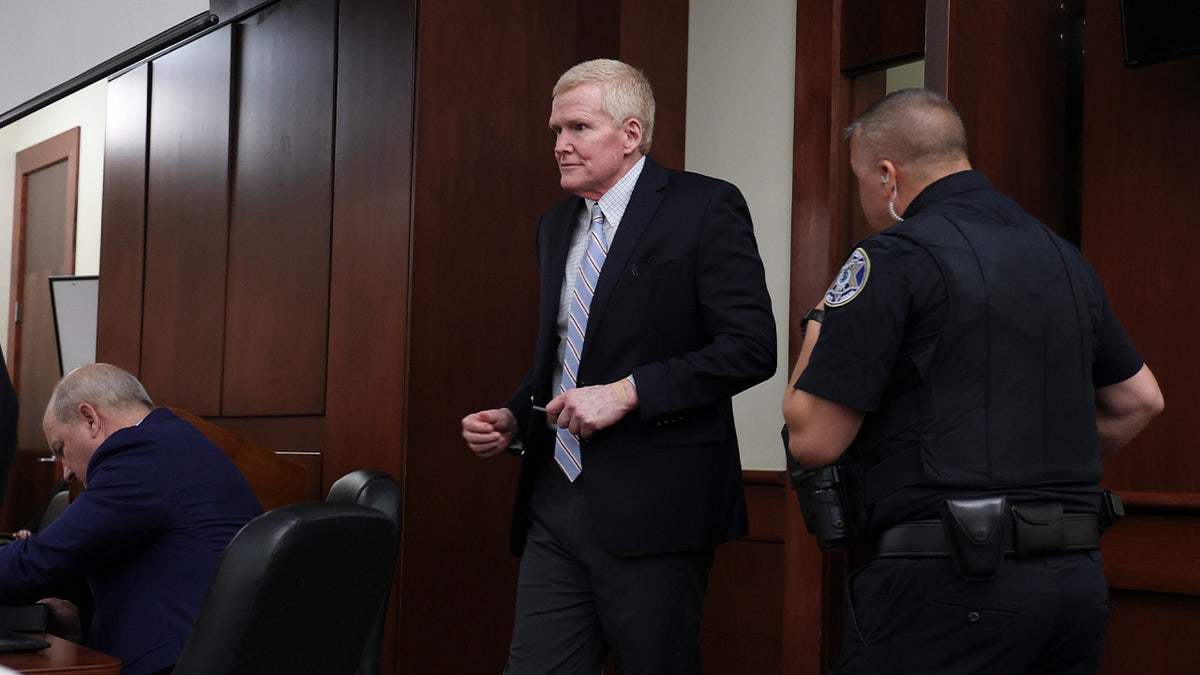
Attorneys representing convicted financial criminal and disbarred attorney Alex Murdaugh have formally filed a massive, 93-page motion in South Carolina state court, demanding that prosecutors turn over key forensic evidence, ballistics data, and raw digital files. The legal filing accuses state authorities of dragging their feet and withholding crucial materials that are vital for trial preparation ahead of Murdaugh’s upcoming April 2027 double-murder retrial.
The motion focuses heavily on biological evidence that the defense claims was never fully pursued by the South Carolina Law Enforcement Division (SLED) state crime lab. Among the primary items demanded by the defense team is an unidentified male DNA profile discovered underneath the fingernails of Maggie Murdaugh, Alex Murdaugh’s late wife, as well as partial DNA profiles collected from swabs taken off her cellular phone.
With the retrial looming, the legal battle over physical evidence has intensified, setting the stage for what legal experts predict will be a fiercely contested courtroom showdown. The defense argues that time is running out to independently test and evaluate the state’s physical evidence, while legal analysts warn that pushing for further DNA testing could prove to be a high-stakes gamble for Murdaugh’s legal team.
Background Context of the Murdaugh Case
The legal saga surrounding Alex Murdaugh ranks among the most sensationalized and complex criminal proceedings in modern American history. The case traces back to the tragic events of June 7, 2021, when Maggie Murdaugh, 52, and her 22-year-old son, Paul Murdaugh, were found shot to death near the dog kennels of the family’s sprawling estate, known as Moselle, located in Colleton County, South Carolina.
For more than a year, the investigation gripped the state, compounding suspicions surrounding the powerful and politically connected Murdaugh legal dynasty. Alex Murdaugh, the fourth generation of his family to serve as a prominent local prosecutor, initially maintained his innocence and claimed he discovered the bodies after returning from visiting his ailing mother. However, the subsequent investigation unraveled a labyrinth of financial crimes, drug addictions, and insurance fraud schemes, ultimately leading to Murdaugh’s indictment for the murders of his wife and son.
During his highly publicized 2023 trial, prosecutors presented a mountain of circumstantial and digital evidence, including a pivotal cellphone video recorded by Paul Murdaugh just minutes before the murders. The video placed Alex Murdaugh at the crime scene alongside the victims—contradicting his initial alibi. In March 2023, a Colleton County jury convicted Murdaugh on two counts of murder and two counts of possession of a weapon during the commission of a violent crime. He was subsequently sentenced to two consecutive life terms in prison.

However, the legal victory for the state proved temporary. In a stunning turn of events, the South Carolina Supreme Court unanimously overturned Murdaugh’s double-murder convictions. The appellate court found compelling evidence that the former Colleton County Clerk of Court, Becky Hill, had improperly influenced the jury through unauthorized communications and media pressure, thereby violating Murdaugh’s constitutional right to a fair trial. With his convictions vacated, a South Carolina judge scheduled a fresh murder retrial to begin on April 5, 2027.
The Push for Advanced Forensic Testing and Unidentified DNA
At the heart of the defense team’s latest 93-page filing is a demand for absolute transparency regarding physical evidence collected at the crime scene. The defense previously secured permission to send DNA evidence recovered from underneath Maggie Murdaugh’s fingernails to Othram, Inc., a specialized forensic genealogy laboratory known for solving cold cases through advanced phenotyping and DNA sequencing.
While initial testing through Othram confirmed the presence of genetic material, Murdaugh’s attorneys argue that the state crime lab identified an unknown male DNA profile during preliminary examinations but failed to fully pursue or develop it. The defense contends that this genetic profile could point toward an alternate perpetrator or provide reasonable doubt, rendering the complete release of the underlying biological data essential for their case preparation.
In addition to the fingernail scrapings, the defense motion demands full access to swab samples taken from Maggie Murdaugh’s cellular device, arguing that partial DNA profiles extracted from the phone warrant deeper scrutiny.
Allegations of State Stalling and Tactical Shifts
The defense’s motion does not merely request physical items; it levels sharp criticisms at the South Carolina Attorney General’s Office and SLED, accusing state investigators of intentionally dragging their feet to compromise the defense’s ability to mount a robust case.
"Every week the State withholds this material is a week taken from the preparation of the defense, and if the delay continues the defense may be forced to seek a continuance that Mr. Murdaugh does not want and that the Court has said it will not grant," the motion states. "The State should not be permitted to create, through inaction, the very delay it would then oppose."
Furthermore, the legal filing accuses prosecutors of hypocrisy regarding the physical custody of evidence. Pointing to the fact that state authorities have maintained exclusive control over every piece of physical evidence for more than five years, the defense argues that investigators selectively tested materials without notifying or consulting the defense, yet now object to the defense employing similar testing methodologies.
The defense has also highlighted what it terms a "flip-flop" by prosecutors regarding the alleged murder weapon. During the 2023 trial, the state heavily emphasized the rarity of a .300 Blackout rifle, arguing that such a firearm was uncommon and pointing suspicion toward weapons owned by the Murdaugh family. According to the new motion, prosecutors have shifted their stance in pretrial proceedings for the retrial, now acknowledging that the .300 Blackout is among the most popular AR cartridge configurations in the country.
Demands for Ballistics Data and 3D Crime Scene Scans
Beyond biological and DNA evidence, Murdaugh’s legal team is seeking broad disclosures concerning regional firearms incidents and digital crime scene reconstructions.
Specifically, the defense has requested a comprehensive list of every shooting incident across the counties surrounding the Moselle property where .300 Blackout cartridge cases or projectiles were recovered by law enforcement, accompanied by detailed reports for each respective crime. The defense aims to determine whether the ammunition used in the murders could be linked to other criminal acts or individuals in the region.
Additionally, the motion addresses raw digital data generated from a 3D laser scan conducted by SLED at the Moselle crime scene. While prosecutors originally provided the defense with a read-only viewer file back in 2022, defense attorneys argue that the restricted file format prevents them from performing independent trajectory analysis and scene reconstruction. They are now demanding the unedited, raw data files to allow their own experts to digitally map the shooting scene.
Legal Analysis: A High-Stakes Gamble for the Defense
While the defense views the motion as a necessary step to uncover overlooked evidence, legal analysts note that pushing for extensive DNA and ballistics testing carries significant risks.

Joshua Ritter, a former prosecutor and prominent legal commentator, weighed in on the defense’s strategy, categorizing the demand for additional DNA testing as a "big gamble." According to Ritter, leaving the identity of the unknown male DNA ambiguous allowed the defense during the initial trial to raise questions about investigative competence and point toward an unsolved mystery.
"I think it’s probably better left alone by the defense so that they can make that argument about this unknown male," Ritter explained. "‘Who is that? Why didn’t the prosecution test it? Why didn’t they do anything about it?’ Maybe they’re concerned that the prosecution could point the finger right back at them and say, well, you guys didn’t test it either, you had it for as much time as we did."
If the defense proceeds with advanced testing and the results ultimately match an acquaintance, family member, or someone with a legitimate reason to be near the victims, it could neutralize one of Murdaugh’s most potent alternative theories of the crime. Conversely, if testing isolates a viable unknown suspect with a criminal record, it could deal a severe blow to the state’s narrative of sole authorship.
Chronology of Key Events in the Murdaugh Case
- June 7, 2021: Maggie and Paul Murdaugh are shot and killed near the dog kennels at the family’s Moselle estate in Colleton County, South Carolina.
- July 14, 2022: A South Carolina grand jury formally indicts Alex Murdaugh on two counts of murder and two counts of possession of a weapon during the commission of a violent crime.
- January 23, 2023: Opening statements begin in the state murder trial of Alex Murdaugh at the Colleton County Courthouse in Walterboro, South Carolina.
- March 2, 2023: A jury finds Alex Murdaugh guilty on all charges. He is subsequently sentenced to consecutive life terms without the possibility of parole.
- November 2023: Murdaugh’s defense attorneys file motions alleging jury tampering by Colleton County Clerk of Court Becky Hill.
- August 2024: The South Carolina Supreme Court unanimously vacates Murdaugh’s double-murder convictions, citing improper jury influence, and orders a new trial.
- June–August 2026: Pretrial hearings take place at the Lexington County Courthouse, highlighting ongoing disputes over evidence discovery.
- August 2026: Murdaugh’s defense team files a 93-page motion to compel the release of unexamined DNA, ballistics records, and raw laser-scan data.
- April 5, 2027: Alex Murdaugh’s double-murder retrial is officially scheduled to commence.
Official Responses and Outlook
As of publication, representatives for the South Carolina Attorney General’s Office and SLED have not formally responded to requests for comment regarding the defense’s latest filings. Judge Clifton Newman, who presided over the original 2023 trial, as well as any judge assigned to oversee the retrial proceedings, will ultimately decide whether the state must surrender the requested physical materials and raw data files.
With the retrial date set for April 2027, both sides face mounting pressure to finalize their discovery obligations. The upcoming rulings on the defense’s motion to compel will likely shape the contours of the courtroom strategy, determining whether new forensic revelations will emerge to rewrite the narrative of one of America’s most closely watched murder trials.