The digital education landscape has undergone a profound transformation, evolving from static desktop software into a dynamic ecosystem of mobile applications, browser-based simulations, and immersive virtual classrooms. As educators, students, and lifelong learners increasingly integrate technology into their daily routines, the demand for curated, high-quality digital learning tools has never been higher. Navigating this vast marketplace requires a strategic approach, as the efficacy of any digital tool depends entirely on alignment with specific learning objectives, age appropriateness, and pedagogical design. Recent data from the edtech sector indicates that global investments in digital learning platforms continue to surge, driven by an institutional shift toward hybrid and personalized learning models.
To help learners and instructors cut through the noise, a comprehensive evaluation of available platforms reveals a diverse spectrum of resources. These digital solutions range from foundational early-childhood literacy games and advanced mathematical modeling software to global citizen-science initiatives and comprehensive higher-education MOOCs (Massive Open Online Courses). Understanding how these tools function within broader educational frameworks is essential for maximizing their impact in both formal classrooms and independent study environments.
The Evolution of Digital Learning and EdTech Integration
The integration of educational technology into mainstream academics accelerated significantly over the past decade, shifting from a supplemental luxury to a core component of curriculum delivery. Industry analysts note that the proliferation of smartphones and tablets has democratized access to specialized knowledge, allowing users to move beyond traditional textbook learning into interactive, experiential domains.
According to recent educational technology adoption studies, schools and individual learners now utilize a hybrid of web-based applications and dedicated mobile software to reinforce classroom instruction. However, experts emphasize that technology is most effective when it serves as a bridge to active critical thinking rather than passive consumption. Platforms that emphasize problem-solving over lecture-style content—such as interactive simulations and exploratory data tools—have shown particularly strong outcomes in student engagement and concept retention.
Comprehensive Directory of Top Learning Platforms by Category
Foundational Learning and K-12 Core Subjects
For young learners and school-aged students, establishing a strong foundation in core subjects like mathematics, science, and literacy is paramount. Several platforms have emerged as industry standards for structured practice and conceptual understanding:
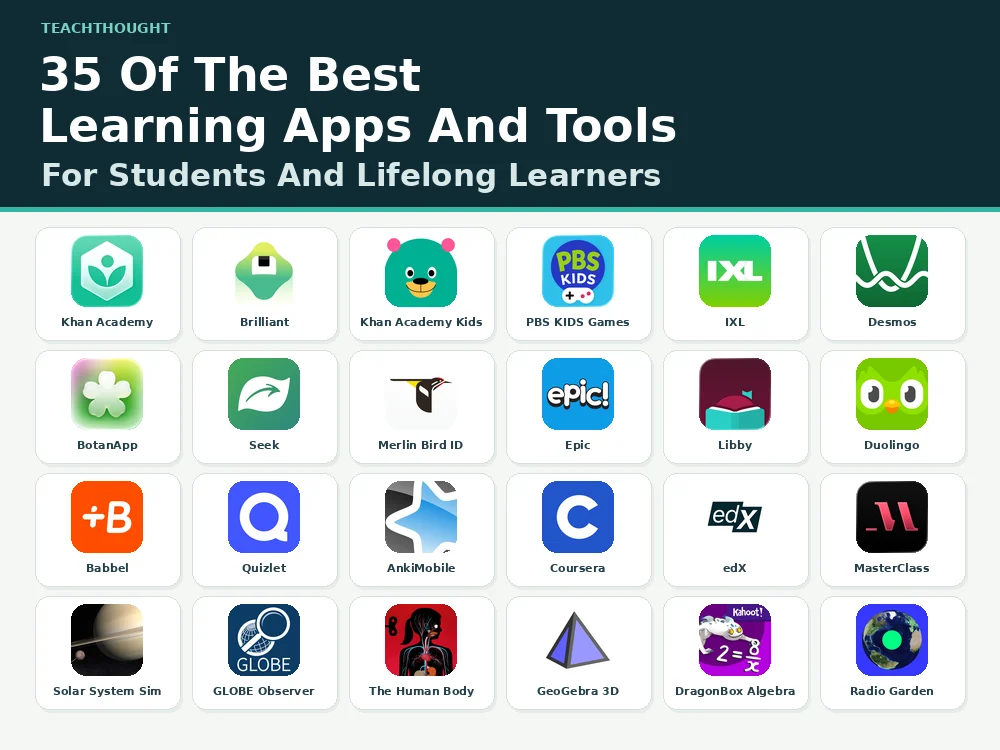
- Khan Academy and Khan Academy Kids: Operating as a cornerstone of free online education, Khan Academy provides comprehensive lessons and targeted practice across mathematics, the humanities, and the sciences for older students. Its counterpart, Khan Academy Kids, extends this mission to early learners, offering engaging books, games, and activities designed to foster early literacy and numeracy. Both platforms are widely accessible across web, iOS, and Android devices.
- Brilliant: Moving away from traditional lecture-based sequences, Brilliant utilizes an inquiry-based, interactive problem-solving model to teach advanced mathematics, coding, data science, and physics. By challenging users to visualize concepts and solve puzzles, the platform bridges the gap between theoretical knowledge and practical application.
- IXL: Widely adopted in K-12 classrooms, IXL offers targeted skill practice in mathematics, language arts, science, social studies, and Spanish. Its diagnostic framework helps educators and parents pinpoint specific learning gaps and deliver customized remediation.
- BrainPOP: Designed primarily for middle school students in grades 3 through 8, BrainPOP combines short animated narrative explanations with formative quizzes and cross-curricular activities, making complex topics digestible and entertaining.
Mathematics, Science, and STEM Explorations
STEM education has benefited immensely from digital visualization tools, allowing students to manipulate variables and observe complex phenomena in real time.
- Desmos Graphing Calculator: A staple in modern mathematics classrooms, Desmos offers a powerful, free tool for visualizing equations, geometric transformations, and functional relationships dynamically across web and mobile interfaces.
- PhET Interactive Simulations: Developed by the University of Colorado Boulder, PhET provides research-backed interactive simulations for physics, chemistry, biology, and math. These simulations allow students to experiment with virtual lab environments that may otherwise be physically inaccessible or hazardous.
- Scratch: Created by the Lifelong Kindergarten Group at the MIT Media Lab, Scratch is a premier block-based programming environment. It empowers children and beginners to build interactive stories, games, and animations, fostering fundamental computational thinking skills.
- GeoGebra 3D Calculator and Polypad: These digital manipulation spaces allow students to interact directly with geometric shapes, fractions, number tiles, and three-dimensional surfaces, translating abstract mathematical principles into tangible digital experiences.
- DragonBox Algebra 12+: By gamifying algebraic transformations, DragonBox successfully introduces complex mathematical notation to younger learners through progressive visual puzzles.
Natural Sciences, Ecology, and Citizen Science
Bridging the gap between digital screen time and the physical world, several apps encourage environmental stewardship, species identification, and direct contribution to scientific research.
- Merlin Bird ID and Seek by iNaturalist: Developed by the Cornell Lab of Ornithology and the California Academy of Sciences respectively, these applications utilize advanced image-recognition technology and audio analysis to help users identify birds, plants, animals, and fungi in their natural habitats. They transform outdoor excursions into active biological field studies.
- Botan App: Focused specifically on botany, this application assists users in identifying plant species through photographs while supplying essential horticultural care information.
- GLOBE Observer and Zooniverse: These citizen-science powerhouses invite ordinary citizens and students to contribute directly to active scientific research. GLOBE Observer allows users to record environmental observations—such as cloud cover and mosquito habitats—for NASA research, while Zooniverse engages volunteers in classifying astronomical data, transcribing historical records, and analyzing ecological images.
- NASA’s Eyes and Solar System Sim: Providing breathtaking 3D visualizations of the solar system, active spacecraft missions, and Earth science data, these tools bring astrophysics and planetary science directly to the browser and mobile screen.
- OneZoom: This interactive, zoomable "tree of life" visually maps evolutionary relationships across millions of species, offering a stunning macro-perspective of global biodiversity.
Literacy, Reading Libraries, and Language Acquisition
Language arts and multilingual capabilities remain critical pillars of personal and professional development. Digital libraries and adaptive language software have revolutionized how reading and foreign languages are acquired.
- Epic and Libby: Epic serves as a premier digital reading library tailored for children, featuring thousands of popular ebooks, read-to-aloud books, and audiobooks. For older students and adults, Libby connects users directly to their local public library systems, offering seamless digital borrowing of ebooks, audiobooks, and magazines using a valid library card.
- Duolingo and Babbel: As market leaders in language learning, Duolingo offers gamified, bite-sized vocabulary and grammar lessons across dozens of languages, while Babbel emphasizes structured, conversation-focused curricula designed for practical communication. Both platforms utilize spaced repetition to reinforce long-term memory retention.
- Quizlet and Anki: Essential study aids for students of all ages, Quizlet and Anki utilize digital flashcard systems. While Quizlet offers collaborative study sets and multiple-game modes, Anki is renowned for its sophisticated spaced-repetition algorithm that schedules reviews precisely when a user is most likely to forget a piece of information.
Higher Education, Professional Development, and Creative Arts
For lifelong learners seeking advanced instruction or creative skill development, online course providers and multimedia libraries offer university-grade content.
- Coursera and edX: These platforms partner with top-tier global universities and industry leaders (such as Google, IBM, and Harvard) to offer individual courses, professional certificates, and fully accredited online degree programs. They represent the democratization of elite higher education.
- MasterClass: Focusing on inspiration and master-level insights, this subscription-based video streaming platform features notable practitioners teaching their respective crafts, ranging from creative writing and filmmaking to culinary arts and musical composition.
- Book Creator and iCivics: Book Creator empowers students and educators to author multimedia digital books combining text, audio, and video, while iCivics utilizes engaging simulations and games to educate youth on the mechanics of democratic governance and civic engagement.
- Musicca, Radio Garden, and Explore.org Live Cams: Rounding out the creative and cultural landscape, Musicca provides interactive music theory exercises, Radio Garden lets users tune into live radio broadcasts from across the globe via an interactive globe, and Explore.org offers real-time webcam feeds of global wildlife habitats for behavioral observation and relaxation.
Analysis of Implications and Strategic Selection
The abundance of digital learning tools presents a unique challenge for educators, parents, and self-directed learners. While the democratization of knowledge offers unprecedented opportunities, the risk of fragmentation and "app fatigue" remains a legitimate concern. Educational researchers stress that the value of an application is not inherent in its technical sophistication, but rather in how thoughtfully it is integrated into a coherent learning strategy.
Institutional adoption of edtech tools requires careful policy consideration regarding data privacy, subscription costs, and equitable access. Many platforms operate on a freemium model, providing basic access at no cost while locking advanced analytics, teacher dashboards, or offline capabilities behind paywalls. Schools and districts must evaluate whether recurring subscription costs align with long-term pedagogical outcomes.
Ultimately, selecting the right digital learning tool requires a tripartite evaluation: identifying the precise learning objective, understanding the cognitive developmental stage of the learner, and assessing the quality of feedback and formative assessment provided by the platform. Whether utilizing a free interactive physics simulation for a single classroom lesson, deploying a digital library platform for an entire academic year, or pursuing a multi-month professional certification course on Coursera, technology functions best when it serves as a catalyst for human curiosity, critical inquiry, and sustained intellectual growth.