
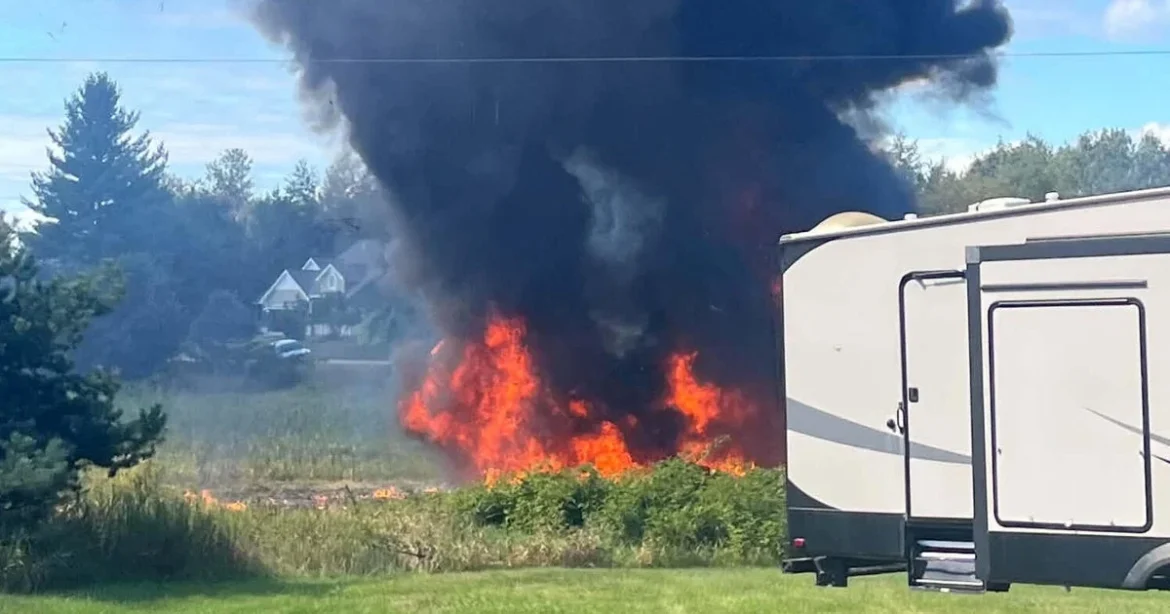
A high-stakes emergency unfolded in rural Michigan on Thursday afternoon when an F-16 Fighting Falcon assigned to the Texas Air National Guard crashed in Grand Traverse County, triggering a significant multi-agency response and immediate public safety directives. The incident, which occurred during a routine training sortie, has forced the closure of major local transit arteries and necessitated the emergency evacuation of residents within a one-mile radius of the impact site.
As of late Thursday, military and local officials have confirmed that the pilot successfully ejected from the aircraft before impact. The pilot is currently under medical supervision and remains in stable condition. Local law enforcement, led by the Grand Traverse County Sheriff’s Office and supported by the Michigan State Police, confirmed that there were no immediate reports of injuries or fatalities among civilians on the ground.
Chronology of the Incident
The sequence of events began on the afternoon of September 17, 2026, when the F-16, operating out of the Alpena Combat Readiness Training Center, experienced an unspecified in-flight emergency. The aircraft was participating in a scheduled training exercise—a common occurrence in the skies over Northern Michigan, which serves as a premier training ground for Air National Guard units from across the United States.
At approximately 17:10 EDT, local emergency management agencies began issuing alerts as the aircraft descended. The crash occurred in the vicinity of County Road 633 and Blair Townhall Road, a rural area characterized by a mix of residential properties and wooded terrain. Within minutes of the crash, the Grand Traverse County Emergency Management office issued a formal shelter-in-place order for the immediate area, specifically covering County Road 633 between Jefferson Place and Blair Townhall Road.
By early evening, the situation escalated from a shelter-in-place order to a mandatory evacuation zone. Emergency responders established a one-mile perimeter around the intersection of County Road 633 and Jefferson Place, citing the need to secure the site and mitigate potential hazards associated with aircraft wreckage, which may include hazardous materials or sensitive ordnance components.
Official Responses and Military Context
The 149th Fighter Wing, based at Joint Base San Antonio-Lackland in Texas, released a brief statement confirming the identity of the aircraft. "A 149th Fighter Wing, Texas Air National Guard F-16 Fighting Falcon was on a routine training mission from the Air National Guard’s Combat Readiness Training Center, in Alpena, when it experienced an incident earlier this afternoon," the Texas Military Department stated.
Blair Township Supervisor Nicole Blonshine provided a vital update to the community during the height of the response, noting that preliminary assessments suggest no homes were struck during the crash. "At this time, we do not believe anyone on the ground was harmed, and we have no reports of structural damage to residential dwellings," Blonshine noted. Despite this positive news, she emphasized that the site remains an active investigation zone and that the public should maintain a significant distance from the area to allow military recovery teams and investigators to operate.
The American Red Cross has been mobilized to assist displaced residents. A temporary shelter has been established at the Kensington Church, located at 6880 Secor Road in Traverse City, to provide logistical support and safe haven for those affected by the evacuation order.
Understanding the Alpena Combat Readiness Training Center
The involvement of the Alpena Combat Readiness Training Center (CRTC) in this incident highlights the significant role Northern Michigan plays in domestic military readiness. The Alpena CRTC is one of four such facilities in the United States and is widely regarded for its expansive, low-altitude training airspace and specialized range facilities.
The center frequently hosts Air National Guard units from across the country for "Northern Strike" exercises and other tactical readiness training. These missions often involve high-speed maneuvers, simulated air-to-air combat, and low-level flight patterns. While the F-16 is a proven platform with decades of service history, the complexity of these training missions involves inherent risks. The cause of the crash, whether mechanical failure, pilot error, or external factors, remains the subject of a forthcoming investigation by the Air Force Safety Investigation Board (SIB).
Implications of the Crash and Safety Protocols
The decision to implement a one-mile evacuation radius is a standard safety precaution in the wake of a military aircraft accident. Fighter jets like the F-16 carry a variety of potentially hazardous materials, including hydrazine—a highly toxic propellant used in the aircraft’s emergency power unit (EPU)—as well as remnants of jet fuel and composite materials that can release harmful particulates upon combustion.
Furthermore, investigators must account for the presence of egress systems. The F-16 ejection seat mechanism involves explosive charges that remain a significant hazard to recovery personnel and civilians until they are rendered safe by Explosive Ordnance Disposal (EOD) teams. The presence of EOD units at the crash site is a standard procedure intended to ensure that any remaining components of the ejection system or other flight hardware do not pose an active threat.
Broader Impact on Local Infrastructure
The crash has effectively paralyzed a critical corridor in Grand Traverse County. The closure of County Road 633 has redirected traffic, causing localized congestion in neighboring townships as commuters and emergency vehicles navigate around the restricted zone. The local sheriff’s office has requested that the public avoid the area entirely, warning that unauthorized presence near the crash site could lead to criminal charges and, more importantly, impede the progress of hazardous material remediation.
For the residents of Blair Township, the event serves as a stark reminder of the proximity of military operations to civilian life. While accidents of this nature are statistically rare, they highlight the complex relationship between the Department of Defense and the communities that host its training infrastructure.
Investigatory Procedures
In the coming days, the focus will shift from emergency response to forensic investigation. The Air Force will likely deploy a team of experts to the site to document the wreckage and recover the flight data recorder (FDR), commonly known as the "black box." This device, which records flight parameters, engine performance, and pilot inputs, will be essential in determining the root cause of the crash.
Parallel to the military investigation, local authorities will continue to work on site remediation. Once the area is deemed safe by military teams, the focus will shift to environmental cleanup, ensuring that no chemicals from the wreckage have contaminated local groundwater or soil.
Community Resilience and Next Steps
As the investigation proceeds, officials have emphasized the need for patience and adherence to official channels. The Grand Traverse County Emergency Management office remains the primary point of contact for residents seeking updates on when the evacuation order might be lifted.
The successful ejection of the pilot is being viewed by aviation experts as a positive outcome of a catastrophic event. Ejection from an F-16, particularly at lower altitudes or during high-G maneuvers, is a violent and high-risk procedure. The fact that the pilot is in stable condition speaks to the reliability of the ACES II ejection seat system and the pilot’s training.
As the sun set on Grand Traverse County on Thursday, the focus remained on the containment of the site and the well-being of the residents who were forced from their homes. While the immediate danger to the public has been minimized by the rapid response of local authorities, the community remains in a state of alert. Further details regarding the investigation are expected to be released by the Texas Air National Guard as the recovery operation concludes and investigators piece together the final moments of the flight.
The incident stands as a sobering reflection of the realities of modern aerial warfare training, where the pursuit of combat readiness occasionally brings the dangers of the cockpit into the quiet of rural communities. The cooperation between the Michigan State Police, local sheriff deputies, and federal military officials continues to be the cornerstone of the effort to restore normalcy to the region.
