
Sweden’s general election has descended into a historic nail-biter as public broadcaster SVT’s revised projection at 9:45 PM local time, built on actual results from 10% of districts, places the centre-left opposition bloc narrowly ahead of the incumbent government by a razor-thin margin of just a single seat. With the nation gripped by political suspense, the projection places the opposition at 175 seats in the new parliament—the exact threshold for a majority—while the incumbent right-leaning coalition trails with 174 seats.
The latest model calculations underscore an unprecedentedly close contest, reflecting a national divide of just 0.1 percentage points in vote share, with the opposition capturing 49.3% compared to the governing bloc’s 49.2%. As the electoral authorities continue processing millions of ballots, analysts warn that the final outcome may not be definitively settled until postal and overseas votes are fully tallied later in the week.
A Knife-Edge Count and Partial Results
As the evening progressed and vote-counting surpassed 71% completion, the parliamentary distribution remained deadlocked at 175 to 174. The statistical models highlight a numerical difference of approximately 20,000 votes separating the two dominant political factions.

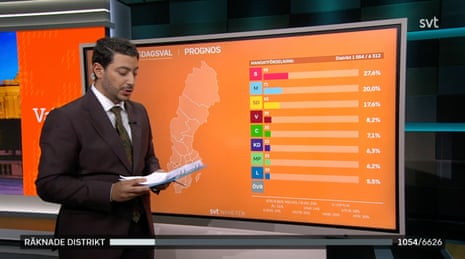
The latest seat-share and vote distribution projections from SVT outline a fragmented legislature:
- Social Democratic Party (S): 27.6%
- Moderates (M): 20.0%
- Sweden Democrats (SD): 17.5%
- Left Party (V): 8.2%
- Centre Party (C): 7.1%
- Christian Democrats (KD): 6.3%
- Green Party (MP): 6.2%
- Liberals (L): 5.5%
Political analysts have noted an unexpected resilience within the governing coalition’s core party. Prime Minister Ulf Kristersson’s Moderates surged in the SVT projection from 18.1% up to 20.0%, bucking historical trends where junior coalition partners often cannibalize the leading party’s support during times of economic strain. Meanwhile, the far-right Sweden Democrats slipped into third place at 17.5%, providing a counter-narrative to broader continental trends concerning far-right electoral momentum.
Historical Parallels and Electoral Mechanics
Sweden is no stranger to legislative gridlock. The current parliamentary margin echoes the iconic 1973 general election, when the political blocs deadlocked at an exact tie of 175 seats each, ultimately prompting constitutional reforms that fixed the unicameral Riksdag at an odd number of 349 seats to prevent future structural stalemates. Six years later, in 1979, the centre-right bloc similarly secured victory by a single seat.
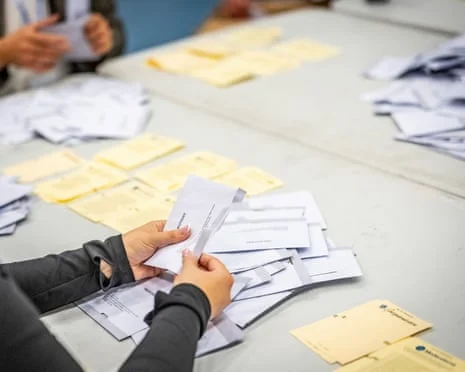
The complex logistics of Sweden’s election day also contributed to heightened anxiety. Long queues formed across major urban centers, including Stockholm and Umeå, with some citizens waiting up to three hours to cast their ballots. The Swedish Election Authority acknowledged that the multi-step voting process—which requires citizens to navigate separate yellow ballots for the national parliament, white ballots for municipal assemblies, and blue ballots for regional councils encased in three distinct envelopes—proved cumbersome, prompting calls for system simplifications. Furthermore, over 3.5 million voters cast their ballots early during an extended window that opened on August 26.
Campaign Dynamics and Key Issues
The election campaign was characterized by intense polarization, aggressive personal attacks, and fierce debates over the nation’s economic direction, public safety, and immigration policies.
Incumbent Prime Minister Ulf Kristersson positioned his administration as a stable, pragmatic team capable of navigating complex domestic reforms. Throughout the campaign, Kristersson emphasized law and order, stricter sentencing guidelines, and robust economic stewardship. His administration, which governed via a three-party minority coalition supported by the Sweden Democrats under the Tidö Agreement, broke a decades-long political taboo in 2022 by relying on the far-right party for legislative backing. For the 2026 cycle, Kristersson went a step further, promising formal ministerial portfolios to the Sweden Democrats if the right-leaning bloc retained power.
Conversely, opposition leader and former prime minister Magdalena Andersson campaigned on a platform of economic relief and social cohesion. Andersson criticized the incumbent government for deepening societal inequalities and failing to protect household purchasing power amid sluggish economic growth. Her campaign framed the election as a crucial choice for the soul of the Swedish welfare state, arguing against the normalization of far-right politics in executive governance.
The Sweden Democrats, led by Jimmie Åkesson, campaigned heavily on restricting immigration and overhauling criminal justice policies. Using provocative rhetoric and campaign messaging that drew comparisons to populist movements abroad, the party sought to capitalize on public anxieties regarding integration and public security. However, internal controversies—including local disputes over candidates and foreign policy vetting—alongside a late surge by the liberal and green factions, complicated the right-leaning coalition’s path to an unassailable majority.

Broader Implications and Next Steps
The outcome of this election carries profound implications not only for domestic Swedish policy but for the broader political landscape of Northern Europe. If the centre-left opposition’s one-seat lead holds upon the final certification of votes, Magdalena Andersson will be tasked with forming a viable government.
Political scientists note that constructing a stable left-leaning administration will present significant governance challenges. The opposition bloc relies on a diverse coalition ranging from the pro-business Centre Party to the Left Party, entities that hold contrasting views on taxation, labor market flexibility, and economic interventionism.
Conversely, should late postal ballots swing in favor of the incumbent right-leaning bloc, Sweden will enter uncharted territory with a far-right party entering government formally for the first time in modern history. This milestone would mirror similar political realamalgamations observed across European democracies, cementing the shift of mainstream conservative parties toward institutional cooperation with nationalist factions.
For now, political leaders have urged patience as electoral officials verify provisional tallies. With Green Party co-leaders Amanda Lind and Daniel Helldén cautioning that final certified results may not emerge until Wednesday, Sweden—and observers across the continent—settle in for a prolonged period of political uncertainty.
