
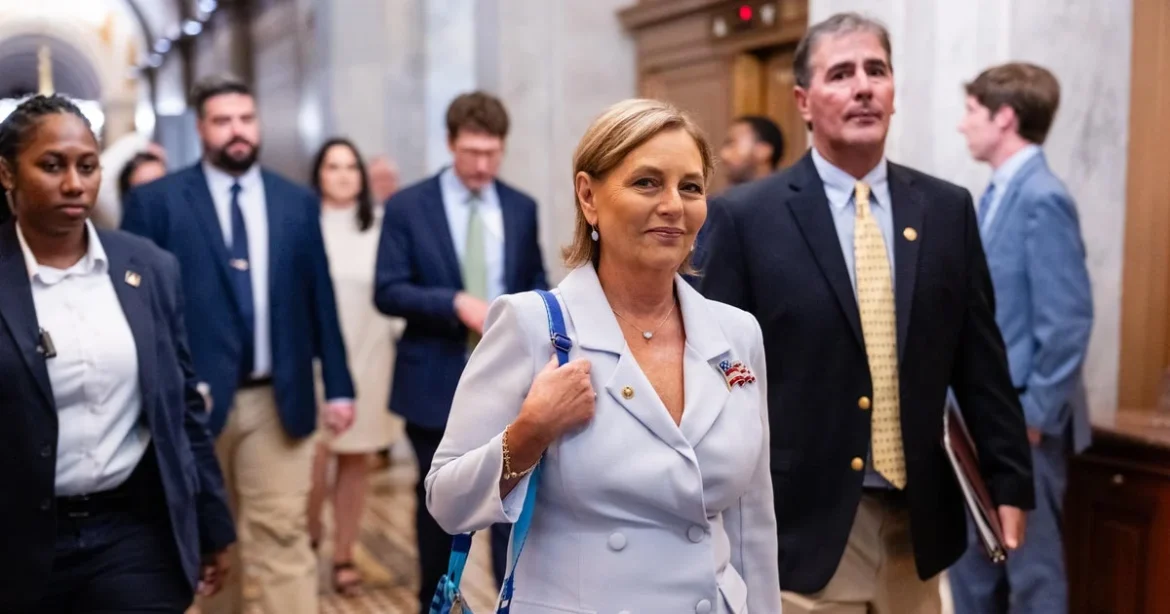
Senator Darline Graham of South Carolina, recently appointed to fill the vacancy created by the untimely death of her brother, the venerable Republican Senator Lindsey Graham, is reportedly engaged in profound discussions regarding a prospective campaign for a full six-year term in the United States Senate. This potential bid has already garnered the unequivocal backing of former President Donald J. Trump, signaling a significant development in the nascent electoral landscape of the Palmetto State.
On Thursday, Senator Graham indicated during a pivotal meeting at the White House that she is actively weighing the merits and challenges of a Senate run, a revelation confirmed by CBS News through two sources intimately familiar with her deliberations. South Carolina is poised to hold a special Republican primary on August 11, the outcome of which will determine the GOP nominee to contest the general election in November for the coveted six-year Senate term. The political machinations surrounding this race have intensified rapidly, underscoring the high stakes involved in securing a critical Senate seat in a traditionally conservative stronghold.
The very next day following her White House visit, former President Trump publicly articulated his strong encouragement for Darline Graham to enter the race, promising his "Complete and Total Endorsement" should she choose to pursue the office. In a Friday afternoon post on his Truth Social platform, Trump lauded her as a "spectacular person," explicitly stating that he had personally urged her to run for Senate during their White House encounter. "I hope Darline does this, in that there would be nobody better to honor the legacy of her beloved brother, Lindsey," Mr. Trump penned, concluding with the emphatic rallying cry, "RUN, DARLINE, RUN!" This robust endorsement from a figure who continues to exert immense influence within the Republican Party could prove to be a decisive factor in what is expected to be a competitive primary. The initial report regarding Darline Graham’s consideration of a Senate run was first broken by Semafor, highlighting the immediate national attention this unfolding political drama has attracted.
A Swift Transition: From Tragedy to Political Succession
The events leading to Darline Graham’s current position and her contemplation of a full term have unfolded with remarkable speed, beginning with the profound shock of her brother’s sudden passing. Senator Lindsey Graham, a political titan in South Carolina and a prominent national figure, died last weekend after a brief and sudden illness, leaving a significant void in the Senate. His death sent ripples of grief and political uncertainty throughout the United States Capitol and across South Carolina, where he had served in the upper chamber since 2003. Graham, who was widely expected to secure his fifth term this November, had built a formidable political career marked by his hawkish foreign policy stances, his influential role on the Senate Judiciary Committee, and his complex, yet ultimately loyal, relationship with former President Trump. His absence created an immediate need for succession, governed by state law.
In response to this vacancy, South Carolina Governor Henry McMaster, a Republican, acted swiftly. On Monday, Governor McMaster officially appointed Darline Graham as Lindsey Graham’s replacement for the remainder of his current term, which was set to conclude in early January. Her appointment was met with considerable public and political interest, not only due to the circumstances but also because of the historical significance it represented. Darline Graham, 62, was formally sworn into office on Tuesday, thereby making history as the first woman to represent South Carolina in the United States Senate. This moment underscored a shift in the state’s political representation, bringing a new perspective to its delegation in Washington.
Her rapid ascent from a career focused on public service to the halls of the U.S. Senate has naturally raised questions about her political readiness. Darline Graham’s professional background is primarily rooted in disability services, most recently serving with distinction as the commissioner of the South Carolina Commission for the Blind. She does not possess a background in elected office, a detail that might typically pose a challenge for a newcomer to such a high-profile political arena. However, during her Monday remarks, she conveyed confidence in her ability to fulfill the demanding responsibilities of the role, citing the crucial support and institutional knowledge of her late brother’s experienced staff. This continuity in staffing is often a vital bridge for appointed senators, allowing for a smoother transition and effective legislative operations.
The Endorsement’s Weight and South Carolina’s Political Calculus
The immediate and enthusiastic endorsement from former President Trump carries substantial weight within the Republican Party, particularly in a state like South Carolina, which remains a bedrock of conservative support and where Trump’s influence continues to be profound. Historically, a Trump endorsement in a Republican primary has often proved to be a near-decisive factor, capable of elevating lesser-known candidates and deterring potential challengers. His public declaration of "Complete and Total Endorsement" for Darline Graham is likely to significantly streamline her path to the nomination, potentially clearing a field that might otherwise attract numerous Republican aspirants vying for such a prestigious seat.
Trump’s framing of her potential candidacy as a means to "honor the legacy of her beloved brother, Lindsey," skillfully taps into the emotional sentiment and respect many South Carolinians held for Senator Graham. This narrative positions Darline Graham not just as a candidate in her own right, but as a continuity candidate, embodying the spirit and principles of her predecessor. This could be a potent message for voters seeking stability and familiarity in a time of political transition.
Further solidifying her position, Darline Graham also appears to have the tacit approval of her fellow South Carolina Senator, Tim Scott. Senator Scott, a rising star in the Republican Party and the current chair of the National Republican Senatorial Committee (NRSC), the primary fundraising arm for Senate Republicans, expressed an open-minded and supportive stance when questioned about her potential bid by CBS News on Wednesday. "Darline has so far been off to a remarkable start," Scott remarked, adding, "Why not her?" Scott’s positive assessment and the NRSC’s implied willingness to support her candidacy would be crucial for fundraising and campaign infrastructure, especially for a candidate new to the electoral circuit. The NRSC’s primary mission is to elect Republicans to the Senate, and a candidate with both the incumbent’s staff support and a clear path to victory, aided by a Trump endorsement, would be a strong contender for their resources.
The Broader Implications for South Carolina and the Senate
South Carolina stands as a reliably Republican state, consistently delivering electoral victories for conservative candidates. Lindsey Graham’s Senate seat has been held by Republicans for decades, and its retention is critical for the GOP’s efforts to maintain or expand its majority in the Senate. The special Republican primary on August 11 will be a crucial contest, serving as the immediate gateway to the general election in November. While the state leans heavily Republican, a contested primary could still be an expensive and demanding undertaking, particularly for a first-time candidate.
Darline Graham’s lack of prior elected experience presents both a challenge and a unique opportunity. On one hand, she will need to rapidly develop a campaign apparatus, articulate her policy positions, and connect with voters across the state without the benefit of a long political resume. On the other hand, her background in disability services could offer a fresh perspective and resonate with voters looking for pragmatic leadership focused on community needs rather than career politics. Her appointment as the first woman senator from South Carolina is also a significant milestone, potentially energizing a broader base of support.
The "legacy" aspect of her candidacy, as highlighted by Trump, will likely be a central theme. Lindsey Graham was a well-known and often controversial figure, but he commanded significant loyalty within his state and among Republican voters. Darline Graham will face the delicate task of honoring her brother’s political spirit while simultaneously carving out her own distinct political identity and vision for South Carolina. This balance will be crucial in distinguishing her from potential primary challengers who might attempt to frame themselves as more experienced or ideologically pure.
The timeline for this race is condensed. With a special primary in early August and the general election in November, candidates have a limited window to campaign, fundraise, and build name recognition. For Darline Graham, leveraging the existing network of her brother’s supporters, capitalizing on the high-profile endorsement from President Trump, and effectively communicating her message will be paramount. The outcome of this election will not only determine South Carolina’s representation in the Senate for the next six years but will also serve as a barometer of the continued power of presidential endorsements in Republican primaries and the enduring influence of political legacies in American elections.
The rapid succession of events, from the somber news of a senator’s death to the swift appointment of his sister and her subsequent contemplation of a full term with powerful backing, encapsulates the dynamic and often unpredictable nature of political life. As South Carolina prepares for an expedited electoral cycle, all eyes will be on Darline Graham as she navigates these uncharted waters, seeking to transform a tragic vacancy into a historic mandate. Kaia Hubbard contributed to this report.
