
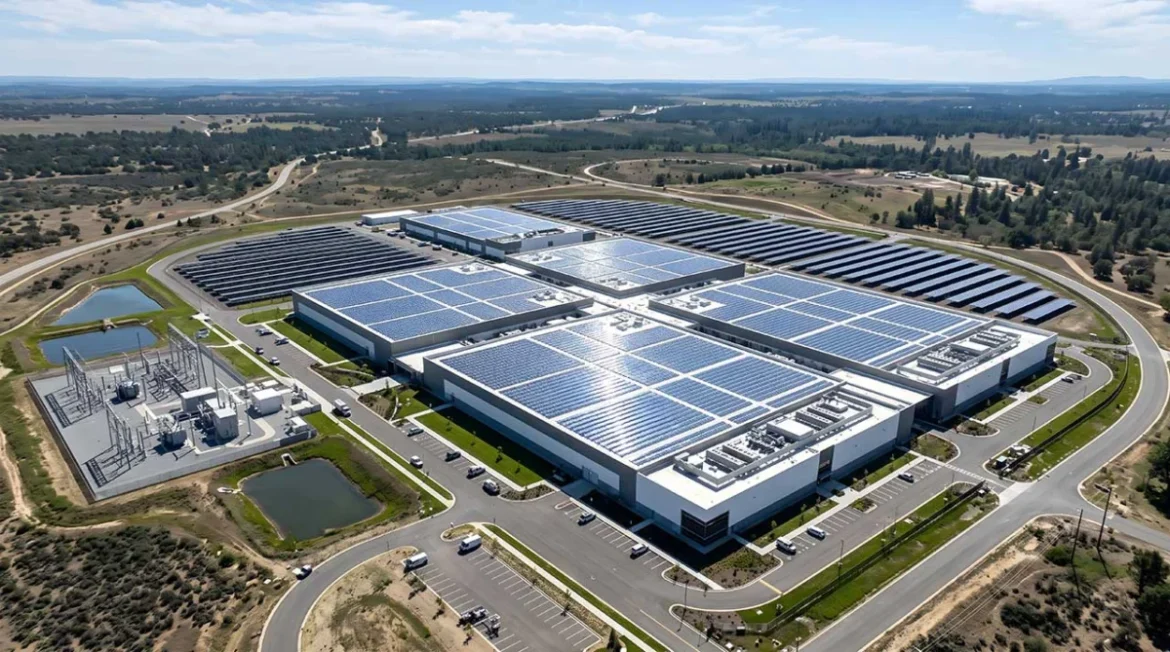
The rapid commercialization of artificial intelligence has transitioned from a software revolution into a massive physical infrastructure expansion, forcing a historic reckoning over energy, water, and local land use. While answering a simple chatbot prompt demands roughly the energy equivalent of running a microwave for a single second, the computational paradigm has fundamentally shifted. Modern enterprise applications increasingly rely on autonomous AI "agents"—systems that independently plan multi-step workflows, execute web searches, self-correct errors, and execute complex operations over extended periods. A single autonomous agent task can consume as much electricity as powering a standard household laptop continuously for nearly six hours. This exponential spike in energy demand has transformed AI from a theoretical computing topic into a localized public policy crisis, sparking unprecedented battles over regional power grids, municipal water resources, and community zoning laws across the United States.
The Evolution of AI Environmental Accounting: From Static Prompts to Autonomous Agents
To understand the environmental footprint of modern artificial intelligence, researchers and energy analysts have repeatedly revised their computational models. In February 2024, an academic study published in the peer-reviewed journal Scientific Reports attempted to compare the carbon emissions of generative AI against human writing. The researchers concluded that prompting an AI to write a single page of text emitted between 130 and 1500 times less carbon dioxide than a human author performing the same task, attributing roughly 2 grams of CO2 to an AI query compared to approximately 1,400 grams for a human writer over a 48-hour span.
However, critics immediately exposed methodological flaws in the human baseline calculation. The initial study had divided an average American’s annual carbon footprint—roughly 15 tons—by the total hours in a year, effectively charging the human writer for baseline emissions such as home heating and transportation that occur regardless of typing activity. When adjusted strictly for the electricity consumed by a writer’s laptop, human emissions for a writing task dropped closer to 2 kilograms of CO2 over a multi-day project.
A direct response published in the same journal in November 2025 by researcher Nolan Woo introduced a graded-answer methodology, evaluating AI models on competitive high-school programming challenges and factoring in the energy expended during iterative trial-and-error loops. Woo discovered that total emissions were dictated less by the raw size of the model and more by the sheer volume of attempts required to achieve a correct solution. Crucially, early-generation models struggled heavily with complex multi-step reasoning, frequently failing to complete tasks across historical benchmark datasets.
By 2026, however, rapid advancements documented in Stanford University’s AI Index Report showed commercial models achieving above 95% accuracy in complex coding tasks. Yet this jump in capability coincided with the widespread adoption of agentic workflows. Research from South Korea’s KAIST engineering institute revealed that "hidden energy" costs skyrocket when utilizing autonomous agents. A single-agent task consumed an average of 348 watt-hours—136 times the energy of a basic prompt. The KAIST team identified a major efficiency bottleneck: specialized computing hardware sat idle for more than half of the testing duration, continuing to draw substantial electrical current while waiting for external web searches and software dependencies to resolve.
Simultaneously, the International Energy Agency (IEA) noted in an April 2026 report that the underlying task-based energy efficiency of AI is improving at an unprecedented historical rate. Industry engineers are aggressively working to strip infrastructural waste out of data center operations to reduce runaway running costs—which remain net-negative for many providers—thereby inadvertently lowering the technology’s overall environmental intensity.
The Jevons Paradox and the Expansion of Global Workloads
Any direct environmental comparison between human and machine output relies fundamentally on a single core assumption: that the machine replaces human labor hours rather than expanding total output. Empirical data increasingly suggests the latter. A working paper from the National Bureau of Economic Research indicates that knowledge workers heavily exposed to generative AI tools actually increase their weekly working hours by an average of 3.5 hours. Furthermore, workplace surveys conducted by staffing and consulting firms demonstrate that only about 25 percent of employees redirect AI-generated time savings into personal leisure; the remainder is reinvested into additional enterprise output.
This behavioral dynamic mirrors Jevons Paradox, first articulated by economist William Stanley Jevons in 1865, who observed that the invention of more efficient steam engines did not reduce Great Britain’s coal consumption, but instead cheapened power to the point where industrial applications multiplied, driving aggregate coal use higher for decades. Similarly, as AI agents make data processing faster and less expensive, the total volume of enterprise requests scales exponentially, easily neutralizing per-task efficiency gains.
The Water Footprint: Direct Cooling Versus Indirect Power Generation
While electricity consumption dominates public discourse, water usage has emerged as an equally contentious flashpoint in local data center developments. According to data from the Lawrence Berkeley National Laboratory, U.S. data centers consumed approximately 17.4 billion gallons of water in 2023 for climate control and cooling infrastructure. Industry projections suggest this figure could quadruple by 2028. While total data center cooling water remains a fraction of total agricultural irrigation, localized concentrations present severe ecological strains, particularly in arid regions such as the American Southwest.
Crucially, on-site cooling represents only a fraction of the total water equation. Generating the electricity required to power data center servers requires massive volumes of water at thermoelectric power plants. Factoring in this upstream electrical generation, the true water footprint of U.S. data centers is estimated to be roughly 12 times higher than direct on-site cooling figures. While facility operators frequently install closed-loop air-cooling systems to claim near-zero direct water consumption locally, their indirect hydrological impact through the regional power grid remains entirely unchanged. Corporate disclosure reporting remains patchy; while major operators like Google publicly track global usage—such as reporting 7.7 billion gallons consumed worldwide in 2024, with roughly one billion gallons utilized at a single facility in Council Bluffs, Iowa—state-level enforcement varies wildly. In Texas, for instance, regulatory audits revealed that 83 percent of the state’s 341 data centers had failed to file mandatory water usage reports.
The Kitchen Table Impact: Skyrocketing Electricity Bills
The most immediate friction point for consumers is the direct inflation of monthly residential electricity bills. Regional transmission organizations oversee high-voltage power grids across multiple states, conducting forward capacity auctions to ensure power plants remain operational to meet peak seasonal demand. The entry of massive, continuous-load data centers has dramatically altered these markets.
For the PJM Interconnection grid—which manages electricity for 65 million people across 13 states and Washington, D.C.—capacity auction clearing prices surged from approximately $29 per megawatt-day for the 2024–2025 delivery year to roughly $329 per megawatt-day for 2026–2027. An independent market monitor report concluded that data center demand accounted for 63 percent of this unprecedented pricing jump, resulting in $9.3 billion in added costs passed directly to retail ratepayers. The Natural Resources Defense Council projects that average families within the PJM footprint will see utility costs rise by roughly $70 per month by 2028. Similar rate spikes have materialized nationwide, including residential electricity rate increases of 9 percent in Ohio and 14 percent in Pennsylvania over a single twelve-month period.
In response to consumer backlash, state utility regulators are scrambling to restructure rate classes. Virginia, home to the world’s highest concentration of data centers, established a distinct rate category for large computing facilities, while Ohio approved regulatory frameworks requiring 12-year binding contracts and minimum capacity commitments from massive tech firms. These policy interventions aim to force new industrial consumers to fully subsidize the construction of dedicated power generation assets rather than socializing infrastructure costs across standard residential ratepayers.
Chronology of Community Resistance and Regulatory Backlash
The convergence of grid instability, water scarcity, and rising utility bills has catalyzed the largest wave of local land-use opposition in modern American history. According to tracking data from Data Center Watch, at least 75 major data center projects valued at an estimated $130 billion were officially blocked, delayed, or canceled during the first three months of 2026 alone—matching the total volume of opposition recorded throughout the entirety of 2025. Active grassroots citizen groups doubled to 833 organizations spread across 49 states, while state legislatures introduced over 300 bills targeting data center operations within the opening weeks of 2026.
This localized resistance has successfully bridged traditional partisan divides. Republican lawmakers frequently emphasize fiscal threats to grid reliability and municipal tax structures, whereas Democratic officials target environmental degradation, greenhouse gas emissions, and hydrological strain. Despite differing core motivations, both factions have coalesced into unified voting blocks at municipal zoning hearings.
The tactical battlegrounds are exemplified by two distinct municipal conflicts:
- June–August 2025 (Tucson, Arizona): Amazon pursued a massive 290-acre corporate campus utilizing confidentiality agreements established under a 2023 pact that concealed corporate identity from the public and select municipal leaders. Following the public disclosure of the project’s scale, over 1,000 residents flooded a public hearing. In August 2025, the Tucson City Council voted unanimously to reject the project by refusing to annex the target acreage or extend municipal water services. However, the developer subsequently acquired the property under a subsidiary entity just outside city jurisdictional boundaries, bypassing municipal oversight and demonstrating the jurisdictional limits of local zoning authority.
- September 2025–May 2026 (Saline Township, Michigan): Both the local planning commission and township board voted to deny rezoning requests for 575 acres of agricultural land intended for a $16 billion data center development tied to OpenAI and Oracle. Two days later, the developer filed a federal lawsuit alleging that the rural township of 2,900 residents maintained no industrial-zoned land, thereby illegally preempting commercial development. Facing insurmountable legal expenses, the township settled out of court within weeks, permitting construction to proceed in exchange for $14 million in community benefit funds dedicated to local emergency services and farmland preservation. Only a single township supervisor voted against the settlement.
These localized disputes have rapidly escalated into statewide legislative battles. New York became the first state to institute a formal legislative pause on new large-scale data center construction, while at least 19 municipalities in Michigan enacted emergency building moratoriums in the wake of the Saline Township settlement. Simultaneously, major technology corporations and construction labor coalitions have mobilized massive lobbying apparatuses, deploying multi-million-dollar advertising campaigns to protect state-level tax incentives, such as preserving Virginia’s multi-billion-dollar tax break package for tech infrastructure. Nationally, political action committees aligned with artificial intelligence interests have raised upwards of $140 million to support pro-technology candidates, prompting counter-activism from technology sector employees forming worker-led advocacy groups like the Guardrails Alliance.
Implications and Future Outlook
Ultimately, assessing the environmental viability of artificial intelligence requires looking beyond single-prompt energy metrics. While quick, one-shot programmatic queries maintain a relatively low carbon profile compared to manual human equivalents, open-ended autonomous agent workflows dramatically expand resource consumption with every iterative loop.
More critically, the long-term ecological cost of the AI revolution is governed not by abstract algorithmic efficiency, but by macroscopic infrastructure choices: the geographical placement of server farms, the carbon intensity of local electrical grids, the legal structures governing industrial water withdrawal, and the execution of utility power contracts. As municipalities across the United States grapple with surging utility bills and ecological strain, public planning boards and state legislatures have transformed into the primary arbiters of the AI economy, ensuring that the future of computational intelligence will be negotiated directly in the public square.
