
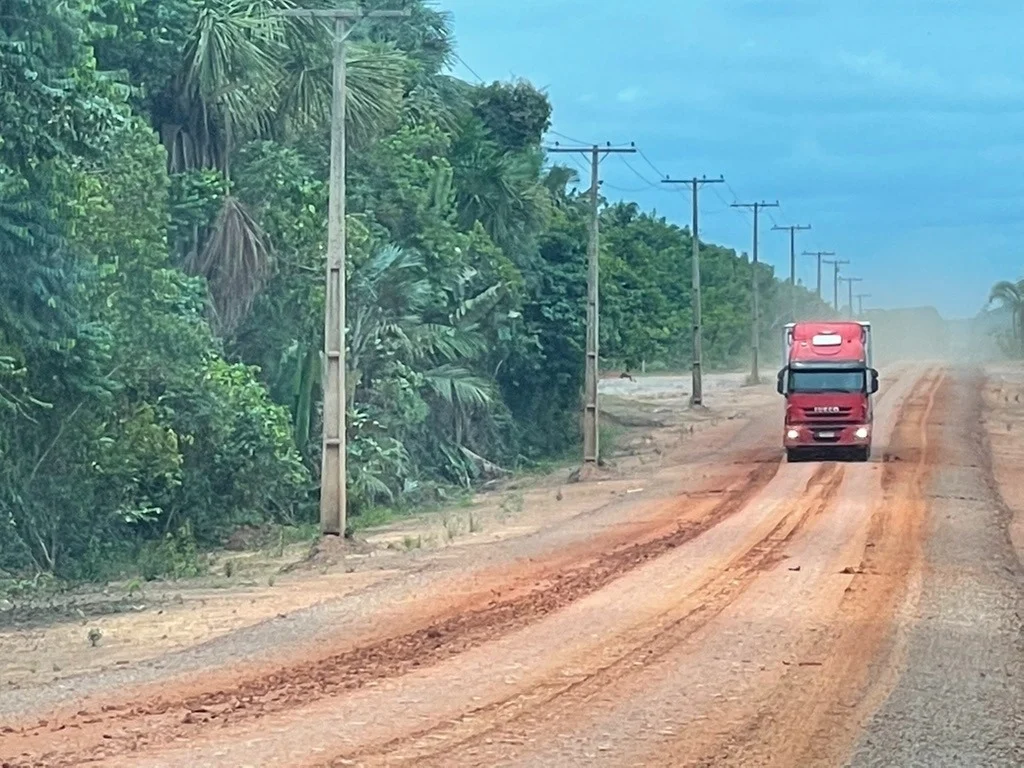
The expansion of the BR-319 highway, a 885-kilometer artery connecting Manaus to Porto Velho, has become the epicenter of a burgeoning crisis in the Brazilian Amazon. A comprehensive new study led by researchers from the University of São Paulo (USP) reveals that large swaths of forest surrounding the highway have been effectively colonized by criminal organizations. These groups are orchestrating a complex network of illegal gold mining, timber extraction, land grabbing, and cattle ranching, transforming a vital ecological corridor into a hub for illicit financial flows and territorial control.
The Anatomy of a Developing Crisis
The BR-319, originally constructed during the height of Brazil’s military dictatorship in the 1970s, was intended to integrate the remote northern Amazon into the national economy. However, the road quickly fell into severe disrepair, becoming largely impassable during the rainy season. For decades, the forest began to reclaim the path, acting as a natural barrier to human encroachment.
The situation shifted dramatically in 2015 when then-President Dilma Rousseff authorized the first major maintenance work on the highway. This decision signaled to land speculators and criminal syndicates that the region would soon be opened to exploitation. The momentum accelerated significantly during the administration of Jair Bolsonaro, whose rhetoric encouraged infrastructure development and weakened environmental enforcement. According to the study’s lead author, Lucas Ferrante, the resulting lack of government surveillance created a "fertile ground" where environmental crimes and drug trafficking now operate in tandem, sharing logistics, transit routes, and money-laundering mechanisms.
Chronology of the BR-319 Expansion
The history of the BR-319 is marked by alternating periods of abandonment and aggressive development, each with profound consequences for the Amazonian ecosystem:
- 1970s: The highway is constructed under the military regime as a symbol of national integration, cutting through dense, pristine rainforest.
- 1998: Lack of maintenance and the challenges of the Amazonian climate render the road virtually unusable, leading to its effective abandonment.
- 2015: The federal government initiates maintenance projects, sparking immediate concerns among climate scientists regarding the potential for increased deforestation.
- 2019-2022: The Bolsonaro administration prioritizes the full paving of the highway, fueling a massive increase in land speculation and illegal cattle ranching.
- 2024-2025: Tensions escalate as environmental licensing requirements are challenged; deforestation rates in the surrounding areas spike to record highs.
- April 2026: The Lula administration utilizes a controversial legal maneuver to bypass traditional environmental licensing, aiming to accelerate construction despite warnings from the scientific community.
- September 2026: In a reactive measure, the government creates four new sustainable development reserves covering 668,000 hectares to mitigate the predicted ecological fallout.
Data-Driven Insights and Field Evidence
The USP study did not rely on anecdotal evidence alone. The researchers synthesized multi-layered datasets, including satellite imagery, official cattle trading records, and findings from five distinct field expeditions conducted over the last two years. The empirical data presents a grim reality: the network of illegal, unofficial access roads branching off the main highway is now estimated to be six times the length of the BR-319 itself.
These secondary roads, carved out by land grabbers to bypass federal checkpoints, are the primary conduits for environmental destruction. During one of these research missions, Ferrante’s team discovered the body of a farm worker along an illegal path—a stark, visceral indicator of the rising violence and lawlessness that characterizes the region.
The economic engine behind this destruction is the cattle industry. The study highlights that large-scale ranching is frequently utilized as a front to launder funds derived from illegal logging and gold mining. As forest is cleared, it is converted into pasture, effectively legalizing the land grab through the subsequent registration of the property. This process creates a "high-risk corridor" where environmental crime is institutionalized under the guise of agricultural expansion.
Official Responses and Mitigation Efforts
The federal government’s approach to the BR-319 remains a subject of intense debate. While the Lula administration has pursued the paving of the road, it has simultaneously attempted to implement environmental safeguards. The proposal to install three checkpoints and 170 wildlife crossings is framed as a commitment to sustainable development.

However, experts like Ferrante argue these measures are insufficient. "The federal government’s plan for three checkpoints is a drop in the ocean," Ferrante stated in a recent interview. "To effectively police the region, we would need at least 28 checkpoints monitoring all secondary access points. Without a comprehensive and aggressive presence of federal environmental agencies, the infrastructure for crime will continue to outpace the infrastructure for protection."
Conservationists emphasize that the BR-319 acts as a "tipping point" road. If paved, it is projected to open up the heart of the Amazon to further development, potentially triggering a transition of the rainforest from a carbon sink into a carbon source. This transition would have global implications for climate stability, as the loss of this specific region would accelerate the degradation of the broader Amazon biome.
Broader Implications for Brazilian Governance
The situation surrounding the BR-319 is emblematic of a broader governance challenge in Brazil: the struggle to enforce the rule of law in the face of powerful economic interests and organized criminal syndicates. The "legal loophole" used to bypass licensing requirements sets a dangerous precedent, suggesting that national development goals can be prioritized over environmental constitutional protections.
The study concludes with a stern warning to policymakers: "Under current governance conditions, paving BR-319 would consolidate a high-risk corridor for environmental crime, territorial appropriation, public insecurity, and potentially irreversible socio-environmental degradation." The researchers are urging the government to pause, reassess, and potentially revoke the licenses for road improvements until a more robust security and enforcement framework is established.
Socio-Economic Impact on Local Communities
The encroachment of organized crime into these areas does not only affect the environment; it profoundly disrupts the lives of indigenous peoples and traditional communities. These populations, who have historically acted as guardians of the forest, are increasingly finding their territories contested by criminal groups. The lack of government presence means that these communities have little recourse when faced with land theft, intimidation, or violence.
The economic model being imposed—one based on extraction and rapid land conversion—offers few long-term benefits to the local population. Instead, it concentrates wealth in the hands of land grabbers and criminal syndicates, while the long-term ecological services provided by the standing forest—such as rainfall regulation and carbon sequestration—are permanently destroyed.
The Path Forward
As Brazil approaches a crossroads regarding the future of the BR-319, the scientific community is calling for a paradigm shift. The reliance on simple engineering solutions, like adding wildlife crossings, ignores the underlying socio-economic drivers of the current crisis. To protect the Amazon, the government must address the systemic corruption that allows organized crime to thrive.
The integration of advanced satellite monitoring, the strengthening of federal environmental agencies like IBAMA, and a crackdown on the financial networks that facilitate land grabbing are essential steps. Without these measures, the paving of the BR-319 risks becoming a permanent monument to the failure of sustainable development policy. The international community, which has a vested interest in the preservation of the Amazon, continues to watch the progress of the highway with deep concern, recognizing that the fate of the forest is inextricably linked to the decisions made in the corridors of power in Brasília.
Ultimately, the BR-319 serves as a litmus test for the Brazilian government’s ability to balance infrastructure growth with its global commitments to climate change and biodiversity. Whether the government chooses to prioritize the immediate, often destructive demands of development or opts for a more rigorous, science-based approach will determine the future of one of the planet’s most vital ecosystems. As the data suggests, the window for intervention is closing, and the stakes for the Amazon—and the world—could not be higher.
