
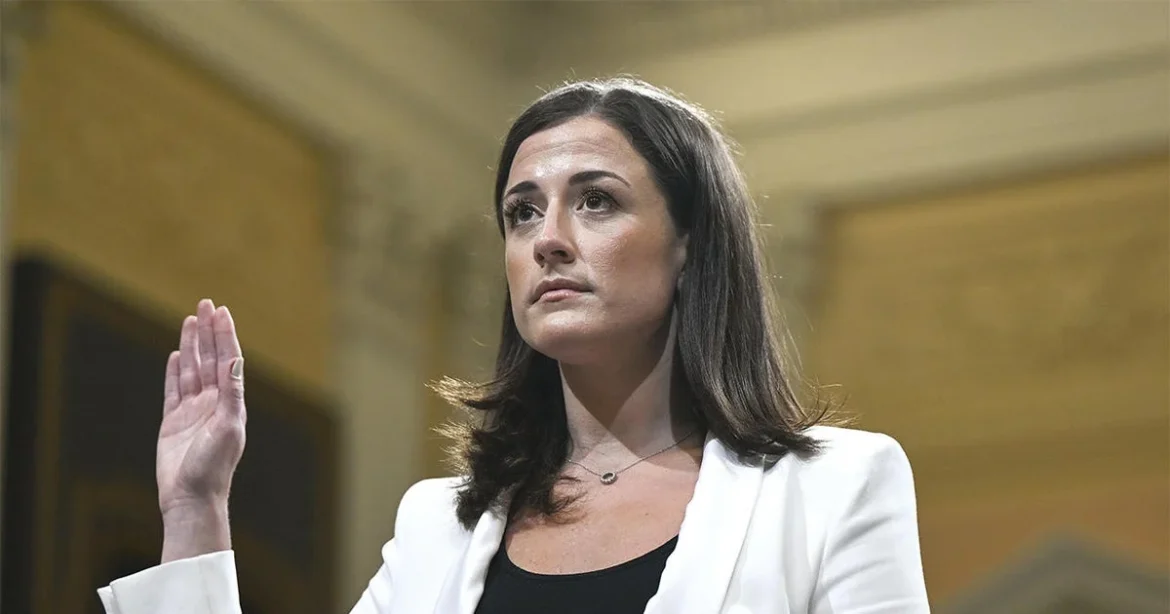
Federal prosecutors suffered a significant setback in their long-running investigation into former White House aide Cassidy Hutchinson when a federal grand jury formally declined to return an indictment against her. The decision, which centers on scrutiny surrounding her high-profile testimony before the House select committee investigating the January 6, 2021, assault on the U.S. Capitol, marks a notable moment in the ongoing legal fallout from the events of that day. According to four separate sources briefed on the secret grand jury proceedings, jurors evaluated the evidence presented by the Justice Department and ultimately chose not to concur on the proposed charges.
The development was first brought to light by The Washington Post before being corroborated by other major news organizations, including CBS News. The investigation itself had been quietly handled by the Civil Rights Division of the Department of Justice. The ultimate conclusion of the grand jury proceedings became public during an unrelated court hearing before U.S. Magistrate Judge Zia Faruqui. During the proceedings, Neville Hedley, a litigator representing the Justice Department’s Civil Rights Division, informed the court that the grand jury had declined to approve the proposed indictment. While Hedley did not publicly utter Hutchinson’s name during the hearing, multiple knowledgeable sources subsequently confirmed that she was the intended target of the aborted prosecution.
Background and Origins of the Hutchinson Investigation
Cassidy Hutchinson rocketed to national prominence in the summer of 2022 when she delivered explosive, televised testimony before the House select committee investigating the January 6 attack. At the time of the Capitol riot, Hutchinson served as a close aide to White House Chief of Staff Mark Meadows, placing her at the epicenter of the West Wing during the final, turbulent weeks of Donald Trump’s presidency.
Her cooperation with congressional investigators infuriated allies of Donald Trump and large segments of his political base. During her deposition and subsequent live testimony, Hutchinson provided dramatic, firsthand accounts of the internal deliberations and atmosphere within the White House leading up to and during the attack on the legislative branch. Among her most notable claims was that both Trump and Meadows had been explicitly warned on the morning of January 6 that members of the crowds gathering for the rally were carrying dangerous weapons, including firearms and bear spray. According to Hutchinson, Trump brushed off the warnings, stating that the armed individuals were not there to hurt him, and demanded that security officials remove magnetometers—metal detectors—from the perimeter of his speech site on the White House Ellipse so that larger crowds could enter.
Furthermore, Hutchinson testified about a chaotic post-speech incident relayed to her by then-White House Deputy Chief of Staff Tony Ornato. According to her account, Trump grew furious when his lead Secret Service detail refused to drive him to the U.S. Capitol following his address, where he had urged supporters to march down Pennsylvania Avenue. Hutchinson testified that Ornato told her Trump became verbally and physically aggressive inside the presidential SUV, reportedly lunging toward the steering wheel in an attempt to redirect the vehicle.
This specific allegation quickly became a focal point of intense political and factual debate. Representatives for the Secret Service and the vehicle’s driver subsequently pushed back against the narrative. The driver of the presidential vehicle later testified under oath that Trump never grabbed or lunged for the steering wheel, though public disputes remained over the exact tenor of the confrontation inside the vehicle.
While federal prosecutors never publicly specified which precise segments of Hutchinson’s expansive testimony formed the basis of their criminal inquiry, media reports indicated that the investigation was initiated following criminal referrals submitted by Republican members of the U.S. House of Representatives. These lawmakers alleged that certain statements made by Hutchinson during her congressional appearances warranted scrutiny regarding potential false statements to investigators.
Chronology of Key Events
The legal and political saga surrounding Cassidy Hutchinson’s testimony and the subsequent Department of Justice inquiry spans more than half a decade, marked by several critical milestones:
- January 6, 2021: A joint session of Congress certifying the 2020 Electoral College vote is disrupted as a mob of Donald Trump’s supporters breaches the U.S. Capitol. Cassidy Hutchinson is working inside the West Wing as an aide to Mark Meadows.
- June 2022: Hutchinson testifies before the House select committee investigating the January 6 attack, delivering dramatic public and recorded testimony detailing White House actions and conversations.
- Late 2022 to 2024: Congressional referrals from Republican allies of Donald Trump prompt scrutiny of Hutchinson’s public and transcribed statements, eventually drawing the attention of federal prosecutors.
- 2025: The Justice Department’s Civil Rights Division assumes oversight of the probe into Hutchinson, initiating formal investigative steps and presenting evidence to a federal grand jury.
- October 2026: During a federal court hearing before U.S. Magistrate Judge Zia Faruqui, Justice Department litigator Neville Hedley reveals that the grand jury has declined to return the proposed indictment. News outlets, led by The Washington Post and CBS News, confirm that the subject of the investigation was Hutchinson.
Implications of the Grand Jury’s Rejection
Grand juries operate behind closed doors, serving as an independent check on prosecutorial power by evaluating whether the government has presented sufficient evidence to establish probable cause that a crime was committed. The decision by a federal grand jury to decline an indictment requested by prosecutors—known colloquially as a "no bill"—is a relatively rare occurrence, as federal prosecutors typically present cases in which they are confident of securing a consensus.
The rejection in Hutchinson’s case carries several notable implications for the broader legal landscape surrounding accountability for the January 6 attack and the treatment of witnesses who cooperated with congressional oversight. Legal analysts point out that securing perjury or false statement charges stemming from complex congressional testimony is exceptionally difficult. Prosecutors must prove beyond a reasonable doubt not only that a statement was objectively false, but also that the witness knew it was false and made the statement willfully, rather than relying on faulty memory, secondhand hearsay, or differing interpretations of events.
Because Hutchinson frequently testified about conversations where she was not the primary participant—such as the alleged vehicle altercation relayed to her by Tony Ornato—defense attorneys could readily argue that she was accurately reporting what she had been told, even if the underlying facts were disputed by other witnesses. This evidentiary hurdle likely played a significant role in the grand jury’s reluctance to approve criminal charges.
Response and Reactions
As of late October 2026, the Department of Justice has declined to formally comment on the grand jury’s decision or outline its next steps regarding the investigation. Department policy generally restricts public discussion of uncharged matters or internal deliberations.
Defense attorneys and civil liberties advocates viewed the grand jury’s rebuff as a validation of the protections afforded to witnesses who come forward in congressional inquiries. Conversely, critics of Hutchinson and allies of Donald Trump, who initially pushed for the investigation, expressed frustration over the outcome, maintaining that discrepancies in her public record warranted full judicial accountability.
Broader Context within the Justice Department
The handling of the Hutchinson investigation by the Civil Rights Division highlights the complex and politically sensitive nature of the cases arising from the January 6 attack. Over the preceding years, the Justice Department has prosecuted hundreds of individuals involved in the physical storming of the Capitol, as well as high-profile figures associated with efforts to overturn the 2020 election results.
However, investigations touching directly upon the testimony and credibility of high-profile congressional witnesses occupy a uniquely contentious space. With the grand jury declining to indict Hutchinson, the active criminal inquiry led by the Civil Rights Division appears to have reached a dead end. Whether federal prosecutors will attempt alternative avenues or allow the matter to close permanently remains to be seen, but the immediate result ensures that Cassidy Hutchinson will not face federal criminal charges related to her congressional testimony.
