
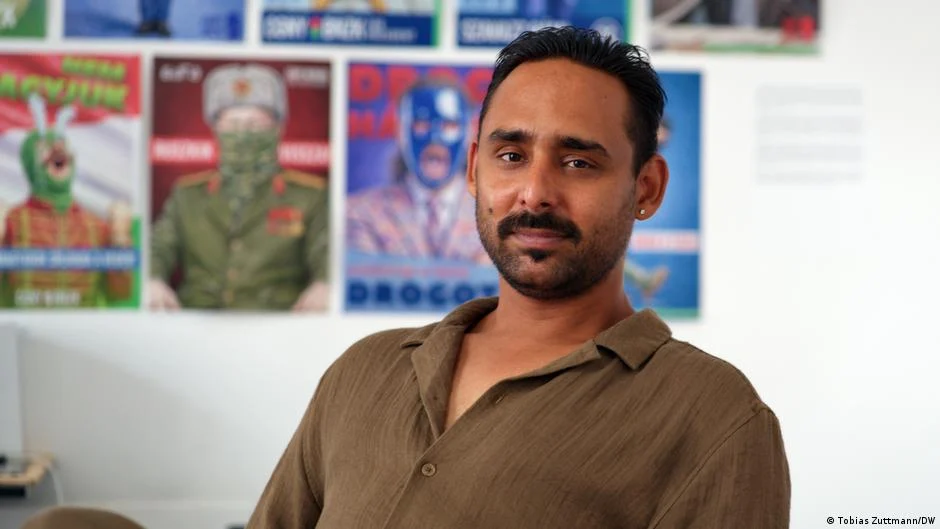
The canvas depicts a man locked in a strategic stalemate with a robot, his face still glistening with damp, fresh paint. In the silence of a Budapest night, Norbert Olah works within the Bura Galeria, an art space that has become a vital sanctuary for contemporary Romani expression. For Olah, this studio is more than a workplace; it is a laboratory where the long-standing friction between ethnic identity and national politics is distilled into visual form. As the Hungarian capital stirs outside, Olah grapples with a legacy of systemic exclusion, using his brush to challenge the pervasive stereotypes that have long relegated Romani art to the periphery of the "sophisticated" European art scene.
For years, Olah intentionally decoupled his creative practice from his ethnicity. The choice was not born of shame, but of a calculated defense against the industry’s propensity to label and categorize. In the traditional art market, "Romani art" is frequently dismissed as naive, unprofessional, or kitsch. By suppressing his heritage, Olah sought to be judged solely on his technique and vision. However, as the political climate in Hungary curdled under the influence of the Fidesz party, the silence regarding his own identity became untenable. He realized that in a nation where ethnicity is an explicit political battleground, artistic neutrality is an impossibility.
A Chronology of Exclusion: The Orban Era
The ascent of Viktor Orban and the Fidesz party in 2010 marked a seismic shift for the Roma, who make up approximately 700,000 of Hungary’s population. For a young artist like Olah, entering the Hungarian University of Fine Arts during this period meant witnessing the closing of doors that had previously been ajar.
The ensuing 16 years of Orban’s dominance were characterized by a bifurcated approach to the Roma minority. On one hand, the government touted state-sponsored employment programs; on the other, these initiatives effectively trapped thousands in precarious, low-wage, and temporary labor roles that offered no pathway to professional mobility. Rhetorically, the government’s stance was even more aggressive. Orban and his inner circle frequently employed inflammatory language, painting the Roma as a "domestic reserve" for menial, degrading labor.
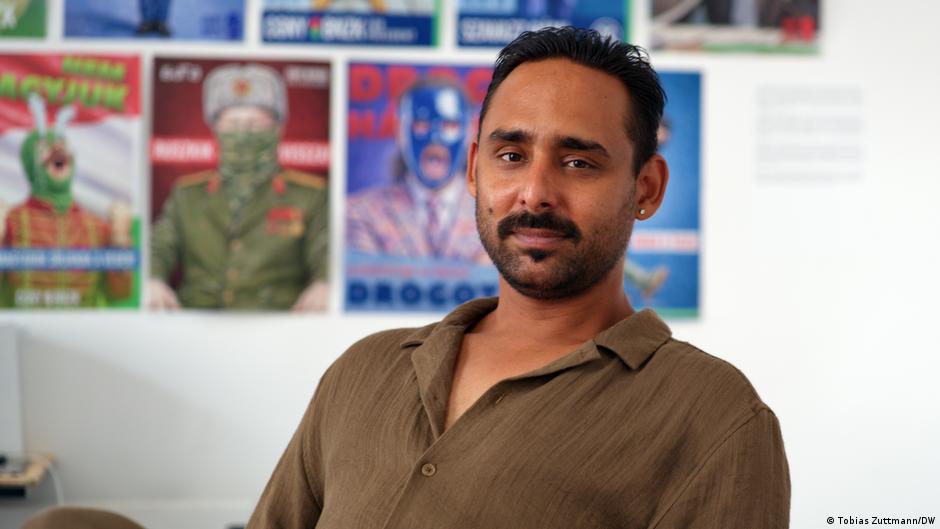
This rhetoric reached a nadir in April 2026, when then-transport minister Janos Lazar suggested that the Roma should be utilized to clean "crap out of overflowing toilets" on public trains. Such comments were not merely isolated gaffes; they were indicative of a state-sanctioned antiziganism that allowed discrimination to flourish under the guise of public policy.
The Aesthetics of Defiance
Olah’s transition from a neutral observer to a confrontational artist reached a turning point in 2021 during the OFF-Biennale Budapest. Along with his father, Olah constructed a brick wall in front of the Roma Parliament—a cultural center that had been shuttered by the government in 2016 under the pretext of structural instability, only to be left to rot as a hollowed-out monument to bureaucracy.
By titling the piece "Anxiety of the Romani Artist" and engraving terms like "segregation" and "assimilation" into the bricks, Olah forced the public to confront the erasure of Roma culture. The subsequent performance, in which he destroyed the wall with a sledgehammer, served as a cathartic dismantling of the societal barriers he had long navigated.
This act of protest laid the groundwork for the establishment of the Bura Galeria in District VII. Unlike traditional institutions, the Bura Galeria does not seek validation from the mainstream art world; it operates as an autonomous platform where the Roma define their own cultural worth. In 2024, Olah further cemented this mission by founding the artist collective "Gypsy Criminals." The name is a biting reclamation of a slur frequently utilized in Hungarian crime statistics to criminalize the entire Romani population. By adopting the label, the collective strips the phrase of its power to shame, turning it into a badge of ironic resistance.
Political Transition and the Weight of Symbolism
The landscape of Hungarian politics shifted in April 2026, following the election that saw the rise of Peter Magyar’s Tisza party. The change in atmosphere has been palpable. Unlike his predecessor, Magyar engaged with Roma leaders during his campaign and explicitly included equal opportunity clauses in his manifesto. The election of four Romani members of parliament, including a deputy speaker, represents an unprecedented level of political representation.

However, the reality on the ground remains complex. While the tone of political discourse has shifted from overt hostility to cautious inclusion, the material conditions for the majority of Roma have yet to see significant improvement. Analysts note that while symbolic gestures—such as the presence of Roma in parliament—are vital for shifting public consciousness, they do not automatically dismantle the deep-seated socioeconomic structures that maintain poverty and exclusion.
Olah remains a pragmatic observer of this transition. He views the current political environment not as a utopia, but as a potential restoration of normalcy—a baseline from which a functioning society can operate. He acknowledges that if the government fails to address the underlying issues of poverty and discrimination, he will be ready to pivot his critique toward the new administration. His loyalty lies with the art of interrogation rather than political alignment.
Roma Futurism: Reimagining the Horizon
Moving beyond the trauma of the past, Olah’s current work has taken a turn toward the speculative. His latest project, "Roma Futurism," projects the Romani experience into the cosmos. He paints scenes of astronauts in zero gravity holding traditional musical instruments and couples strolling on the surface of Mars, with the blue-and-green Roma flag flying in the lunar vacuum.
This thematic shift is more than an exercise in science fiction; it is a deliberate expansion of the Romani narrative. By placing the Roma in space—a domain traditionally reserved for the superpowers of history—Olah is challenging the audience to strip away their prejudices. If an alien civilization were to encounter the Roma, would they bring with them the same biases as a 21st-century European state?
The space station he is currently designing, modeled after the traditional Romani cartwheel, serves as a powerful metaphor for movement and advancement. For Olah, the wheel is no longer just a tool for travel; it is a symbol of a community that is no longer content to be stationary or defined by the borders drawn by others.

Broader Implications and the Path Forward
The situation in Hungary serves as a microcosm for the broader challenges facing minority populations across Europe. The resurgence of populist rhetoric, coupled with the slow pace of institutional change, necessitates a robust and defiant cultural response. Artists like Norbert Olah are instrumental in this process because they provide a visual language for dissent.
Data from the organization Roma for Democracy suggests that the Roma electorate is increasingly sophisticated in its voting patterns, moving away from the transactional, clientelist models previously exploited by Fidesz. This shift suggests that the Roma community is not merely a passive recipient of political change, but an active participant in the shaping of a post-Orban Hungary.
As Olah meticulously works on his latest canvas, the questions remain: What is the relationship between ethnicity and aesthetics? And can a society ever truly move past the prejudices that define its past? Olah does not provide easy answers, preferring to leave the viewer in the uncomfortable space of uncertainty. He understands that art’s purpose in a fractured society is not to soothe, but to agitate—to ask questions until the status quo can no longer be sustained.
The trajectory of the Roma in Hungary remains tied to the success of this broader democratic transition. If the current government can move from symbolic inclusion to substantive policy reform, the "Roma Futurism" that Olah depicts on his canvases may eventually find a footing in the material reality of the country. Until then, his studio remains a site of perpetual motion, where every stroke of the brush is a step toward a future that is finally, and firmly, in the hands of the Roma themselves.
