
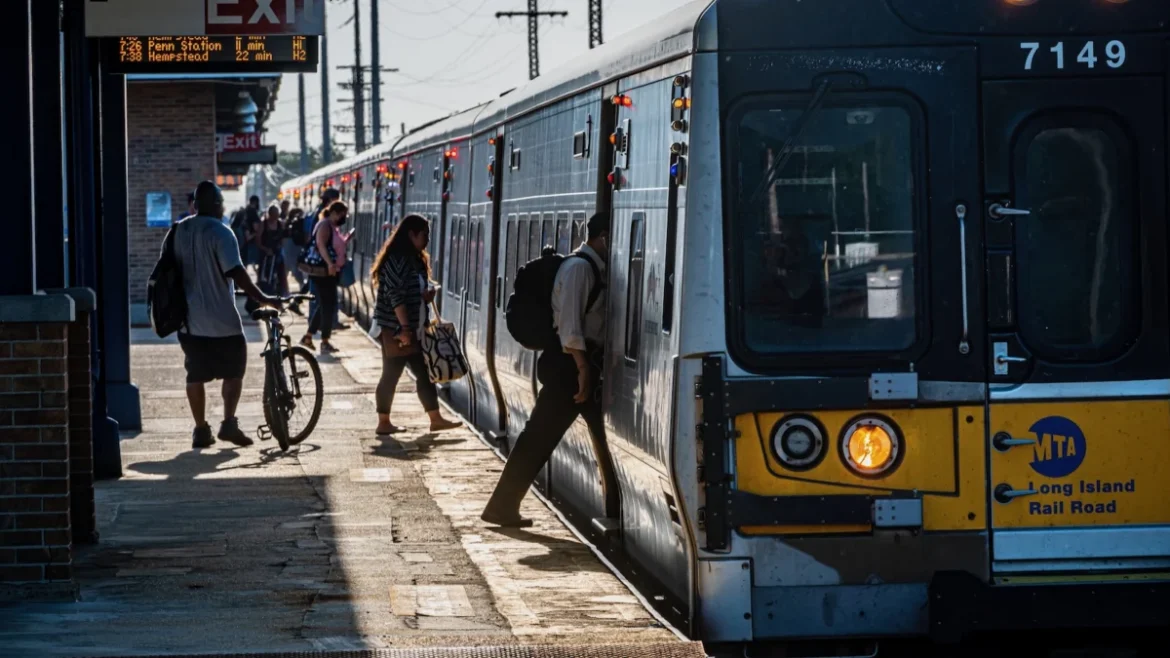
The landscape of American transportation is undergoing a significant shift as escalating geopolitical tensions and soaring energy costs force a reconsideration of daily commuting habits. Across the United States, public transit agencies are reporting a notable surge in ridership, a trend directly correlated with a sharp rise in gasoline prices triggered by the ongoing conflict in the Middle East. As the war in Iran continues to disrupt vital oil shipments through the Strait of Hormuz, the national average price for a gallon of gasoline has surged past the $4.50 mark, with some regions, particularly California, seeing prices climb well above $6.15 per gallon. This economic pressure is acting as a catalyst, pushing commuters toward buses, light rail, and intercity trains at rates not seen since the pre-pandemic era.
The Geopolitical Catalyst: The Strait of Hormuz and Global Oil Markets
The current spike in fuel costs is not a localized phenomenon but the result of a profound disruption in the global energy supply chain. The Strait of Hormuz, a narrow waterway between the Persian Gulf and the Gulf of Oman, serves as the world’s most important oil transit chokepoint. Approximately one-fifth of the world’s total oil consumption passes through this strait daily. With the outbreak of hostilities involving Iran, maritime security has plummeted, leading to a de facto blockade of tankers.
The resulting volatility in Brent Crude and West Texas Intermediate (WTI) markets has trickled down to American gas stations with unprecedented speed. In early 2026, as the conflict intensified, energy analysts observed a "fear premium" being added to fuel prices, which sustained high costs even when physical supplies were technically available. For the average American household, which typically allocates a significant portion of its discretionary income to transportation, these prices have moved from an inconvenience to a financial crisis, necessitating a swift pivot to more affordable alternatives.
Analyzing the Ridership Surge: Data and Thresholds
The relationship between fuel costs and transit usage is well-documented, but current data suggests a unique "threshold effect" is currently in play. According to research conducted by Hiroyuki Iseki, an urban studies and planning professor at the University of Maryland, the response of commuters to gas prices is not always linear. Iseki’s historical analysis of transit trends across 10 major U.S. cities revealed that while a 10 percent increase in gas prices generally leads to a modest 1.2 percent rise in light rail ridership, the impact becomes much more pronounced once specific price "ceilings" are breached.
When gasoline prices hovered around $3.00 per gallon, the shift to transit was gradual. However, as prices surpassed the $4.00 threshold, the psychological and financial burden reached a tipping point. Iseki’s data indicates that a 10 percent increase in fuel costs when prices are already above $4.00 results in a staggering 9.3 percent jump in light rail ridership. This is particularly evident in commuter rail systems, where travel distances are longer. Because the cost of a commute is directly proportional to the distance traveled, those living in outer suburbs—the "commuter belt"—are the first to abandon their vehicles when the math of a daily 40-mile round trip no longer favors the private automobile.
Regional Case Studies: California as the National Bellwether
California remains at the forefront of this transition, driven by the highest gas prices in the contiguous United States. Transit agencies across the Golden State have reported record-breaking numbers for the spring of 2026.
In San Francisco, the Municipal Transportation Agency (SFMTA), known as Muni, recorded its highest ridership totals since the 2020 pandemic collapse in March 2026. This rebound follows a period of significant investment and structural reform. Michael Roccaforte, a spokesperson for the SFMTA, noted that while it is early to definitively link every new rider to gas prices, the agency’s recent focus on speed and reliability upgrades has made the transition easier for former drivers. The SFMTA’s recovery was bolstered by a critical $590 million emergency loan authorized by Governor Gavin Newsom in February 2026, which allowed the agency to maintain service levels during a period of fiscal uncertainty.
Further south, the San Diego Metropolitan Transit System (MTS) reported a 6.5 percent year-over-year increase in ridership for March. Mark Olson, a spokesman for San Diego MTS, emphasized the socioeconomic dimensions of this shift. He noted that low-income residents are disproportionately affected by fuel volatility, as transportation costs consume a larger percentage of their take-home pay. To assist residents in making informed decisions, the agency launched an online "commute calculator," allowing users to input their vehicle’s fuel efficiency and their daily mileage to see the literal dollar-for-dollar savings offered by a transit pass.
In Los Angeles County, Metrolink has also seen a surge in passengers. The sprawling nature of the Los Angeles metro area makes it one of the most car-dependent regions in the world, yet even here, the $6.00-per-gallon reality is forcing a change in behavior. Commuters who once spent two hours a day in stop-and-go traffic on the I-5 or the 405 are now opting for the rail, citing both cost savings and the ability to reclaim "lost time" for work or relaxation during their transit.
Beyond the West Coast: A National Trend
The trend of returning to public transit is not confined to the Pacific coast. On the East Coast, the Washington Metropolitan Area Transit Authority (WMATA) in Washington, D.C., has reported high ridership levels, coinciding with the peak of the Strait of Hormuz blockade. Similarly, in the South, Valley Metro in Texas—a state traditionally defined by its robust oil industry and car culture—has seen an uptick in bus and light rail usage.
Intercity travel is also evolving. Amtrak, the national passenger rail provider, and Brightline, the private high-speed rail operator in Florida, have both reported significant boosts in bookings. As the cost of driving between cities like Miami and Orlando or New York and Philadelphia rises, the competitive pricing of rail travel becomes increasingly attractive. This shift suggests that the "gas price effect" is influencing not just daily commutes, but regional travel and tourism as well.
The Cognitive and Structural Hurdles to Transit Adoption
Despite the current surge, urban planning experts warn that the transition from cars to transit is fraught with long-term challenges. Michael Manville, a professor of urban planning at UCLA, argues that decades of car-centric development have created a "cognitive hurdle" for many Americans. Since the end of World War II, U.S. city planning has prioritized the automobile, resulting in sprawling suburbs where a car is not just a luxury, but a survival tool.
Manville points out that while people may reduce discretionary driving—such as trips to the mall or social outings—changing one’s primary mode of commuting is a much larger life adjustment. For many, the car is a "good servant" that offers privacy and flexibility, especially for families with children. To move a "typical person" from a driver’s seat to a bus seat requires more than just high gas prices; it requires a fundamental shift in how people perceive their time and their autonomy.
Furthermore, the structural reality of American infrastructure presents a barrier. In many parts of the country, transit is simply not a "practical alternative." For a resident in a suburb with no sidewalk and a bus that runs once every hour, the "choice" to take transit does not truly exist, regardless of how high gas prices climb.
Policy Implications and the Future of Federal Funding
The current crisis has renewed the debate over federal transportation priorities. For decades, the United States has funneled the vast majority of its infrastructure spending into highways. Since 1956, mass transit has consistently received less than one-third of federal transportation funding. This disparity has resulted in a national landscape where, as of 2017, 87 percent of all trips in the U.S. were taken by personal vehicle.
Elisa Ramirez, a policy expert for Transportation for America, argues that for transit to become a viable permanent solution rather than a temporary refuge from high gas prices, the federal government must treat it as a core priority. "Time is money," Ramirez stated, emphasizing that for many Americans, driving is not optional because the alternative is too unreliable. "Even if someone can afford the two-dollar fare, they cannot afford to be late for work or miss a doctor’s appointment because a bus never showed up."
The long-term sustainability of the current ridership gains will likely depend on whether transit agencies can close their looming budget deficits. San Diego’s MTS, for instance, faces a $500 million deficit over the next four years. Without consistent, robust funding, agencies may be forced to cut service just as demand is peaking, leading to a "death spiral" where decreased reliability drives users back to their cars, even if fuel remains expensive.
Conclusion: A Critical Juncture for American Mobility
The intersection of geopolitical conflict and domestic economic pressure has placed the American transportation system at a crossroads. The surge in ridership across California, D.C., and Texas demonstrates a clear public willingness to utilize mass transit when the financial incentives align. However, the deep-seated reliance on the automobile—cemented by seventy years of policy and infrastructure—remains a formidable obstacle.
As gas prices remain elevated due to the instability in the Strait of Hormuz, the coming months will serve as a critical test for transit agencies. If they can leverage this moment to prove their reliability and convenience, they may be able to convert "emergency riders" into lifelong transit advocates. If, however, the systems fail to meet the increased demand due to funding shortfalls, the current surge may be remembered only as a brief anomaly in a continuing era of car dominance. For now, the "promising signs" noted by officials in San Francisco and San Diego offer a glimpse of a more diversified, transit-oriented future for American cities.
