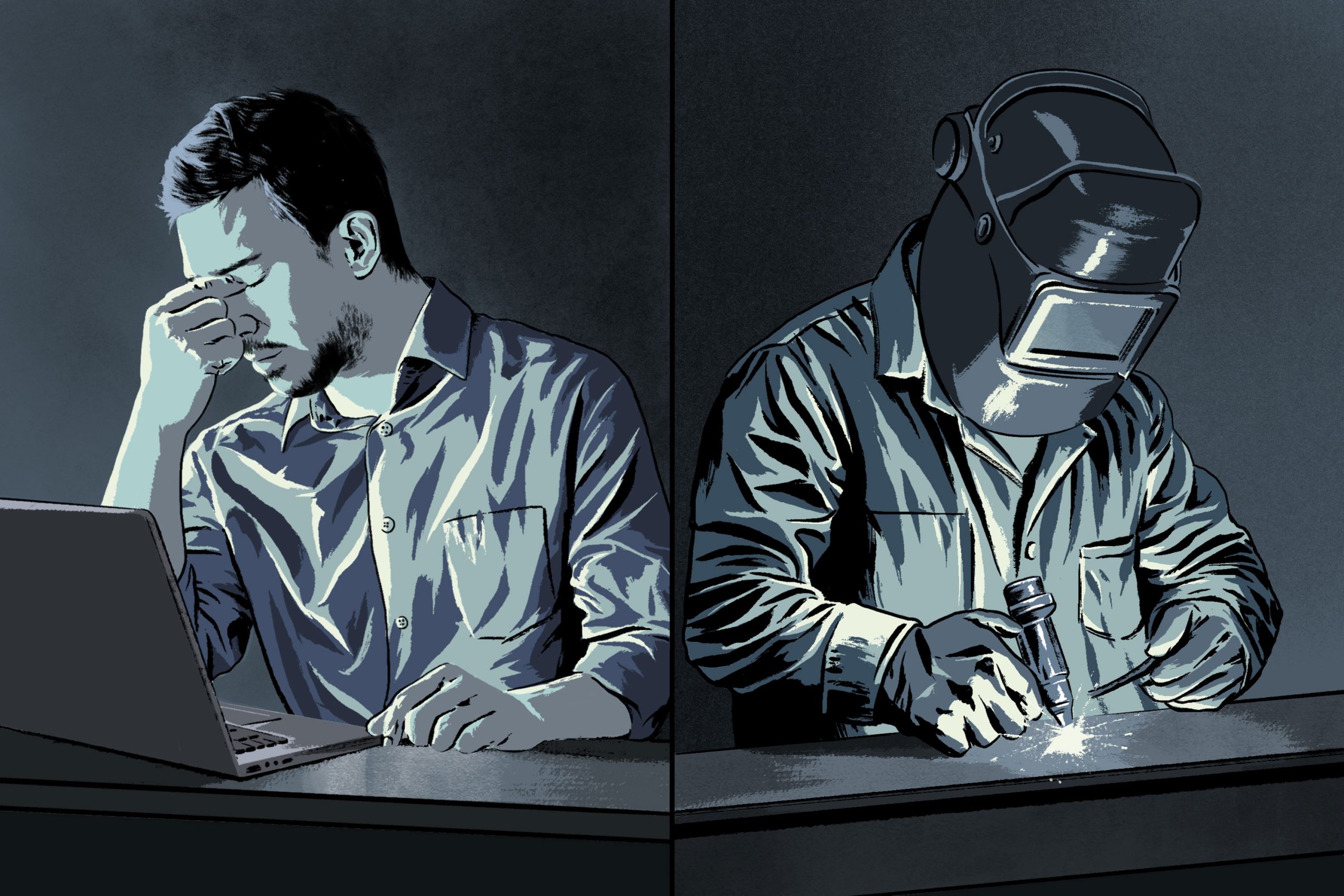
The rapid ascent of generative artificial intelligence has fundamentally altered the calculus of career planning for the next generation of the American workforce. Since the public release of ChatGPT in November 2022, the psychological and economic landscape for young professionals has shifted from one of optimistic exploration to defensive maneuvering. As AI tools demonstrate an increasing aptitude for tasks ranging from software engineering and copywriting to data analysis and administrative support, a growing cohort of workers under the age of 30 is actively pivoting away from digital-first industries. Instead, they are gravitating toward professions that prioritize physical presence, complex human interaction, and tactile problem-solving—jobs that are, for the foreseeable future, shielded from the reach of automation.
A Seismic Shift in Career Strategy
For many recent college graduates, the decision to abandon the white-collar path is a direct response to the perceived instability of the modern office. Keon Davis, a marketing graduate from the University of Wisconsin-Madison, represents the vanguard of this trend. During his junior year, Davis watched with growing unease as the very marketing tasks he performed in his internships—crafting outreach emails and performing consumer research—were increasingly performed by large language models. By the time he reached his graduation in May 2024, Davis had abandoned his original career trajectory, choosing instead to join Teach for America. Today, he manages a third-grade classroom in New York City, finding that the nuance of human connection and student motivation is a domain where AI lacks any meaningful foothold.
This sentiment is echoed by thousands of peers. A Pew Research Center poll released in August 2026 underscored this growing anxiety, finding that 73 percent of adults under 30 believe AI will lead to a reduction in available jobs, a significant increase from the 61 percent who felt the same way just two years prior.
Chronology of the AI Anxiety Wave
The timeline of this shift tracks closely with the evolution of AI capabilities:
- November 2022: The launch of ChatGPT serves as a catalyst, demonstrating that cognitive labor—previously thought to be immune to automation—is now highly vulnerable.
- 2023–2024: Early adoption of AI tools by firms leads to a surge in productivity but also initial rounds of workforce restructuring, particularly in entry-level white-collar roles.
- Late 2024: Empirical data begins to emerge, highlighting a widening employment gap between "AI-exposed" sectors and manual labor fields.
- 2025–2026: Education enrollment data reflects the shift, with a decline in computer science applicants and a corresponding surge in trade apprenticeships and health profession programs.
Research from the Stanford Digital Economy Lab provides the data to validate these fears. Between November 2022 and June 2026, workers aged 22 to 25 in highly exposed roles, such as customer service and software development, experienced a 19-percent decline in employment compared to their counterparts in manual, "least-exposed" roles like maintenance, repair, and nursing assistance. While some economists argue that these layoffs were a correction following pandemic-era over-hiring, the consistent trend toward the trades suggests a permanent shift in how young workers evaluate long-term job security.

The Rise of the AI-Proof Trade
The economic demand for blue-collar labor has never been higher, driven by a massive need for infrastructure upgrades, renewable energy installations, and the aging-out of the current skilled trades workforce. The U.S. Bureau of Labor Statistics notes that growth for electricians, HVAC mechanics, and roofers is significantly outpacing the average for all other professions.
Organizations like Rosedale Technical College in Pittsburgh have become hubs for this retraining phenomenon. President Dennis Wilke reports that enrollment at his institution has grown by 50 percent over the last two years, with an 80 percent increase in inquiries. Many of these applicants are not traditional students, but former office workers who have been laid off or fear they are next.
Kevin Brough, 34, serves as a poignant example of this transition. A former software developer with a degree in computer engineering, Brough was laid off in 2024. Despite his background in high-tech, he opted to enroll in an automotive technology program. "I never thought I’d be changing from software development, but here I am," Brough noted. He now finds job security in the tactile reality of automotive repair, a field where the complexity of physical components requires human dexterity that AI cannot replicate.

The Physical Trade-Off
While the move to the trades offers security, it is not without significant personal cost. The transition requires adapting to the physical demands of labor, which can be a jarring shift for those accustomed to desk-bound work. Meagan Acevedo, a 33-year-old who transitioned from human resources to an electrical union apprenticeship, illustrates this reality. Despite the stability of a union role and a clear, lucrative career path—with potential wages ranging from $38 to $126 an hour on public works projects—the work is physically taxing. Getting up at 3:00 a.m. and lifting 75-pound spools of wire is a stark departure from her office experience. "I’ll be honest, all of it was kind of rough," she admitted, yet she maintains that the trade-off is worth it for the sense of control she now has over her professional future.
The Educational and Policy Disconnect
The rapid movement of students and workers away from tech-adjacent fields presents a challenge for higher education institutions. Universities, which often operate on multi-year curricula, are finding it difficult to keep pace. Some schools are attempting to adapt: Purdue University has implemented an "AI working competency" requirement, ensuring students master the tools that might otherwise replace them, while others are creating new degree paths that combine traditional liberal arts with AI application.
At the federal level, the response has been slow and often decoupled from the specific threats posed by AI. While figures like former Biden official Jacob Leibenluft and labor leaders like AFL-CIO president Liz Shuler have called for federal safety nets, retraining funds, and even excise taxes on companies that replace workers with AI, substantive legislation remains stalled. Proposals from senators such as Mark Kelly and Bernie Sanders—ranging from federal trust funds to tax-funded reskilling—are currently just ideas rather than actionable law.

Broader Implications for the Workforce
The "AI-proofing" of careers is creating a fragmented labor market. On one hand, a new class of high-tech workers will be defined by their ability to manage and optimize AI systems. On the other, a substantial portion of the population is opting out of the digital ecosystem entirely, seeking refuge in the physical world.
The long-term impact of this trend could be a labor shortage in key white-collar sectors that are still necessary for economic functioning, even if they are currently being restructured. Furthermore, as the economy moves toward a bifurcated model of "AI-integrated" versus "manual-only" work, the social and economic mobility of those in the trades will be tested by the physical longevity of those careers.
For now, the decision remains an individual one. As workers like Acevedo, Brough, and Davis continue to navigate the uncertainty, their stories reflect a broader societal trend: when technology threatens the predictability of the future, people revert to the tangible, the manual, and the undeniably human. Whether this shift will stabilize the job market or create new imbalances remains the defining economic question of the coming decade.