
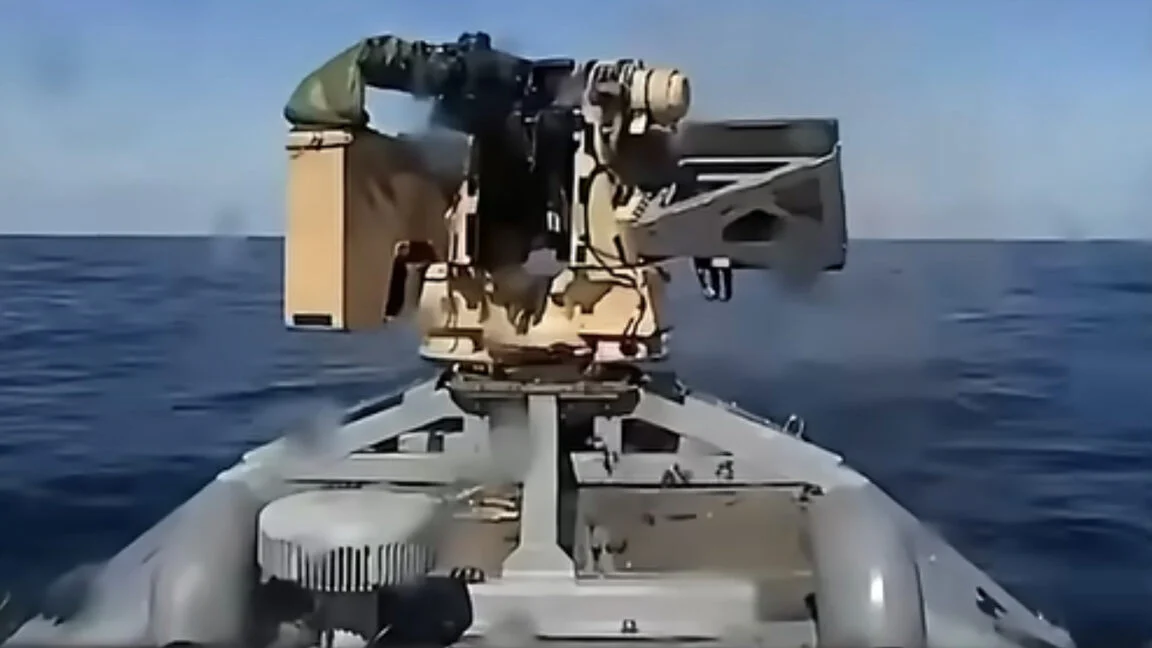
In a historic milestone for modern naval warfare, a Ukrainian uncrewed surface vessel successfully intercepted, engaged, and destroyed a Russian explosive drone boat in the Black Sea using a remote-controlled machine gun turret. This engagement marks the worlds first recorded combat clash between autonomous or remotely operated naval surface craft, signaling a dramatic technological escalation in the ongoing conflict. While aerial drone dogfights and ground-based robotic combat have become commonplace across the frontlines of Ukraine, the September 12 engagement extends this paradigm shift into open maritime waters, redefining naval combat doctrine in real time.
The encounter took place in the contested waters of the Black Sea, an arena that has frequently served as a testing ground for innovative naval tactics. According to reports compiled by defense analysts and corroborated by official Ukrainian channels, operators from Ukraine’s Defense Intelligence directorate identified an approaching Russian uncrewed surface vessel. Rather than relying on traditional manned warships, coastal defense batteries, or aviation assets to neutralize the threat, military planners directed a heavily armed Ukrainian Navy drone boat to intercept the enemy craft.
The target was definitively identified as a Russian Orcan surface drone, a specialized uncrewed vessel utilizing a jet-ski-style steerable water jet propulsion system. Designed primarily as a kamikaze platform, the Orcan is engineered to high-speed transit toward targets—such as moored naval vessels, port infrastructure, or anchored shipping—before detonating an onboard explosive payload. Naval expert H.I. Sutton, writing in Naval News, highlighted the tactical role of the Orcan within Russia’s broader asymmetric naval strategy. These explosive USVs are frequently deployed to harass Ukrainian supply lines, probe coastal defenses, and pressure critical port facilities, often operating in complex coordination with airborne assets like Iranian-designed Geran loitering munitions. The aerial drones provide critical reconnaissance, relay targeting telemetry, and enhance communications relays for the surface operators sitting miles away from the theater of operations.
The Hunter and the Weaponry
To counter this maritime threat, Ukraine deployed a Sargan-3000 drone boat. Unlike its kamikaze counterpart, which is expended upon impact, the Sargan-3000 is engineered as a reusable patrol and combat platform. The vessel is outfitted with a sophisticated 12.7-millimeter heavy machine gun mounted on a remote weapon station. The integration of this stabilized turret is credited to Norwegian defense technology provider Kongsberg, a system renowned for its precision optics and remote-firing capabilities, which allow operators to maintain accurate fire even while bouncing across choppy Black Sea waves.
The resulting engagement lasted mere moments but demonstrated the devastating efficacy of remote naval combat systems. Footage released by the Ukrainian Navy and distributed via government media outlets such as United24 depicts the Sargan-3000 tracking the Russian Orcan from a distance of approximately one kilometer. Leveraging advanced stabilization and targeting optics, the Ukrainian operator opened fire with the heavy machine gun. Initial rounds targeted and severed the Russian drone’s critical communications antenna, blinding the platform to remote operator inputs and severing its telemetry link. With the enemy vessel incapacitated and stripped of evasive maneuvering capabilities, the Sargan-3000 continued to riddle the hull with armor-piercing 12.7mm rounds until structural integrity failed, causing the Russian drone to detonate or sink beneath the waves.
The Inevitability of Drone-on-Drone Combat
Military theorists and naval analysts have long predicted that the proliferation of uncrewed systems would inevitably lead to direct confrontations between autonomous or remote-controlled vehicles. H.I. Sutton noted to science and technology publications that this maritime duel was merely the next logical step in the evolution of modern conflict. Similar cross-domain combat engagements have already been documented in the skies, where reconnaissance and interceptor quadcopters collide or engage in aerial ramming maneuvers, as well as on land, where opposing ground robots trade fire in trench systems.
The Black Sea has effectively transformed into an operational laboratory for asymmetric naval warfare. Since the outset of the full-scale invasion, Ukraine has successfully utilized domestically developed and foreign-supplied USVs—such as the Sea Baby and Magura V5—to challenge the dominance of the Russian Black Sea Fleet. These platforms have inflicted catastrophic losses on Russian naval assets, forcing Moscow to relocate major surface combatants away from traditional naval bases in occupied Crimea to safer harbors further east in Novorossiysk.
However, as Ukraine has demonstrated the immense strategic utility of maritime drones, Russian military industries have raced to develop counter-systems and their own offensive USV fleets. The deployment of the Orcan platform represents Moscow’s effort to contest maritime superiority in coastal and shallow waters. Consequently, the September 12 engagement represents a defensive breakthrough for Ukraine, proving that uncrewed systems can be deployed not only to strike stationary strategic assets but also to hunt down and eliminate moving, hostile robotic threats in the open sea.
Chronology of the Engagement
The sequence of events on September 12 underscored the rapid intelligence-to-action cycle maintained by Ukrainian defense forces operating in the Black Sea maritime domain.
Phase One: Detection and Identification. Operators within Ukraine’s Defense Intelligence apparatus utilized a combination of synthetic aperture radar, aerial surveillance drones, and coastal sensors to detect an anomalous maritime signature traversing the Black Sea. Upon closer inspection, the craft was identified as a Russian Orcan-class explosive USV.
Phase Two: Interception Vectoring. Recognizing the offensive potential of the approaching Russian drone, command elements coordinated with naval drone units. Rather than scrambling manned interception craft—which would expose personnel to significant risks from air and missile threats—the decision was made to dispatch a Sargan-3000 patrol USV already on standby in the operational sector.
Phase Three: Engagement and Destruction. The Sargan-3000 closed the distance to the target, establishing visual and sensor lock at a range of roughly one thousand meters. Activating the Kongsberg remote weapon station, the operator engaged the Orcan. By systematically destroying the communications array first, the Ukrainian operator neutralized any chance of the Russian drone initiating a kamikaze run or self-destruct sequence near friendly forces. Subsequent bursts shattered the hull, culminating in the sinking of the vessel.
Phase Four: Damage Assessment and Footage Recovery. Telemetry and high-definition video captured by the Sargan-3000’s targeting cameras were transmitted back to command nodes, verifying the complete destruction of the Russian asset without any friendly casualties or equipment loss.
Strategic Implications and Future Outlook
The implications of the worlds first naval drone duel extend far beyond the tactical confines of the Black Sea theater. Defense procurement agencies, naval architects, and military strategists worldwide are currently analyzing the engagement to recalibrate future naval doctrine.
For decades, modern navies have prioritized the development of multi-billion-dollar surface combatants—destroyers, frigates, and aircraft carriers—designed to project power globally. However, the conflict in Ukraine has demonstrated that inexpensive, mass-produced uncrewed vessels can deny maritime access, disrupt supply chains, and fundamentally alter the cost-benefit analysis of naval warfare. A single heavy machine gun mounted on a fiberglass or composite hull costing a fraction of a traditional warboat successfully neutralized an advanced explosive platform.
As uncrewed systems become increasingly sophisticated through the integration of artificial intelligence and machine learning, human operators may soon cede tactical targeting decisions entirely to autonomous software algorithms. In such a future, naval engagements could increasingly feature fleets of autonomous hunter-killer drones patrolling strategic waterways, engaging enemy robotic assets without human intervention.
Furthermore, the introduction of USV-on-USV combat necessitates a rapid evolution in how navies protect their high-value assets. Naval task forces of the future will require integrated counter-USV (C-USV) defense suites, combining electronic warfare jamming, directed-energy weapons, acoustic disruption, and kinetic interceptors capable of operating in a marine environment. The loss of the Orcan drone to a remote-controlled machine gun highlights the vulnerability of current explosive surface craft to kinetic counter-measures, prompting developers to explore stealth coatings, autonomous evasive maneuvers, and hardened armoring for future uncrewed combatants.
Official Responses and Analysis
While official statements from the Russian Ministry of Defense regarding the specific incident remain sparse—consistent with broader operational security measures concerning naval losses—Ukrainian authorities have framed the success as a testament to indigenous technological adaptation and tactical ingenuity. Representatives from United24 and the Ukrainian Navy emphasized that the engagement validates ongoing investments in asymmetric warfare capabilities.
Independent defense analysts emphasize that while this event is historic, it is likely a precursor to a much larger transformation in naval warfare. As both state actors and non-state entities gain access to commercial-off-the-shelf marine robotics, the security of global shipping lanes, maritime choke points, and undersea infrastructure will face unprecedented challenges. The ability to deploy low-cost, expendable drone hunters to protect critical maritime zones will become a mandatory requirement for any modern naval force seeking to maintain freedom of navigation in contested waters.
Ultimately, the clash in the Black Sea on September 12 marks the permanent transition of naval warfare into the robotic age. What began as an experimental deployment of improvised explosive boats has matured into a complex, multi-domain chess match where machines fight machines beneath, upon, and above the waves, permanently altering the history of conflict at sea.
