
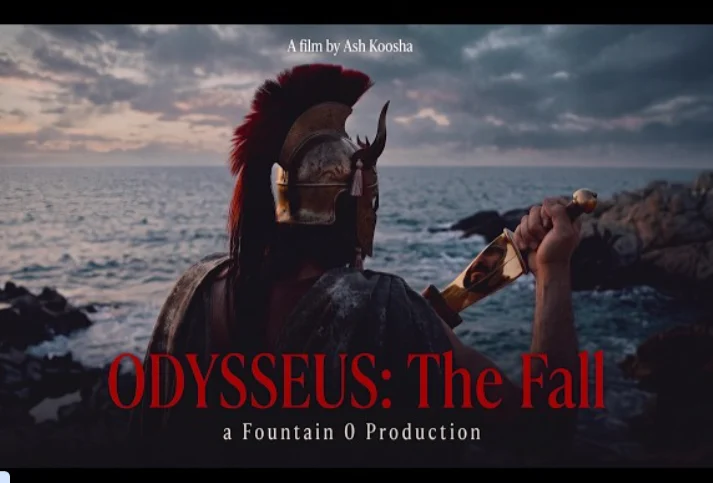
The announcement reverberated through the film industry, as intended, igniting a firestorm of debate and disbelief. An artificial intelligence filmmaker, operating under the guidance of human collaborators, has completed a 135-minute feature film, Odysseus: The Fall, inspired by Homer’s epic poem, The Odyssey. This project, utilizing a public domain work as its foundation, has inevitably drawn comparisons to Christopher Nolan’s highly anticipated $250 million film on the same subject, slated for release in the summer of 2026. The stark contrast in production methods—an AI-generated film created for a fraction of the cost and without traditional actors, versus Nolan’s monumental analogue production—has underscored a burgeoning technological shift and its profound implications for the future of cinematic storytelling.
The creator behind Odysseus: The Fall is Ash Koosha, an Iran-born, England-raised Millennial engineer. Koosha, along with his brother and collaborator Pooya Koosha, and producer Tom Rogers, the founder of CNBC and co-founder of the AI-centric film production banner Fountain 0, have positioned this project not as a direct competitor to Nolan’s work, but as a pioneering exploration of what AI can achieve in filmmaking. Despite the film’s planned deferral of public release for several weeks, the controversy surrounding its creation has been immediate and intense. Questions have swirled around Koosha’s motivations, the ethical considerations of AI-generated art, and how this new venture relates to his previous, more widely sympathized-with AI film, Dreams of Violet. That film, which debuted at Tribeca last month, explored the recent Iranian democracy protests, a subject matter imbued with humanitarian urgency that made its AI-driven production more readily understood and accepted.
The timing of Odysseus: The Fall‘s announcement is particularly potent. It arrives on the heels of a public disagreement between Christopher Nolan and his frequent collaborator, actor Matt Damon, regarding the viability of large-scale analogue filmmaking in the modern era. Damon expressed a sense of finality, stating, "I knew that this was the last chance I was going to have to do something like this." Nolan, in turn, countered by labeling Damon’s sentiment as "defeatist." In this context, Koosha’s AI-driven Odyssey can be perceived by some as accelerating the very "end-of-cinema" moment Damon seemed to lament, ironically using the same foundational material that Nolan’s project aims to champion.
A Provocative Vision: The Genesis of Odysseus: The Fall
The Hollywood Reporter reached out to Koosha, his brother Pooya, and producer Tom Rogers to gain insight into their groundbreaking approach. Their vision for cinema, while cogent, is undoubtedly provocative and has ignited strong reactions within the industry.
"There’s been a lot of excitement, and a lot of questions, and a lot of confusion," Ash Koosha stated when asked about the aftermath of his announcement. He was quick to clarify that their intention is not to oppose Christopher Nolan. "He’s doing what he’s doing in the old world of cinema. And he does it brilliantly. But there’s room for something in the new world." Koosha revealed his lifelong fascination with The Odyssey, dating back to his childhood. His awareness of Nolan’s project came through a Reddit community dedicated to Homer. "I’ve been immersed in all the questions about all the details, like Agamemnon’s outfits and everything else. My goal is not to make a movie that is the same as his. It’s to use the tools to make my own version of the story."
The distinction between Dreams of Violet and Odysseus: The Fall was a key point of discussion. The former’s production was necessitated by the inability to safely film in Tehran and addressed a subject of critical humanitarian importance. Koosha views the two projects as interconnected, albeit in different ways. "Dreams of Violet raised questions, and this raises deeper questions—questions that are important for the industry," he explained. He posed rhetorical questions that encapsulate the core of his artistic inquiry: "’Can we have stories at the speed of news?’ ‘Can other people paint with tools besides people like Christopher Nolan?’ ‘What can be created if they can?’"
Koosha emphatically rejected the notion that Odysseus: The Fall is a derivative work or a "knockoff" intended to capitalize on the existing blockbuster landscape. Instead, he views it as part of a broader cultural dialogue. "Before these AI tools, if I had a theory about Odysseus, I could write a Substack about him. And some people would read it, but how many? Now I can put my take into a film. I can paint my opinion with images and sound and light. And a lot more people can see it." He termed this approach "tangential filmmaking," suggesting it allows for the creation of supplementary narratives that can coexist with major cinematic releases.
Tom Rogers elaborated on this concept, acknowledging the undeniable prowess of Nolan’s work. "Obviously, it’s hard to be in the same arena as Christopher Nolan; everyone agrees his Odyssey is the superior film. And we want people to see that film. But hopefully, they see ours too. Christopher Nolan is the ultimate in physical filmmaking, and what we’re trying to do is be the ultimate in AI filmmaking."
Ash Koosha reinforced this distinction, emphasizing the nascent stage of AI filmmaking. "You can’t judge them on the same terms. They’re at 125 years, and we’re in our infancy. So, of course, there are going to be bumps in the road. But it’s what you can achieve by trying. To me, the risk is low, and the reward is high: a whole new kind of cinema." Rogers added that their project aims to demonstrate that AI filmmaking is not inherently low-quality. "We’re just trying to show what’s possible when you don’t have to worry about budgets. We want people to see it’s not all slop."
A New Interpretation of the Ancient Hero
When asked about his specific interpretation of Odysseus that his film seeks to illuminate, Koosha drew from his personal experiences. "I don’t think he’s well-understood," he stated. "I don’t want to say too much, but I think as someone who came from Iran and moved to the West as a child, I can understand something about his story, about what it means to be far from home. How it wasn’t just about ego motivating him." This personal connection suggests a nuanced portrayal that goes beyond the traditional heroic archetype, exploring themes of displacement and identity.
A Strategic Release: Timing and Transparency
The Koosha brothers and Rogers have opted for a deliberate release strategy for Odysseus: The Fall. Pooya Koosha explained their reasoning: "We want to wait a while, at least until late summer. We don’t want people to feel overloaded and confused. That’s important to us." Rogers echoed this sentiment, highlighting their commitment to transparency. "We could have released it now, but we’re not trying to trick people. We want them to be able to clearly compare." This measured approach underscores their desire for their work to be judged on its own merits, allowing audiences to process and compare it with traditional cinematic offerings.
Tangential Filmmaking: A Democratic Future for Cinema?
The concept of "tangential filmmaking" was further explored, drawing parallels to the early days of the internet and the rise of blogging. Just as blogs offered alternative perspectives to established media outlets, Koosha envisions AI enabling a similar democratization of cinematic content. "Yes, exactly," Ash Koosha affirmed when the analogy was presented. "There is room for all kinds of cinema, and AI finally makes that possible. We’ve had so many years when making cinema was dependent on having enough money, and unless you’re Christopher Nolan, you couldn’t make a movie of a certain scale, and even he couldn’t sometimes. The concentration of revenue became a barrier to entry. All of that is going to go away. That’s what we’re trying to bring about."
Pooya Koosha expressed hope that their endeavor would inspire others. "We hope a lot of other people come in and do this. This is about something very broad and democratic." Rogers reiterated the mission of Fountain 0: "Yes, that’s the whole goal of Fountain 0—to look for the best use of the tools."
The Role of Actors in an AI-Dominated Landscape
A significant question arising from this new paradigm is the future of actors. If "tangential filmmaking" leads to a proliferation of AI-generated content, what becomes of human performers? Tom Rogers offered an optimistic perspective: "I think this will make actors more valuable, whether it’s in an old-world movie or live theater. People will want to see them too, maybe even more than they do now."
This suggests a vision of co-existence, where traditional filmmaking, with its emphasis on human performance, continues to thrive alongside AI-generated content. The "scrappy homemade projects" Ash Koosha alluded to, now empowered by sophisticated AI tools, could overflow alongside meticulously crafted studio productions.
"That’s all we’re trying to do," Ash Koosha concluded. "To show you can make great films in the manner that Christopher Nolan does. But you can make gorgeous films using AI models too." This statement encapsulates the core of their ambition: to expand the definition of filmmaking and to demonstrate that artistic merit and narrative power are not exclusive to traditional, high-budget productions. The advent of AI in filmmaking, as exemplified by Odysseus: The Fall, signals a potential seismic shift, promising a future where the boundaries of cinematic creation are redefined, and the landscape of storytelling becomes more diverse and accessible than ever before.

