
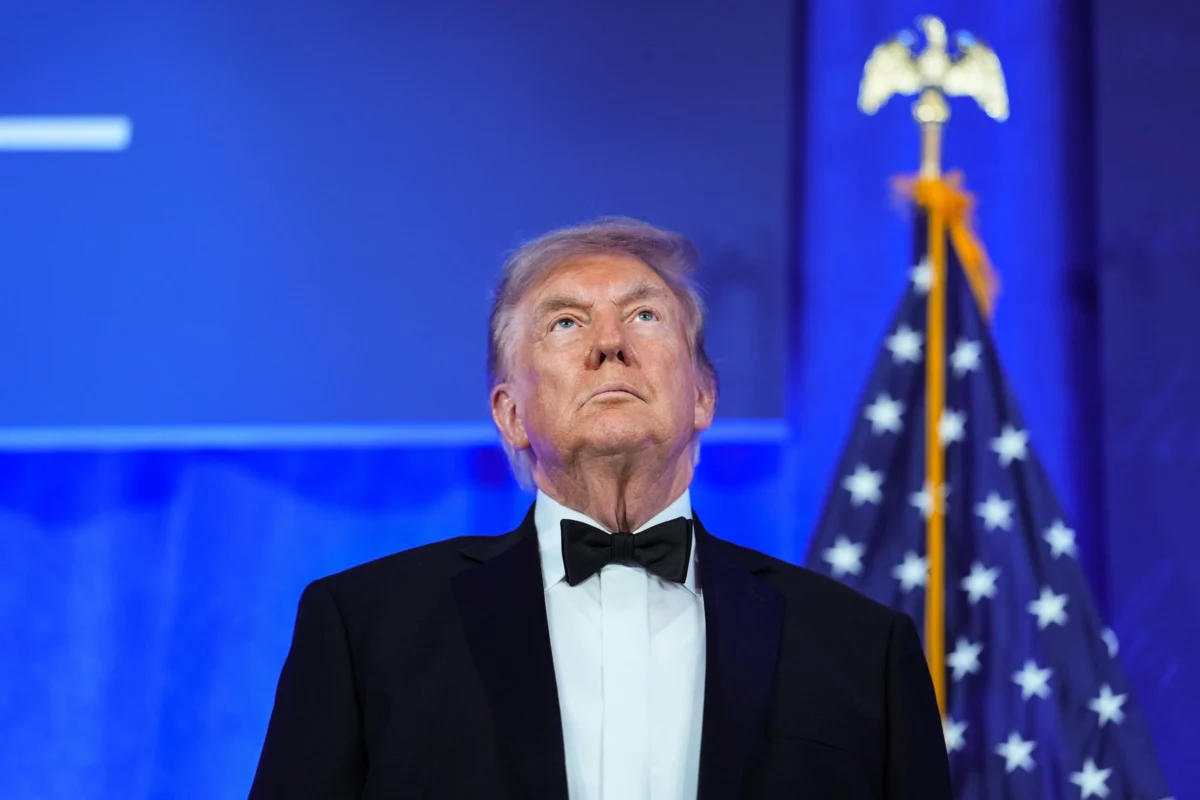
President Donald Trump made his inaugural appearance at the White House Correspondents’ Association (WHCA) Dinner, a long-standing tradition that this year saw its gala rescheduled and held on Friday evening in Washington, D.C. The event, which had been previously disrupted by a security incident, provided a platform for the President to deliver a speech lasting just over an hour. Throughout his remarks, Trump offered pointed criticisms, targeting numerous journalists, politicians, and celebrities with whom he has publicly clashed.
The President opened his address by acknowledging the assembled guests, stating, "I am delighted to be here at the White House Correspondents’ Dinner. Amazing people, a lot of people that I like. Some I don’t like at all, but I respect most of them." This initial sentiment, however, soon gave way to a more confrontational tone. Trump appeared to grapple with the expected tenor of the evening, questioning whether he should be serious or humorous. He suggested that, compared to the remarks he might have delivered at the original dinner, he was "pulling his punches."
A Sharp Turn Towards Media Criticism
The atmosphere shifted noticeably as Trump began to directly address the media. "This evening it’s really all about the fake news media and your handling of prizes – writing and producing and performing made-up stories like the Academy Awards," he declared. Drawing a parallel between the press and the Oscars, Trump lamented the perceived decline in viewership for the latter, attributing it to their focus on political commentary. He asserted, "The Academy Awards used to be the epitome of ratings outside of the Super Bowl… Now it’s down in the dumps. Nobody wants to watch it anymore because they took on Trump. They hit me all night long."
The President then issued a stark prediction regarding the future of the news industry without his presence. "When I’m gone, you’re all going to be broke. Your business model is going to be finished," Trump stated with conviction. "No, it’s true. When I’m not around, you’re going to be broke. There’s not going to be anybody to report on. Nobody gives a damn about anybody else." This declaration underscored his long-held belief that his persona and political activities are a primary driver of audience engagement for many news organizations.
Trump further elaborated on his decision to disengage from traditional media platforms, noting his success on TikTok. "Mostly, I’ve given up on you and the media, so that now I just gave up on you, and I’m number one on TikTok. Did you see that?… I gave up on you, people. I gave up on traditional press, and it obviously worked because we did win in a landslide," he claimed, referencing his electoral performance with a slight misstatement of terminology. He also boasted about his involvement in the sale of TikTok to a group of predominantly American investors.
Historical Context and Event Background
The White House Correspondents’ Dinner, a tradition dating back to 1921, traditionally serves as a moment for the President and the press corps to engage in lighthearted banter and acknowledge the vital role of a free press in a democracy. However, the event has often been a site of tension, particularly during administrations critical of media coverage. President Trump’s administration has been characterized by a consistently adversarial relationship with many news outlets, which he has frequently labeled as "fake news" and the "enemy of the people."
This year’s dinner was particularly significant due to its delayed scheduling. The original gala, set for April 25th, was abruptly interrupted by what authorities described as an apparent assassination attempt on President Trump. A gunman breached security protocols at the Washington Hilton, leading to the immediate evacuation of the President and the apprehension of the suspect. The rescheduled event was held at the Waldorf Astoria hotel, with heightened security measures in place.
In lieu of a comedian, a traditional element of the dinner, the WHCA opted for a performance by mentalist Oz Pearlman. This decision may have been influenced by the recent security concerns and the President’s own critical views on contemporary comedians. Trump specifically mentioned potential hosts Jimmy Kimmel, Jimmy Fallon, and Stephen Colbert, dismissing them as "terrible," "without talent," and "angry people."
A Rambling, Unscripted Address
Trump took the podium at 9:33 p.m. and proceeded to speak for approximately 64 minutes. His remarks deviated significantly from the expected format, veering into a broad range of personal grievances and political commentary.
He engaged in a peculiar exchange regarding the potential renaming of the dinner, referencing a conversation with Paramount CEO David Ellison. Trump recounted Ellison’s alleged suggestion to rename the event the "Trump White House Correspondents’ Dinner" in the future, a notion Trump embraced. This anecdote echoed his prior, unsuccessful attempts to associate his name with prominent institutions, such as the Kennedy Center.
The President also made a passing, and somewhat unexpected, positive remark about Bari Weiss at CBS News, describing her as "a wonderful woman," which elicited a notable reaction from the audience. He then shifted his focus to White House Press Secretary Karoline Leavitt, acknowledging the difficulty of her role in navigating interactions with the press. "She has to deal with all of you all the time, and you can be very difficult," Trump commented, before softening his stance by suggesting he might be "oversensitive" and that some journalists might not like him.
Targeting Perceived Adversaries
A significant portion of Trump’s speech was dedicated to a barrage of insults directed at individuals and organizations he views as adversaries. He described the gathering as "the largest group of Trump derangement syndrome people ever put together at one time, I suspect," a phrase that drew a mixed reaction of laughter and murmurs. The President has previously alluded to "Trump derangement syndrome" as a genuine affliction.
Among his most pointed criticisms was directed at CNN anchor Don Lemon, whom Trump identified as having "the lowest ratings and the lowest IQ on television" and dubbed "the dumbest man on television." He questioned Lemon’s ability to make a comeback in the media landscape.
CNN anchor Kaitlan Collins also found herself in Trump’s crosshairs. While acknowledging her award for broadcast journalism, Trump dismissed it as "fake," stating that her coverage of his confrontation with Ukrainian President Volodymyr Zelensky was "all about me." He advised Collins, described as a "young, active woman," to "smile," suggesting she should be happier given her position at CNN. In a particularly unusual turn, Trump then linked Collins to the controversy surrounding Bud Light’s partnership with transgender influencer Dylan Mulvaney, incorrectly implying Collins was involved in a Bud Light advertisement. He cited Mulvaney’s involvement as a significant financial misstep for the brand.
CNN Worldwide Chairman and CEO Mark Thompson issued a statement in response to Trump’s comments about Collins, affirming CNN’s support for its journalists and the integrity of their reporting. "We stand by our journalists and the integrity and fair mindedness with which the CNN team reports the news. Honest, accurate journalism may sometimes irritate politicians, but our right to report and present that reporting to the public without government interference is fully protected by the U.S. Constitution. CNN will continue to exercise this right," the statement read.
Trump also commented on Anderson Cooper, another CNN anchor, acknowledging past favorable coverage but noting Cooper’s shift in perspective as Trump entered politics.
The President’s criticisms extended to a wider array of figures, including California Governor Gavin Newsom, U.S. Representatives Ilhan Omar, Senators Elizabeth Warren and Chuck Schumer, Rosie O’Donnell, whom he called a "sick older woman," CNN anchor Jake Tapper, and musician Bruce Springsteen. Regarding Springsteen, Trump questioned his appearance and performance, remarking, "What the hell happened to that guy? He looks like hell." He criticized Springsteen’s concert for including "four political speeches" and humorously renamed the tour "Bored in the USA."
Legal Battles and Awards
The dinner also highlighted the ongoing legal entanglements between President Trump and news organizations. Reporters from The Wall Street Journal were honored with the Katharine Graham Award for Courage and Accountability for their reporting on a birthday letter allegedly written by Trump to Jeffrey Epstein. Trump has vehemently denied authoring such a letter and has pursued legal action against the Journal, seeking $20 billion in damages. The Journal’s legal team has characterized Trump’s lawsuit as "an affront to the First Amendment." While an initial suit was dismissed, Trump refiled his complaint in May 2026, and the case remains pending. In an awkward moment during the event, Trump reportedly shook hands with the award-winning Journal reporters before returning to his seat.
Trump mused about the awards presented, asking rhetorically, "Do I get a say in those awards?"
A Glimpse into Future Aspirations
Towards the conclusion of his lengthy address, Trump donned a "Trump 2028" hat and revisited his unsubstantiated claims of winning the 2020 presidential election, suggesting he would run for a fourth term. He expressed his intention to attend the correspondents’ dinner again in 2027.
The President also made a jest at the expense of Robert F. Kennedy Jr., his Secretary of Health and Human Services, referencing an unusual anecdote involving a cow and roadkill, which he attributed to Kennedy’s suggestions for the menu.
Broader Implications and the Role of the Press
President Trump’s participation in the WHCA Dinner, particularly his lengthy and critical address, underscores the ongoing strain between his administration and a significant segment of the American press. His rhetoric, characterized by direct attacks on journalists and news organizations, has been a hallmark of his presidency. The legal battles he has initiated against media outlets further illustrate this contentious relationship.
The WHCA Dinner, despite the President’s controversial remarks, continues to serve as a symbolic forum for the exchange between the executive branch and the media. The event’s history, marked by both convivial exchanges and sharp critiques, reflects the dynamic and often challenging nature of the First Amendment in practice. The presence of the President, even in a confrontational capacity, highlights the enduring significance of the press in holding power accountable, a principle that the White House Correspondents’ Association consistently champions through its awards and its commitment to journalistic integrity. The rescheduled nature of this year’s event, due to a serious security threat, also brought a stark reminder of the risks faced by those in public life and the importance of robust security measures. The association, led by outgoing President Weijia Jiang and incoming President Jacqui Heinrich, navigated the complexities of hosting the event under these unique circumstances.

