
Larry David, the acclaimed creator and star behind the long-running HBO series Curb Your Enthusiasm, has once again graced HBO Max with his unique brand of observational humor in the new sketch comedy series, Life, Larry and the Pursuit of Unhappiness. Premiering in the wake of Curb‘s conclusion, this ambitious American history-themed show, executive produced by Barack and Michelle Obama through their Higher Ground Productions, has quickly become a cultural talking point, not only for its star power but for its audacious reimagining of pivotal historical moments through David’s distinctly awkward and often exasperating lens. The series boasts an extraordinary ensemble cast, featuring dozens of notable celebrities who embody historical figures, offering a fresh, albeit anachronistic, perspective on the nation’s past.
The sheer scale of celebrity involvement in Life, Larry and the Pursuit of Unhappiness is a significant departure from typical cameo-laden productions. Each episode is packed with over a dozen recognizable faces, drawing from David’s extensive network of collaborators, including several of his Curb Your Enthusiasm co-stars, alongside Hollywood titans such as Samuel L. Jackson, Lin-Manuel Miranda, Jerry Seinfeld, and Jon Hamm. Tragically, the series also marks the final on-screen performance of the late Rob Reiner, adding a poignant layer to the ensemble’s collective effort. The Hollywood Reporter is diligently tracking these appearances, ensuring that each contributing artist receives due recognition for their participation in David’s latest comedic endeavor.
A New Frontier in Historical Comedy: The Show’s Premise and Production
Life, Larry and the Pursuit of Unhappiness leverages the rich tapestry of American history, from the nation’s founding to more recent events, as a backdrop for Larry David’s signature comedic style. The series’ core premise appears to be the juxtaposition of David’s perpetually flustered and self-absorbed persona against the gravitas and often profound implications of historical events. This contrast generates humor by highlighting the mundane, petty, and relatable human foibles that can arise even in the most significant contexts.
The involvement of Barack and Michelle Obama’s Higher Ground Productions signals a deliberate effort to blend entertainment with educational and cultural relevance. The Obamas, known for their commitment to impactful storytelling, have positioned this series to engage a broad audience with American history in an accessible and humorous way. The show’s executive producers likely saw an opportunity to use David’s unique comedic voice to spark conversations and encourage a deeper appreciation for the historical figures and events that have shaped the United States.
Chronology of Episodes and Notable Appearances
The series unfolds over a series of episodes, each dissecting different eras and pivotal moments in American history.
Episode 1: "Livingston"
The premiere episode, "Livingston," sets the tone with a memorable introduction by former President Barack Obama, who appears as himself. His presence, as an executive producer, lends an immediate air of significance to the series. Obama’s brief but pointed remarks, offering praise for the nation as it approaches its semiquincentennial and playfully teasing David, underscore the show’s blend of patriotism and irreverence. The narrative is then handed over to the commanding voice of Samuel L. Jackson, whose distinctive narration has become a staple in contemporary media.
The episode quickly dives into historical reenactments with a sketch featuring Henry Winkler as John Hancock, Chris Parnell as Benjamin Franklin, and Alan Tudyk as Thomas Jefferson. These founding fathers are depicted as they debate the inclusion of Robert Livingston’s proposed additions to the Declaration of Independence. The humor arises from the anachronistic insertion of modern sensibilities into this foundational moment.
Following this, David takes on the role of Alexander Graham Bell, attempting to introduce the telephone to a skeptical and demanding public, embodied by a group of spectators portrayed by Parks and Recreation‘s Alison Becker, Mary Sohn of A.P. Bio, and Rodney J. Hobbs from The Office and Modern Family. This sketch satirizes the rapid pace of technological adoption and consumer expectations, a theme that resonates strongly in the 21st century.
A World War I trench warfare scenario follows, with David playing a timid soldier under the command of Michael Chiklis as a gruff sergeant. The sketch also features Mike Castle and Jake Reiner, son of the late Rob Reiner, as fellow soldiers. The episode concludes with David as an intrusive bus passenger encountering Jurnee Smollett’s dignified portrayal of Rosa Parks, a poignant juxtaposition of the mundane with the monumental.
Episode 2: "Farewell"
"Farewell" opens with a highly anticipated reunion between Larry David and Jerry Seinfeld, two titans of sitcom history. They portray explorers Lewis and Clark, embarking on their historic expedition. The sketch humorously reframes their arduous journey as a convenient arrangement between drinking buddies, a perspective amusingly highlighted by Rita Wilson as Mavis Lewis, Meriwether Lewis’s long-suffering wife. This sketch plays on the inherent absurdity of historical narratives when viewed through a contemporary, relatable lens.
David then shifts to the contentious 1876 presidential election, embodying Samuel Tilden. The sketch satirizes the Electoral College system, with Tilden having won the popular vote but narrowly losing the election. The frustration and political maneuvering are brought to life with the assistance of Curb alum Matthew Jones and The Mighty Boosh‘s Rich Fulcher as Tilden’s aides.
The Great Depression era provides the setting for another sketch, where David’s character encounters Larry Wilmore and Colton Dunn. A particular highlight is Kaley Cuoco’s performance as a grieving widow whom David attempts to cut in line for essential resources. This segment cleverly uses a period of national hardship to explore themes of social hierarchy and desperation.
The episode culminates with the poignant final screen performance of Rob Reiner, who portrays George Washington discussing presidential term limits. This sketch serves as a veiled commentary on modern political discourse, with David subtly critiquing figures like Donald Trump without explicit naming. Jimmy Kimmel also makes a meta-commentary appearance, referencing his ongoing public feud with Trump.
Episode 3: "McCarthy"
"McCarthy" kicks off with David inserting himself into the Boston Tea Party, a classic "fish out of water" scenario. Lin-Manuel Miranda, drawing on his Hamilton fame, shines as a ringleader of the protest, while comedian Lou DiMaggio also appears, playing off David’s character’s exclusion from the revolutionary act.
The narrative then moves to the Underground Railroad, where J.B. Smoove’s character, Jonesey, introduces an element of chaotic absurdity into the historical narrative. The episode also features David as a less-than-heroic Wright sibling, engaging in domestic squabbles with his wife (Isla Fisher) over his butter-churning skills, while Jon Hamm and Sean Hayes portray the actual Orville and Wilbur Wright as they prepare for their pioneering flight. This contrast highlights David’s penchant for exploring the mundane within grand historical contexts.
The episode’s most impactful segment centers on the McCarthy era, with David portraying Senator Joseph McCarthy. Michael McKean, known for his work on SNL and Better Call Saul, delivers a powerful rendition of attorney Joseph Welch’s iconic "Have you no decency, sir?" rebuttal. Rob Huebel also features as a senator moderating one of the infamous hearings, adding to the tension and historical accuracy of the scene, albeit filtered through David’s comedic sensibility.
Episode 4: "Deepthroat"
Episode four delves into the Watergate scandal with David portraying "Deep Throat," the enigmatic informant. In a humorous twist, David’s version of Deep Throat provides Washington Post reporters, including Beck Bennett as Bob Woodward, with nonsensical information rather than crucial leaks, satirizing the nature of investigative journalism and the dissemination of information.
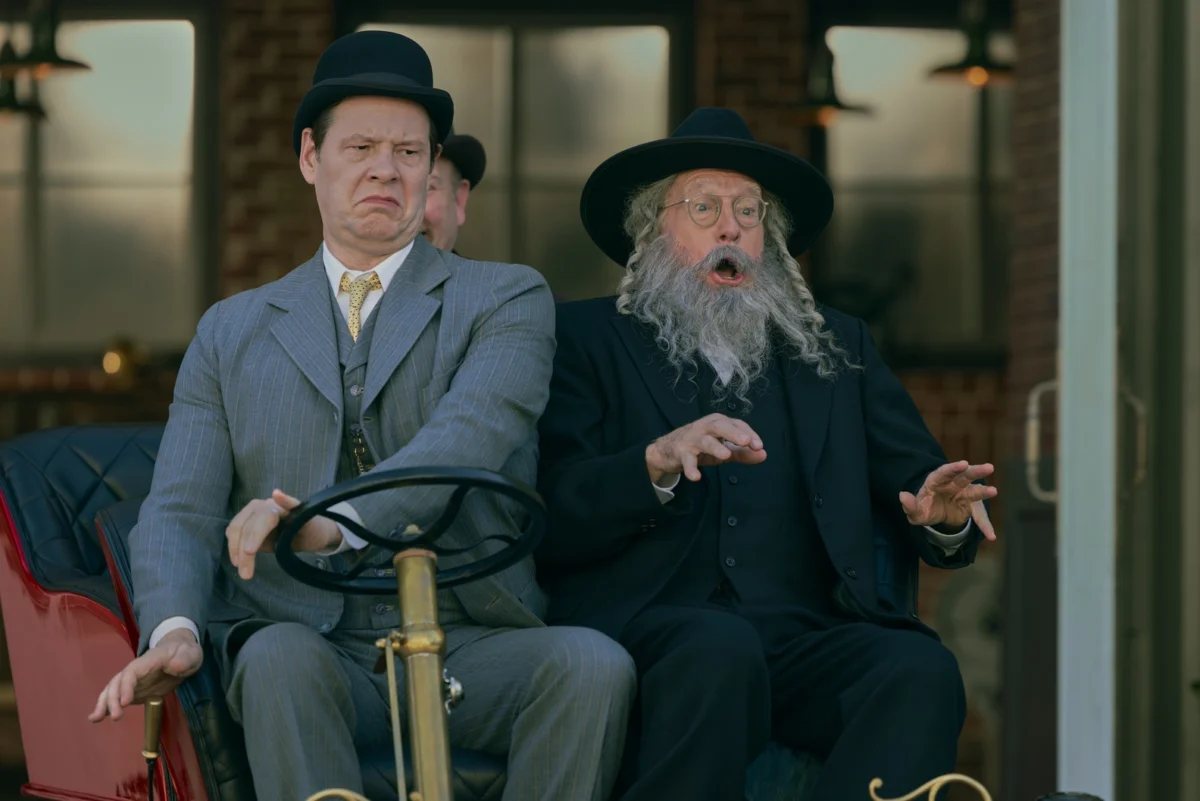
The episode then presents Ike Barinholtz as Henry Ford, who is less than pleased to be showcasing his automobile to David’s rabbi character. This sketch tackles historical figures with problematic legacies and frames them within David’s signature awkward social interactions. David also appears as President James Buchanan, navigating a social gathering and making advances on women, a scenario that underscores his ability to find discomfort in almost any social situation. Jordana Brewster and Katie Aselton are among the women who encounter Buchanan, with Diallo Riddle as his assistant.
The episode’s standout moment is a parody of the political discourse surrounding vaccines. David plays Dora Salk, the overly proud mother of Jonas Salk, bragging about her son’s polio vaccine discovery. The sketch directly references and satirizes contemporary vaccine skepticism, including a pointed jab at HHS Secretary Robert F. Kennedy Jr. (husband of David’s former co-star Cheryl Hines). The inclusion of a character named Bobby who expresses doubts about the vaccine’s safety mirrors modern debates and highlights David’s willingness to tackle sensitive, current issues through historical parables.
Episode 5: "Lincoln"
The penultimate episode focuses on two significant historical moments. The first sketch takes place at the O.K. Corral, featuring Timothy Olyphant as Wyatt Earp and Don Johnson as Doc Holliday. David’s character injects a dose of Curb-style logistical bickering into the planning of the infamous shootout, a classic example of the show’s technique of applying mundane concerns to dramatic historical events. Marc Menchaca, Johnno Wilson, and Maximo Salas round out the cast in this Western-themed segment.
The second and more substantial sketch examines the strained relationship between Abraham Lincoln and his wife, Mary Todd Lincoln. Bill Hader delivers a portrayal of a beleaguered Lincoln, who conspires with his chief of staff, played by Lawrence Butterfield, to remove Mary from Ford’s Theatre. The sketch culminates in a chaotic scenario during a performance of Our American Cousin, with Mary and Butterfield arguing over a stolen sweater, a moment that feels directly lifted from the playbook of Curb Your Enthusiasm. Kathryn Hahn plays Mary Todd Lincoln, and Lennon Parham appears as Laura Keene, the actress in the play. Jay Renshaw and Seth Morris portray John Wilkes Booth and Andrew Johnson, respectively, setting the stage for the historical assassination.
Broader Impact and Implications
Life, Larry and the Pursuit of Unhappiness represents a bold experiment in sketch comedy, using American history as a canvas for Larry David’s distinctive comedic voice. The series’ success lies in its ability to humanize historical figures by portraying them as flawed, relatable individuals grappling with familiar social anxieties and absurdities. By inserting David’s character into these pivotal moments, the show invites viewers to reconsider historical narratives through a lens of contemporary humor and skepticism.
The extensive casting of A-list celebrities not only elevates the production value but also broadens its appeal, drawing in fans of individual actors as well as devoted followers of Larry David. The series’ exploration of controversial or sensitive topics, such as the McCarthy hearings, the Electoral College, and vaccine skepticism, demonstrates a willingness to engage with complex societal issues, albeit through a comedic and often satirical framework.
The series’ impact extends beyond mere entertainment. It has the potential to spark renewed interest in American history, encouraging viewers to delve deeper into the actual events and figures depicted. By presenting these historical moments with a fresh, often irreverent, perspective, Life, Larry and the Pursuit of Unhappiness proves that even the most hallowed historical narratives can be re-examined and made relevant to a modern audience through the power of comedy. The show’s innovative approach, blending historical substance with comedic absurdity, solidifies its place as a significant and talked-about addition to the television landscape.

