
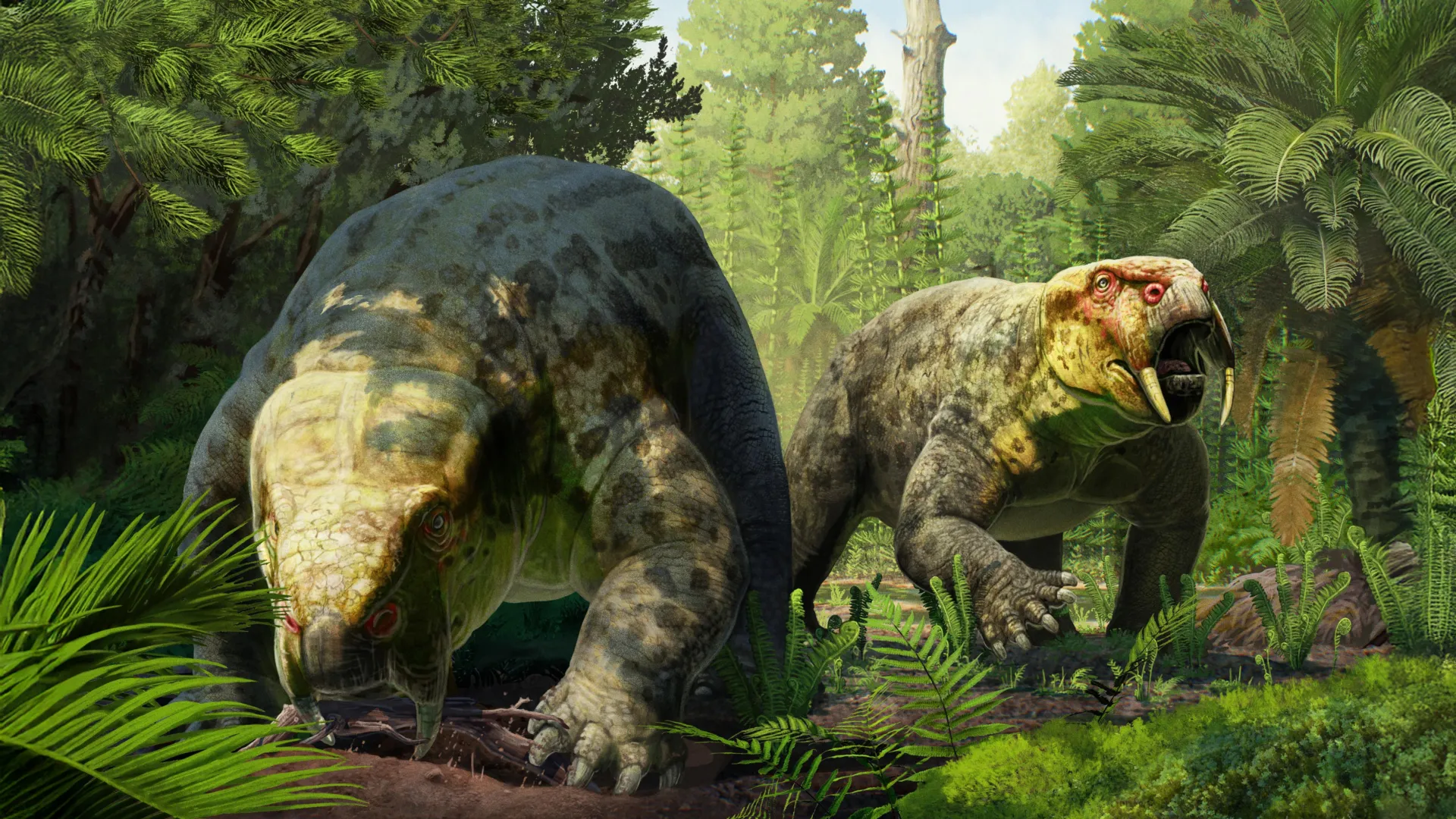
An international team of paleontologists has unveiled a breakthrough that ripples through the history of life on Earth, identifying a previously unknown species of prehistoric herbivore that roamed modern-day Tanzania approximately 240 million years ago. The creature, formally named Dinodontosaurus isiyavamanda, belongs to the dicynodont group—mammal-lineage synapsids that flourished during the Triassic period. This discovery, detailed in the September 15 issue of the Journal of Vertebrate Palaeontology, serves as more than just a new entry in the fossil record; it acts as a critical chronological marker that forces a significant reassessment of when and where the earliest dinosaurs emerged.
A Legacy Unearthed: The 1963 Expedition
The narrative of this discovery began over six decades ago. In 1963, a British expedition team ventured into the Tanzanian wilderness, excavating a vast repository of synapsid fossils. At the time, these creatures were the dominant terrestrial vertebrates, long before the rise of the dinosaurian empires. Upon their return, the specimens were deposited into the extensive archives of the Natural History Museum in London.
For the better part of sixty years, many of these fossils remained in a state of academic limbo. While some were categorized, others—including a remarkably preserved skeleton of a large dicynodont—were only partially examined. It was not until the modern era of collaborative, multi-disciplinary research that the true significance of these bones was realized. Researchers, led by Hady George of the University of Bristol, conducted a meticulous re-examination of the 1963 skeleton alongside a more recently recovered fragmentary skull. Their comparative anatomical analysis confirmed that both specimens belonged to the genus Dinodontosaurus, a discovery that was entirely unexpected given that the genus had previously only been documented in South America.
Anatomy and Naming: A Cultural and Scientific Link
The specific epithet, isiyavamanda, was chosen by the research team to honor the Wamanda people, the traditional inhabitants of the region where the fossils were unearthed. Anatomically, Dinodontosaurus isiyavamanda represents a distinct evolutionary branch of dicynodonts. These animals were bulky, tusked herbivores that played a vital role in the Triassic food web.
The anatomical comparison highlighted subtle but definitive differences from its South American counterparts, cementing its status as a new species. This geographic bridge between Africa and South America during the Triassic provides a rare window into the connectivity of the ancient supercontinent Pangea. The presence of identical or closely related genera across these vast distances confirms that these ecosystems were not as isolated as previously theorized, allowing for a more nuanced understanding of faunal distribution in the early Mesozoic Era.
Reframing the Triassic Timeline
The most profound implication of this finding involves the "Triassic Mystery." For years, paleontologists have scrutinized the Tanzanian rock strata, which were believed to contain some of the earliest dinosaur fossils in the world. Because these layers were traditionally correlated with South African deposits—which were thought to be older—the Tanzanian fossils were assumed to represent a very early stage of dinosaur evolution.
However, the identification of Dinodontosaurus isiyavamanda serves as a geological "anchor." Because this genus is now confirmed in both Tanzania and South American deposits, scientists can correlate these two distinct geographical regions with far greater precision. New radiometric dating techniques applied to South American volcanic ash layers suggest that these dinosaur-bearing sequences are approximately 10 million years younger than the previously assumed South African timeline.
By extension, this places the Tanzanian fossils into a younger window than once thought. This shift effectively "resets" the clock for the earliest appearance of dinosaurs, suggesting that the dawn of the dinosaur age was a more synchronized global event than a slow, staggered evolution occurring in isolation.
Perspectives from the Research Frontline
Hady George, the study’s lead author and a PhD student at the University of Bristol’s School of Earth Sciences, underscored the importance of this shift in perspective. "Our discovery marks the first confirmed record of the genus Dinodontosaurus outside South America," George stated. "By linking the Tanzanian and South American fossil-bearing rocks, we show they are of equivalent age. This helps confirm that the oldest dinosaur candidates from Tanzania are likely no older than those from South America, which refines the entire timeline of dinosaur origins."
The human element of this discovery is equally compelling. Nigel Larkin, a visiting research fellow at the University of Reading and a co-author of the paper, first encountered the skeleton during his Master’s thesis at University College London in 1994. Even then, he suspected it was a unique species.
"I judged it to be a species new to science, but it took me nearly 30 years to start the process of writing it up for publication," Larkin remarked. He noted that the delay, while lengthy, allowed for the application of modern technology that was unavailable in the 1990s. "Techniques have improved vastly—we can do so much more with micro-CT scanning to examine such specimens than we ever could have imagined. International collaboration is also much easier today. What is 30 years? It is the blink of an eye compared to the age of this specimen."
The Enduring Value of Museum Collections
The successful identification of Dinodontosaurus isiyavamanda serves as a powerful testament to the necessity of maintaining and revisiting museum archives. Dr. Mike Day, Curator of Non-Mammalian Tetrapods at the Natural History Museum in London, emphasized that this research validates the decades of curation performed by generations of scientists.
"This fossil specimen has been in our care for over 60 years," Dr. Day noted. "It is wonderful that its identity has now been brought to light. It goes to show how revisiting museum collections can change our understanding of the past just as much as finding new fossils in the field."
This sentiment is echoed by the broader scientific community, which increasingly views museum collections as "living" libraries. As scanning technology, isotope analysis, and DNA sequencing continue to evolve, fossils that were "finished" research projects in the 20th century are being re-opened, revealing new anatomical details and ecological context that were once invisible to the human eye.
Future Directions and Unresolved Questions
While the publication of Dinodontosaurus isiyavamanda is a landmark achievement, the researchers emphasize that the work is far from complete. A substantial portion of the Tanzanian remains, particularly the postcranial skeleton (the parts of the skeleton behind the skull), remains in storage or requires further cleaning and analysis.
The team has already outlined a roadmap for future investigation:
- Comparative Biomechanics: Researchers plan to utilize digital modeling to simulate how these dicynodonts moved and fed. This will offer insight into how large herbivores partitioned their environment, allowing them to coexist with other species in the crowded, competitive landscape of the Triassic.
- Ecological Modeling: By comparing the Tanzanian specimens with their South American counterparts, scientists hope to reconstruct the paleo-climate of the period, determining how these animals adapted to the specific humidity and vegetation of their respective environments.
- Phylogenetic Revision: The discovery will necessitate an update to existing cladograms—the branching diagrams that represent evolutionary relationships—to ensure that the position of early dinosaurs and their synapsid neighbors remains accurate within the updated 240-million-year-old timeline.
Ultimately, the discovery of Dinodontosaurus isiyavamanda is a reminder that the history of life is not a static text, but a dynamic field of study. Every fossil hidden in a dusty museum drawer has the potential to rewrite the chapters of prehistory, proving that in the field of paleontology, the past is never truly closed. As researchers continue to bridge the gaps between continents and eras, the story of how dinosaurs rose to dominate the planet becomes clearer, shedding light on a world that was as complex and interconnected as our own.

