
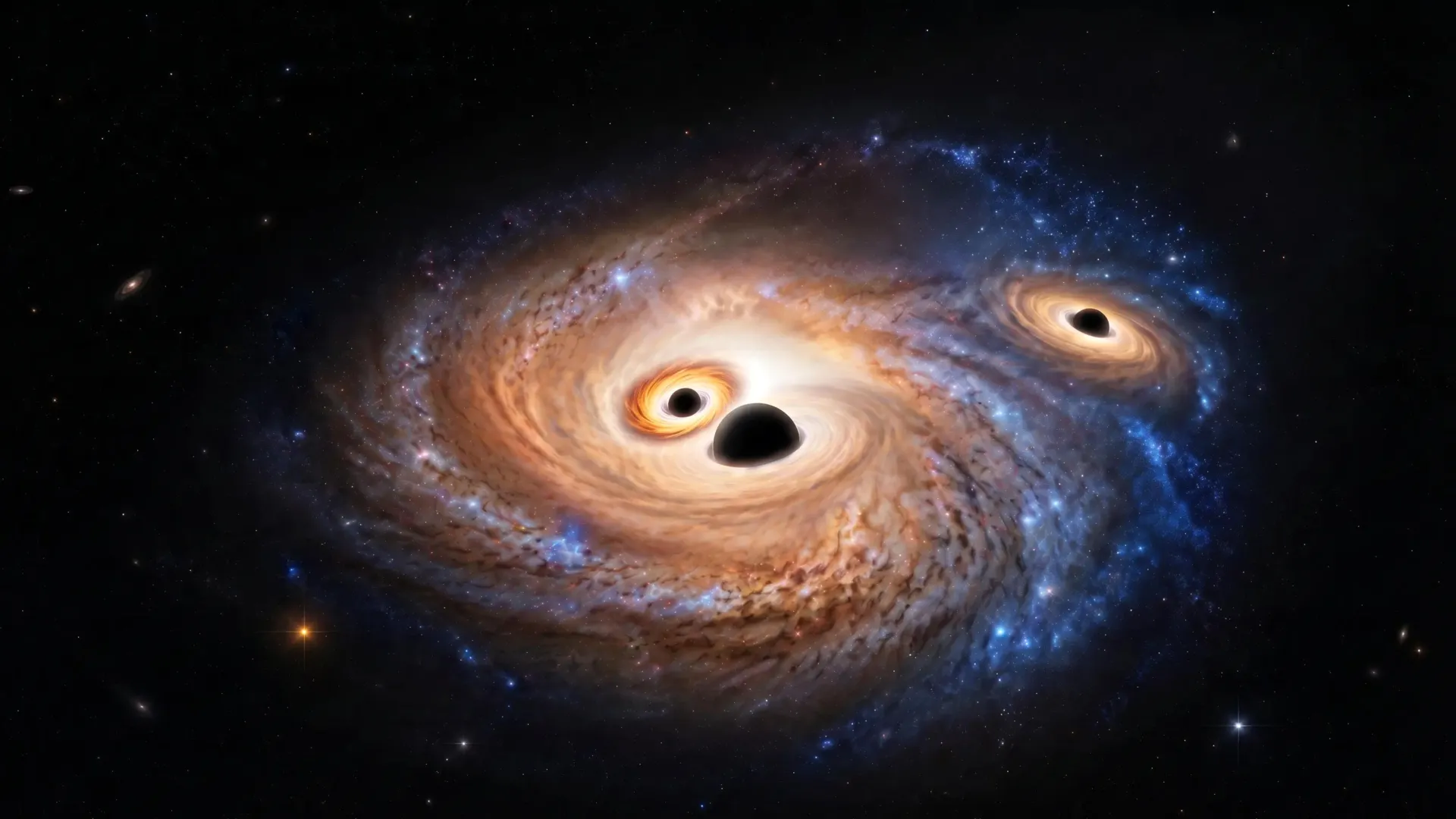
In a landmark achievement for observational cosmology, an international research team led by the Max Planck Institute for Extraterrestrial Physics (MPE) has identified three actively feeding supermassive black holes within a single galaxy, J0148-4214, located more than 12.5 billion light-years from Earth. This discovery, made possible by the unprecedented sensitivity of the James Webb Space Telescope (JWST), provides a rare, high-resolution look into the chaotic environment of the infant universe. By observing this galaxy as it existed just 1.2 billion years after the Big Bang, astronomers have gathered critical evidence regarding the mechanisms that allowed supermassive black holes to reach gargantuan sizes in such a remarkably short cosmic timeframe.
The Chronology of a Cosmic Collision
The history of J0148-4214 is a narrative of rapid assembly. At a redshift of z=5.02, the light currently reaching Earth was emitted when the universe was in its relative infancy. During this era, often referred to as the epoch of hierarchical structure formation, galaxies were frequently involved in high-velocity collisions and mergers. As these massive structures collided, the gravitational influence of their respective central black holes began to exert a profound effect on the surrounding gas and stellar populations.
The research team, utilizing the Near Infrared Spectrograph (NIRSpec) on the JWST, discovered that J0148-4214 contains a complex, multi-component engine. Two of the black holes are situated in the core of the galaxy, separated by a projected distance of merely 620 light-years. A third, distinct black hole is located approximately 5,500 light-years from the center. The spatial arrangement of these objects suggests that J0148-4214 is the result of a recent or ongoing merger of smaller galaxies, each of which brought its own central black hole into the new, combined system.
Spectroscopic Evidence and Detection Methodology
Identifying three distinct black holes in a single, distant, and compact galaxy presents an immense technical challenge. Because these objects are so far away, they appear as a single point of light to even the most powerful traditional telescopes. To overcome this, the researchers employed a technique known as integral field spectroscopy. By capturing a spectrum of light at every pixel in the field of view, the NIRSpec-IFS instrument allowed the scientists to map the kinematics of hydrogen gas across the entire galaxy.
Near a feeding black hole, gas is pulled into an accretion disk and accelerated to relativistic speeds. This process creates broad emission lines in the light spectrum—distinctive signatures that reveal the presence of active galactic nuclei (AGN). When the team analyzed the core of J0148-4214, they observed a "complicated" emission pattern that could not be explained by the presence of a single, uniform source. By applying spectro-astrometry, the team tracked subtle shifts in the centroids of these spectral lines, effectively "deconvolving" the light to reveal two separate, closely orbiting black holes in the center and a third outlier.
Disparity in Mass and Accretion Rates
The three black holes within J0148-4214 display remarkable diversity in their physical characteristics. The largest of the trio possesses a mass approximately 80 million times that of the Sun. The second central black hole is estimated at 2 million solar masses, while the outlier holds a mass of roughly 600,000 solar masses.
Perhaps most surprising to the research team was the disparity in feeding rates. The 600,000-solar-mass black hole is currently accumulating matter at a rate that exceeds the theoretical Eddington limit—the point at which the outward pressure of radiation from the accretion disk should theoretically halt the inward pull of gravity. This "super-Eddington" accretion suggests that black holes in the early universe possessed mechanisms for growth that were far more efficient than those observed in the local, modern universe. This finding serves as a potential solution to the "too big, too soon" problem, which has long puzzled astrophysicists who struggle to explain how black holes grew to billions of solar masses so quickly after the Big Bang.
Scientific Perspectives on the Findings
Dr. Hannah Übler, the lead author of the study and a research group leader at MPE, emphasizes the significance of the discovery for future gravitational wave research. "This is the first evidence of three active black holes in a single galaxy in the distant universe," she noted. "It suggests that processes in the early universe were efficient at bringing massive black holes together, setting the stage for the massive black hole mergers we expect to detect with future gravitational wave observatories."
Dr. Giovanni Mazzolari, a researcher at MPE and second author of the paper, highlighted the role of the JWST in providing the necessary data to quantify the system. "The JWST data allowed us not only to identify the three black holes, but also to estimate their masses, accretion rates, and the stellar mass of the galaxy," Mazzolari said. "We find a total stellar mass of about 1.3 billion suns, and the black holes represent a significant fraction of that."
Professor Roberto Maiolino of the University of Cambridge, a co-author of the study, added, "These results are extremely exciting. They suggest that black hole merging may be an additional, fast route for their rapid growth in the early universe."
Implications for Cosmological Models
The discovery of the third black hole, located far from the galactic center, raises intriguing questions regarding the dynamics of galaxy mergers. One leading hypothesis is that this black hole is the result of a "gravitational recoil." During a previous merger of two smaller black holes, the emission of gravitational waves could have been asymmetric, creating a kick that propelled the resulting black hole away from the center of the newly formed galaxy. Alternatively, the object could be a satellite black hole gradually spiraling toward the center to eventually join the primary pair.
The imminent merger of the two central black holes, expected within a few hundred million years, provides a window into the evolution of massive structures. As these giants collide, they will release immense amounts of energy and potentially serve as a template for the mergers that populated the early universe with supermassive black holes.
Conclusion: A New Frontier in Astronomy
The discovery at J0148-4214 is more than just a unique cosmic occurrence; it is a proof-of-concept for the capabilities of the James Webb Space Telescope. By demonstrating that distant, compact galaxies can hide multiple, interacting black holes, the research team has opened a new avenue for studying the hierarchical assembly of the cosmos.
Prior to this study, many researchers assumed that distant AGN were solitary, monolithic structures. The realization that these systems are often composed of multiple, rapidly growing black holes forces a re-evaluation of current cosmological simulations. Future surveys using NIRSpec and other high-resolution instruments are likely to reveal more of these hidden, multi-black-hole systems, providing a more granular understanding of the chaotic and rapid development that defined the first few billion years of our universe. As the field looks toward future gravitational wave detectors like LISA (Laser Interferometer Space Antenna), the identification of these merging systems in the early universe serves as a crucial foundation for predicting the types of events that shaped the modern celestial landscape.

