
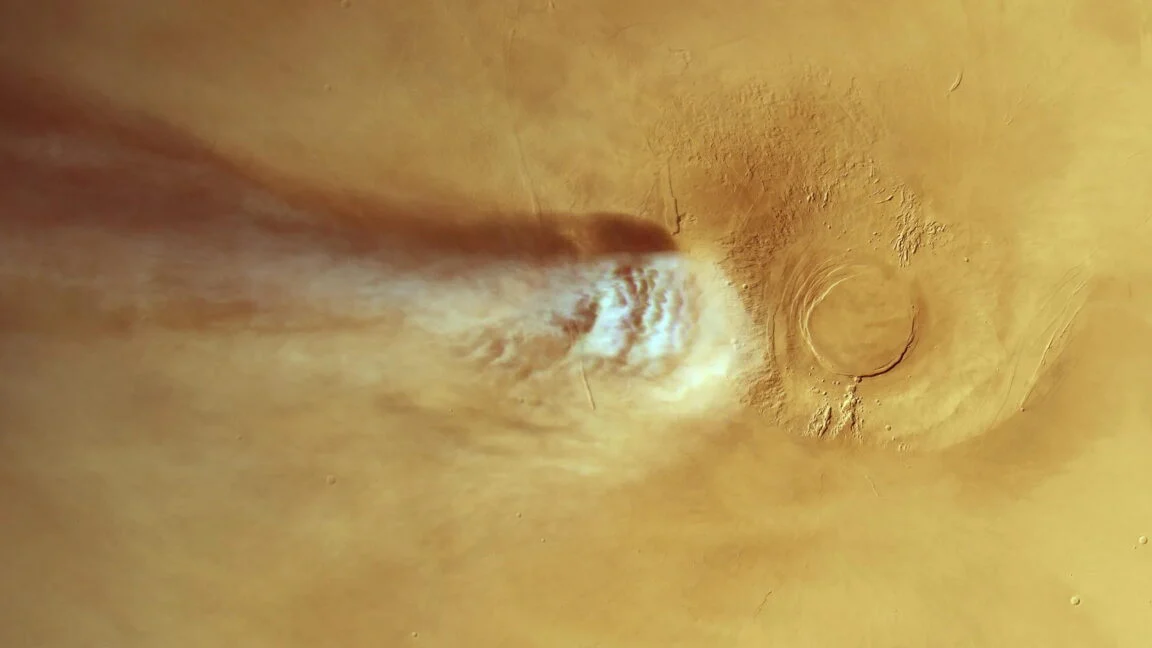
The Red Planet continues to challenge our fundamental understanding of atmospheric physics, offering up phenomena that defy earthly rules and push the boundaries of meteorological science. Recent findings published in the journal Nature Geoscience have cast new light on one of the most enigmatic meteorological occurrences in the solar system: the Arsia Mons Elongated Cloud (AMEC). Stretching an astonishing 1,800 kilometers (approximately 1,120 miles) across the Martian landscape, this colossal cloud has long puzzled astronomers and planetary scientists. Now, new atmospheric modeling suggests that the AMEC forms through a bizarre, exotic physical process never before observed in nature—a mechanism that requires atmospheric conditions so extreme they render Earth’s most severe weather look tame by comparison.
The discovery forces a fundamental reassessment of how water vapor can behave under alien skies. On Earth, cloud formation is a collaborative effort between moisture and microscopic atmospheric debris. Water vapor requires a solid foundation—tiny airborne particles known as cloud condensation nuclei, such as dust, sea salt, pollution, or soot—to gather upon before it can condense into liquid droplets or freeze into ice crystals. Without these impurities, moisture simply remains suspended in the air as vapor, unable to initiate the phase change necessary to form visible clouds.
However, the new study indicates that the Martian giant ignores this universal rule entirely. Instead of relying on dust or other aerosols to seed its formation, the AMEC appears to materialize through a process called homogeneous nucleation. During this rare thermodynamic event, water vapor transforms directly and spontaneously into ice crystals entirely on its own, completely bypassing the need for foreign debris or condensation nuclei.
To visualize this extraordinary event, planetary scientists often use terrestrial analogies, though none exist natively on our planet. As lead researcher and planetary scientist Jorge Hernández-Bernal vividly explains, the process is akin to microscopic droplets of condensation suddenly and spontaneously appearing suspended in the exact middle of an empty room, rather than forming on a cold windowpane or dust particle. It is a phenomenon that is, by all traditional standards of atmospheric science, wholly unexpected.
Extreme Conditions and the Anatomy of a Martian Giant
Unlocking the secret of how the AMEC forms required researchers to reverse-engineer an exceptionally violent set of meteorological circumstances. Homogeneous nucleation is not a gentle process; it demands a hyper-specific, highly volatile environment to force water molecules to coalesce without any external structural assistance.
According to the published modeling, the phenomenon is triggered by a sudden, drastic thermal collapse. The localized atmosphere experiences a temperature plummet of 30 degrees Celsius (54 degrees Fahrenheit) within a compressed window of just 10 minutes. Coupled with an astronomical surge in relative humidity, this thermal shock forces the atmosphere past its saturation tipping point instantaneously.
The architectural centerpiece of this bizarre meteorological engine is Arsia Mons, a colossal shield volcano that towers roughly 65,000 feet (nearly 20 kilometers) above the Martian surface. To put its sheer scale into perspective, Arsia Mons is more than twice the height of Mount Everest, placing its peak well into the thin upper reaches of the Martian troposphere.
The volcano acts as a monumental topographic speedbump in the path of planetary wind currents. When prevailing winds collide with the sheer wall of the 65,000-foot-tall volcanic peak, they are abruptly deflected upward. This forced vertical displacement generates a powerful atmospheric wave, thrusting warm, moist air parcels high into the frigid upper layers of the atmosphere in a matter of minutes. As the moist air ascends, it undergoes adiabatic cooling, resulting in the rapid, massive temperature drop required to ignite homogeneous nucleation.
A Brief Chronology of the Arsia Mons Elongated Cloud
The journey toward understanding the AMEC has spanned decades of persistent observation, punctuated by sudden technological leaps in space exploration and atmospheric modeling.
The recurring nature of the cloud has been documented by robotic emissaries orbiting Mars for years. Because of its massive size, the AMEC is easily spotted from space, appearing as a bright, elongated plume stretching away from the summit of Arsia Mons. Historically, it recurs with predictable seasonality, forming every Martian year during the planet’s southern hemisphere solstice. For weeks at a time, the cloud materializes in the early morning hours, rapidly expanding to hundreds of kilometers in length before vanishing by mid-morning as solar heating intensifies and evaporates the ice crystals.
Despite repeated observations by orbiters such as the European Space Agency’s Mars Express and NASA’s Mars Reconnaissance Orbiter, the exact thermodynamic mechanics behind the cloud remained elusive. Traditional models assumed the cloud was a standard orographic cloud—similar to the stationary lenticular clouds that form over mountain peaks on Earth—relying on standard heterogeneous nucleation driven by background Martian dust.
The breakthrough came when an international team of researchers applied advanced high-resolution numerical modeling to simulate the microphysics of the upper Martian atmosphere. By inputting telemetry data regarding wind speeds, topography, and vapor content, the team successfully reproduced the formation of the AMEC in stunning detail. The resulting simulations not only matched the physical dimensions and timing of the cloud observed from orbit but also revealed the radical thermodynamic pathway of homogeneous nucleation underpinning its existence.
Unprecedented Atmospheric Extremes
The revelation that the Arsia Mons Elongated Cloud forms through homogeneous nucleation carries profound implications for comparative planetology. Scientists have long theorized that this exotic form of cloud genesis could theoretically occur in the upper atmospheres of other terrestrial worlds, including Venus and even Earth. However, until now, it had never been directly observed or successfully modeled in a planetary environment.
The primary barrier to observing homogeneous nucleation on Earth is the staggering threshold of humidity it demands. To force water vapor to nucleate homogeneously without condensation nuclei, the surrounding air must reach a state of supersaturation that is more than 100,000 times greater than any humidity value ever measured in Earth’s atmosphere. Even within the most violent storm systems, hurricanes, or stratospheric polar clouds on our planet, such extreme moisture concentrations are physically unattainable.
Before these recent models were calculated and verified, planetary scientists did not know that such extraordinary humidity levels could exist on Mars either. The Red Planet is, after all, famously arid, with an average global water content so low that if all its vapor were condensed onto the surface, it would form a global layer just a few micrometers thick. Finding localized pockets capable of sustaining moisture concentrations tens of thousands of times higher than Earth’s maximum records fundamentally challenges existing assumptions about the Martian hydrological cycle.
Scientific Perspectives and the Knowledge Gap
The success of the new atmospheric models highlights both the ingenuity of modern planetary science and the vast gaps that still remain in our understanding of neighboring worlds.
"We don’t have nearly as much information about Mars’ atmosphere as we do about Earth’s, so reproducing the AMEC to this degree is a big success," Hernández-Bernal noted, emphasizing the complexity of decoding an alien climate with limited physical sampling stations. "The result is remarkable."
Unlike Earth, which boasts a dense, interconnected network of weather balloons, oceanic buoys, meteorological towers, and continuous satellite monitoring, Mars has only a handful of active orbiters and stationary surface rovers taking localized measurements. Consequently, planetary meteorologists must rely heavily on deductive reasoning, laboratory simulations, and mathematical modeling to fill in the missing pieces of the puzzle.
The ability of the new models to accurately simulate the birth of the AMEC validates the theoretical frameworks used to study planetary climates across the solar system. By successfully accounting for the extreme humidity and rapid thermal drops required for homogeneous nucleation, researchers have demonstrated that our current understanding of phase transitions in fluid dynamics is robust, even when applied to extreme alien environments.
Broader Impact and Implications for Astrobiology and Exploration
While a migrating cloud of ice crystals hovering over a dormant volcano may seem like a purely academic curiosity, the findings carry significant weight for the broader fields of planetary science, climate evolution, and future human exploration.
Understanding the behavior of water vapor in the Martian atmosphere is critical for mapping the planet’s current water cycle and reconstructing its climatic history. Water is the central protagonist in the search for past or present life on Mars. Knowing how moisture is transported, concentrated, and phase-changed at high altitudes helps scientists trace the movement of subsurface and atmospheric reservoirs over geological timescales.
Furthermore, as space agencies and private aerospace ventures look toward crewed missions to Mars, localized weather prediction will become a matter of mission safety. While the AMEC forms high in the upper atmosphere and poses no direct threat to surface operations, the extreme meteorological dynamics that create it—rapid temperature swings, high-altitude wind shears, and localized humidity spikes—are part of the broader, volatile Martian weather system. Mastering the physics of atmospheric phenomena on Mars ensures that future explorers will be better equipped to anticipate and adapt to the unpredictable temperament of the Red Planet’s skies.
As researchers continue to analyze data from missions like Mars Express and prepare for the next generation of deep-space observation tools, the 1,800-kilometer cloud of Arsia Mons stands as a monument to the unexpected complexity of the cosmos. It serves as a humbling reminder that even after decades of intense study, our solar system remains fully capable of surprising us with physics that transcend our terrestrial experience.

