
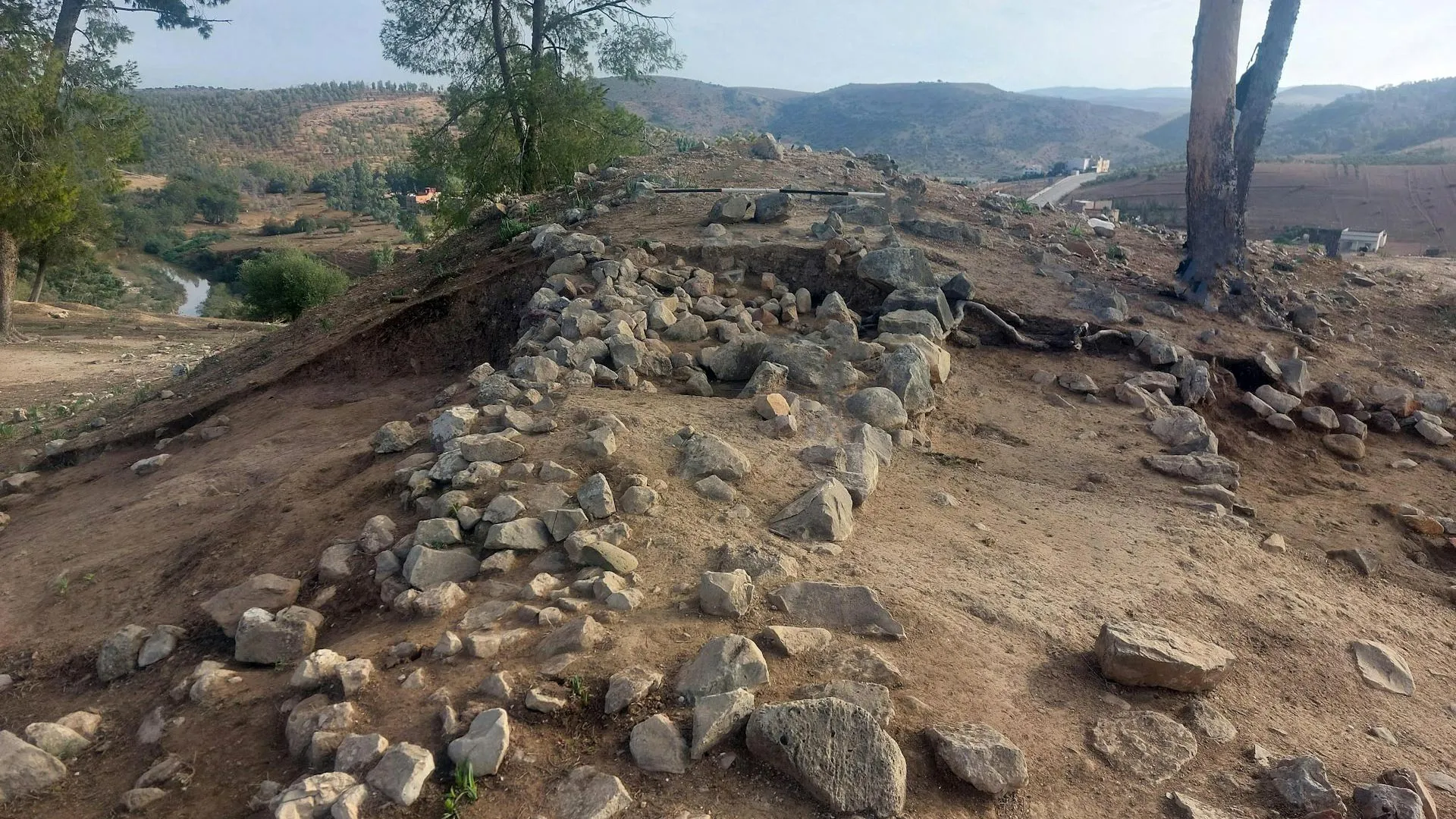
Deep within the rugged hills of north-west Morocco, overlooking the winding path of the Oued Beht river, a transformative archaeological discovery is rewriting the history of human civilization in the Maghreb. Recent excavations at the Oued Beht site have unveiled a complex, multi-layered past, providing the first definitive evidence of large-scale defensive architecture in North Africa outside of the Nile Valley. This finding not only challenges long-standing assumptions about the region’s prehistoric isolation but also demonstrates that North African societies were active, structural participants in the broader socio-economic currents of the Mediterranean basin during the second millennium BC.
The Oued Beht Archaeological Project, a collaborative international endeavor, has been systematically uncovering evidence that pushes back the timeline for organized human settlement and sophisticated engineering in Morocco. While previous reports identified the site as a massive agricultural complex dating back 5,000 to 5,400 years, the 2023 field season has provided a more granular look at the site’s evolution. Researchers have now confirmed that the southern ridge of the settlement was fortified between 4,000 and 3,500 years ago, marking a pivotal shift in the strategic organization of regional communities.
A Chronology of Human Persistence
The history of Oued Beht is not one of a single, static epoch, but rather a testament to the enduring appeal of the landscape. The chronology of the site can be divided into three distinct phases of intensive human activity:
- The Final Neolithic (c. 3500–2900 BC): During this foundational period, the site emerged as a major agricultural hub. Environmental analysis of soil samples has confirmed the cultivation of wheat and barley, supported by livestock management and the gathering of wild resources. The presence of thousands of polished stone axes and ornate, painted pottery suggests a society with a robust craft-production sector.
- The Bronze Age Transition (c. 2000–1500 BC): This era witnessed a significant reorganization of the settlement. The construction of a sophisticated ditch-and-rampart defensive system indicates that the community transitioned from an open agrarian village to a strategically protected center.
- The Medieval Period (11th–13th Century AD): Centuries after its prehistoric abandonment, the ridge was reclaimed. The medieval inhabitants repurposed the defensive topography of the site, rebuilding fortifications and establishing a hamlet, while creating a formal burial ground between the residential and defensive zones.
The Engineering of Defense
The structural discovery at Oued Beht—a "barred spur" or éperon barré—confirms that the inhabitants possessed advanced knowledge of defensive engineering. By constructing a series of walls, ditches, and ramparts across the narrowest section of the ridge, the builders effectively isolated the southern tip of the plateau, turning a natural feature into a formidable defensive perimeter.
Archaeologists note that such construction projects required more than just labor; they necessitated a high degree of social coordination, planning, and centralized authority. While the identity of the potential "adversaries" remains a matter of scholarly debate, the architecture itself speaks to a climate of heightened regional competition. Experts suggest that the wall was likely built to regulate access to resources, manage trade routes, or protect the settlement’s accumulated wealth during a period of significant demographic and social flux in the western Mediterranean.
Comparative Archaeology and Mediterranean Connections
For decades, the prehistory of the Maghreb was viewed through the lens of fragmentation, often compared unfavorably to the more "documented" histories of the Iberian Peninsula or the Aegean. However, the Oued Beht findings bridge this gap. The second millennium BC was a period of intense dynamism across the Mediterranean. In southern Iberia, the Argaric culture (c. 2200–1550 BC) was establishing its own model of fortified, hierarchical society.
The similarity in the trajectory of development between North Africa and the Iberian Peninsula suggests that the Strait of Gibraltar was not a barrier, but a conduit. The presence of sophisticated, planned settlements in Morocco mirrors the societal changes occurring in Europe. This implies that the Maghreb was deeply integrated into the Mediterranean network, participating in the exchange of goods, technologies, and social structures. The defensive fortifications at Oued Beht are not isolated curiosities; they are, rather, a reflection of the same pressures that drove civilizations across the Mediterranean to fortify their centers of power.

Implications for North African Historiography
The implications of these findings are profound for the field of archaeology. By demonstrating that North African societies were capable of large-scale, organized construction projects, the Oued Beht project disrupts the narrative that complex social organization in the region was imported from external influences. Instead, it suggests a local, organic development of state-like functions, resource management, and social stratification.
Dr. Youssef El-Khatib, a lead researcher involved in the study, noted that the site serves as a "missing link" in the history of rural North African communities. "We have long lacked the evidence to adequately describe how these societies transitioned from farming to more complex, defensive-oriented structures," he stated. "Oued Beht provides the empirical data required to move past speculative theories and into a more robust understanding of indigenous North African social evolution."
Furthermore, the site’s multi-period nature serves as a reminder of the continuity of human history in the Maghreb. The fact that the site remained a point of interest for nearly 4,000 years suggests that the geographical advantages of the ridge were well-understood by successive generations. This continuity provides a unique lens through which to study how rural populations adapted to changing political landscapes, from the Neolithic period through the medieval era.
Data-Driven Insights
Recent excavations have yielded a wealth of material evidence that supports these conclusions. Beyond the architectural remains, the team has recovered:
- Faunal and Botanical Remains: Isotopic analysis of remains confirms a diet reliant on stable agricultural output, coupled with hunting and gathering practices that persisted well into the early periods of the site’s occupation.
- Lithic and Ceramic Assemblages: The sheer volume of polished stone tools indicates that Oued Beht functioned as a regional production hub, likely supplying surrounding communities with essential farming implements.
- Radiocarbon Dating: Using high-precision mass spectrometry on charcoal deposits associated with the defensive wall, researchers have achieved a high-confidence timeline that places the construction of the ramparts firmly within the transition between the Neolithic and the regional Bronze Age, effectively dating the structures to between 4,000 and 3,500 years ago.
Future Research and Preservation
As the Oued Beht Archaeological Project continues, the focus is shifting toward the preservation of these fragile structures and the expansion of the excavation area. The Moroccan government, in collaboration with international academic institutions, has moved to secure the site, recognizing its potential as a primary source for understanding the deep history of the Maghreb.
The discovery has also sparked a call for a broader re-evaluation of archaeological surveys in North Africa. Many sites previously ignored due to a lack of monumental surface architecture may now require a second look. If Oued Beht is any indication, the landscape of Morocco is likely hiding a vast network of prehistoric settlements that, when mapped, will provide a comprehensive narrative of the development of the region’s earliest complex societies.
In conclusion, the work at Oued Beht is not merely an exercise in cataloging the past; it is a fundamental reconfiguration of our knowledge regarding North African history. By moving the focus away from the Nile Valley and acknowledging the ingenuity of the communities in the Maghreb, researchers are effectively restoring the region to its rightful place as a central, vital player in the story of human development. The defensive walls of Oued Beht stand as a silent testament to a people who, thousands of years ago, were as concerned with the security and prosperity of their home as any of their Mediterranean contemporaries, marking the site as a cornerstone of global archaeological heritage.

