
Among the tapestry of extinct human species that once roamed Earth, the Neanderthals stand out as perhaps the most recognizable. Their relatively recent existence and their striking similarities to modern humans have long captivated scientific and public imagination. Recent discoveries continue to flesh out our understanding of their lives, revealing evidence of sophisticated behaviors such as the medicinal use of antibiotic-rich birch bark tar, the creation of ochre-based art, and sophisticated hunting techniques involving large game like elephants. Contrary to earlier assumptions, their robust nasal structures may not have been an adaptation to frigid climates, and intriguing evidence suggests they even navigated significant bodies of water. Yet, despite this growing wealth of knowledge about their daily lives and capabilities, the origins of the Neanderthals remain one of the most profound and persistent enigmas in human evolutionary science. The precise lineage and ancestral connections of this distinct hominin group are subjects of intense debate and ongoing research, with existing hypotheses often presenting more questions than answers.
A Tangled Evolutionary History
For decades, the prevailing scientific narrative posited a linear progression from earlier hominin species to the Neanderthals, who then eventually gave way to Homo sapiens. This model, however, has been significantly challenged by advances in genetic sequencing and the discovery of new fossil evidence. The traditional view often placed Homo erectus as a direct ancestor, with migrations out of Africa leading to the development of distinct regional populations. However, the lack of definitive Homo erectus fossils in key European locales, where early Neanderthal ancestors are believed to have emerged, has created a significant gap in this evolutionary chain.
The earliest concrete evidence of Neanderthal-like fossils originates from the Sima de los Huesos (Cave of the Bones) site in northern Spain, with remains dating back approximately 430,000 years. While these fossils exhibit many Neanderthal characteristics, they also possess traits that differentiate them from later, classic Neanderthals, leading some researchers to classify them as either ancestors or very close relatives. However, a groundbreaking genetic analysis in 2016 of DNA extracted from these ancient remains revealed a remarkably strong Neanderthal signature, firmly linking them to the Neanderthal lineage. This discovery suggests that the Neanderthal lineage was already well-established by this period, and likely existed for tens, if not hundreds, of thousands of years prior.
Neanderthals persisted through significant environmental shifts, including numerous glacial periods, until their eventual disappearance around 40,000 years ago. The archaeological and genetic record paints a complex picture of their decline. Evidence suggests that a severe climatic cooling event towards the end of their existence may have forced them into refugia in southern France, leading to a drastic reduction in their genetic diversity. The last definitively identified Neanderthal populations are believed to have inhabited the southern regions of Europe, primarily in what is now Spain.

Unraveling the Ancestral Puzzle: Denisovans and the Mysterious "Ancestor X"
To trace the Neanderthals’ lineage further back, researchers have focused on their relationship with other contemporary hominin groups, most notably the Denisovans. These enigmatic hominins occupied East Asia during a similar timeframe as the Neanderthals. Genetic studies indicate a close relationship between Neanderthals and Denisovans, suggesting they evolved from a common, as yet unidentified, ancestor, sometimes referred to as "Neandersovans."
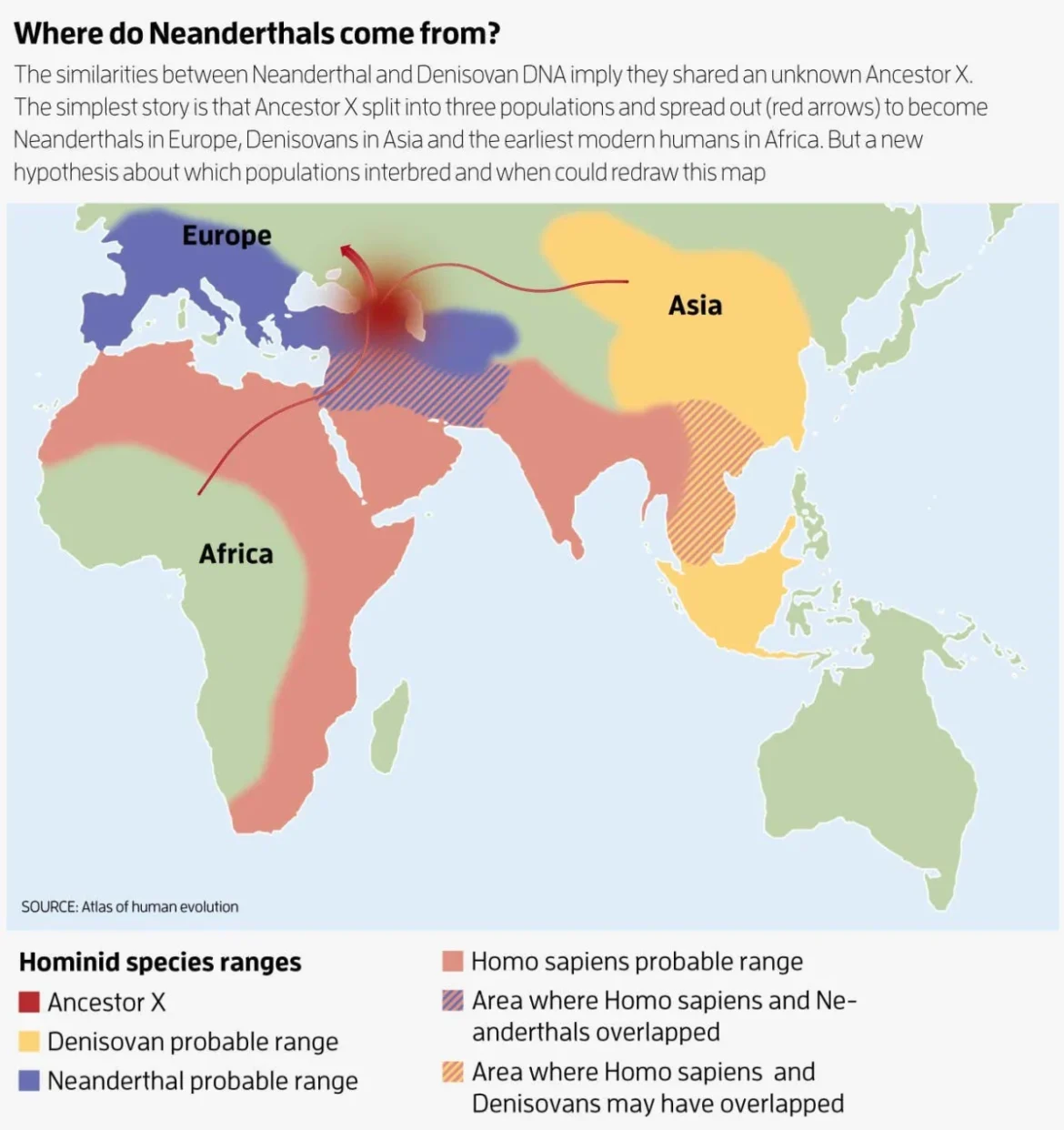
Crucially, genetic analyses show that Neanderthal DNA is more similar to Denisovan DNA than to that of modern humans. This implies the existence of an even more ancient, common ancestor, provisionally termed "Ancestor X." The prevailing genetic model suggests that this mystery population, Ancestor X, diverged, with one branch giving rise to the ancestors of modern humans and another leading to the Neandersovans, from which both Neanderthals and Denisovans ultimately evolved.
However, this genetic narrative presents a significant challenge for paleontologists. If this model is accurate, the fossil record should ideally reveal evidence of both Neandersovans and Ancestor X. To date, neither of these distinct hominin groups has been definitively identified in the fossil record. This absence raises critical questions: have these remains simply eluded discovery, or could the genetic interpretations, while powerful, be misleading in some crucial aspects?
Candidate Ancestors: A Fossil Record of Ambiguity
The search for Neanderthal ancestors hinges on examining the fossil evidence from hominins that lived outside Africa and predate the earliest known Neanderthal remains. Several candidates have been proposed, each with its own set of supporting and conflicting evidence.
Homo erectus: The Pioneer Explorer
Homo erectus holds the distinction of being the first hominin species to venture beyond Africa, appearing in East Africa as early as 2 million years ago. By approximately 1.8 million years ago, they had reached the Caucasus region, at the crossroads of Europe and Asia, and subsequently spread eastward, with fossil evidence found as far afield as Java, Indonesia. Based purely on this migratory timeline, H. erectus appears to be a logical candidate for the ancestor of European hominins, including the Neanderthals.

However, a significant hurdle exists: despite extensive archaeological efforts, no definitive H. erectus fossils have been discovered in Europe. The closest find to date consists of fragmentary facial bones—part of the cheek and upper jaw—unearthed in a Spanish cave and dated to between 1.1 million and 1.4 million years ago. These remains, classified as Homo aff. erectus ("Homo similar to erectus"), are too incomplete for definitive identification, leaving a substantial temporal and geographical gap between this tentative European presence and the earliest known Neanderthals. This ambiguity means that while H. erectus might be a distant progenitor, a firm ancestral link remains elusive.
Homo antecessor: A Promising but Unproven Contender
Homo antecessor, discovered in northern Spain, presents a more geographically aligned candidate. The dating of its remains has been subject to revision, with the most recent estimates placing it between 772,000 and 949,000 years ago. In a significant development in 2020, researchers successfully extracted proteins from an H. antecessor tooth, revealing a close molecular relationship to the elusive "Ancestor X." This finding strengthens the chronological fit and provides molecular evidence supporting its potential role.
However, H. antecessor is currently known only from the Gran Dolina cave site. While remains from at least six individuals have been recovered, the limited geographic distribution and unknown longevity of the species make it difficult to ascertain its widespread influence. Therefore, H. antecessor remains a promising but unproven link in the Neanderthal evolutionary story.
Homo heidelbergensis: A Fading Candidate
For a considerable period, Homo heidelbergensis was considered the leading candidate for Ancestor X. Fossils attributed to this species, found in both Europe and Africa and dating between 300,000 and 500,000 years ago, exhibited cranial similarities to both Neanderthals and modern humans. However, subsequent re-evaluations have led to the reassignment of many fossils originally classified as H. heidelbergensis to other species. The remaining specimens are now predominantly from Europe, and crucially, appear to be too recent to represent the ancient Ancestor X hypothesized by geneticists. This reassessment has significantly diminished the plausibility of H. heidelbergensis as a direct ancestor.
The primary challenge in definitively linking these candidate species to Neanderthals lies in the lack of preserved DNA. Fossils of H. erectus, H. heidelbergensis, and H. antecessor are either too ancient or were discovered in environments (hot and humid tropical regions) where genetic material would have degraded over time. This absence of ancient DNA prevents direct genetic comparison and leaves researchers reliant on morphological interpretations of often fragmentary remains, making it difficult to establish confident evolutionary relationships.

Rethinking Migration and Interbreeding: A New Paradigm
The current divergence between genetic and archaeological interpretations of Neanderthal origins highlights the need for a more nuanced understanding of hominin movements and interactions. Genetic evidence suggests a split between the lineage leading to modern humans and the Neandersovans (ancestors of Neanderthals and Denisovans) occurring between 500,000 and 700,000 years ago, thus defining a timeframe for Ancestor X.
The geographical distribution of early hominin populations – Neanderthals in Europe, Denisovans in East Asia, and early Homo sapiens in Africa – suggests a potential scenario where a widespread ancestral population diverged and migrated in different directions. The most parsimonious explanation would point to a common origin in Western Asia, encompassing regions like the Levant, the Middle East, the Caucasus, or Ukraine. This is a deliberately broad designation, acknowledging the imprecision of current data.
Recent archaeological discoveries offer potential support for earlier timelines for Ancestor X. A skull from Yunxian, China, identified as an early Denisovan, dates back an astonishing 940,000 to 1.1 million years ago, potentially pushing back the existence of Ancestor X and reintroducing H. erectus into discussions. Similarly, hominin remains from the Grotte des Hominidés in Morocco, dated to approximately 773,000 years ago, exhibit features consistent with Ancestor X. While Morocco is not in Western Asia, its location in North Africa is geographically proximate to the hypothesized origin region.
The Hybrid Hypothesis: A Radical Reinterpretation
Adding another layer of complexity, and a potentially revolutionary perspective, is the peculiar genetic legacy observed in the interbreeding between Neanderthals and modern humans. While interbreeding events are known to have occurred between 50,000 and 43,000 years ago across Europe and West Asia, earlier instances are also evident. Modern humans of non-African descent carry Neanderthal DNA, and ancient Neanderthal genomes show traces of modern human DNA. Strikingly, Neanderthal X chromosomes appear to have been largely replaced by modern human variants, and their original Y chromosomes and mitochondrial DNA were replaced by those of Homo sapiens.
This phenomenon has led to a radical new hypothesis proposed by geneticist David Reich of Harvard University. In a pre-print paper released in March 2026, Reich posited that the origin of Neanderthals might lie not in a separate evolutionary branch, but in an early migration of modern humans out of Africa. He suggests that between 400,000 and 250,000 years ago, early Homo sapiens ventured into Europe and interbred with the then-unidentified local hominin populations. The resulting hybrids, according to this hypothesis, largely lost their modern human DNA but retained their modern human Y chromosomes and mitochondrial DNA. These hybrids, in this striking reinterpretation, would constitute the Neanderthals.

This scenario offers a compelling explanation for the presence of distinctive Levallois tools in both Africa (used by modern humans from at least 400,000 years ago) and in Europe and the Middle East (used by Neanderthals between 480,000 and 300,000 years ago). While independent invention is possible, it is more elegant to suggest that modern humans introduced these tools to Europe during their early migrations.
The timing of Reich’s proposed interbreeding period, however, raises questions when considered alongside the estimated age of Ancestor X. Nevertheless, this hypothesis represents a significant shift in thinking. It challenges the traditional view of distinct hominin lineages and embraces the growing understanding that human evolution was a complex process involving significant gene flow between different groups. If validated, Reich’s hypothesis would not only rewrite our understanding of Neanderthal origins but also bring them even closer to us, suggesting a direct lineage from the earliest members of our own species. The implications of this idea are profound, potentially necessitating a substantial revision of the human family tree and our place within it, emphasizing that even distinct hominin groups like Neanderthals may be, in part, products of interbreeding events. The ongoing examination of this tentative hypothesis promises to further illuminate the intricate and interconnected story of human evolution.