
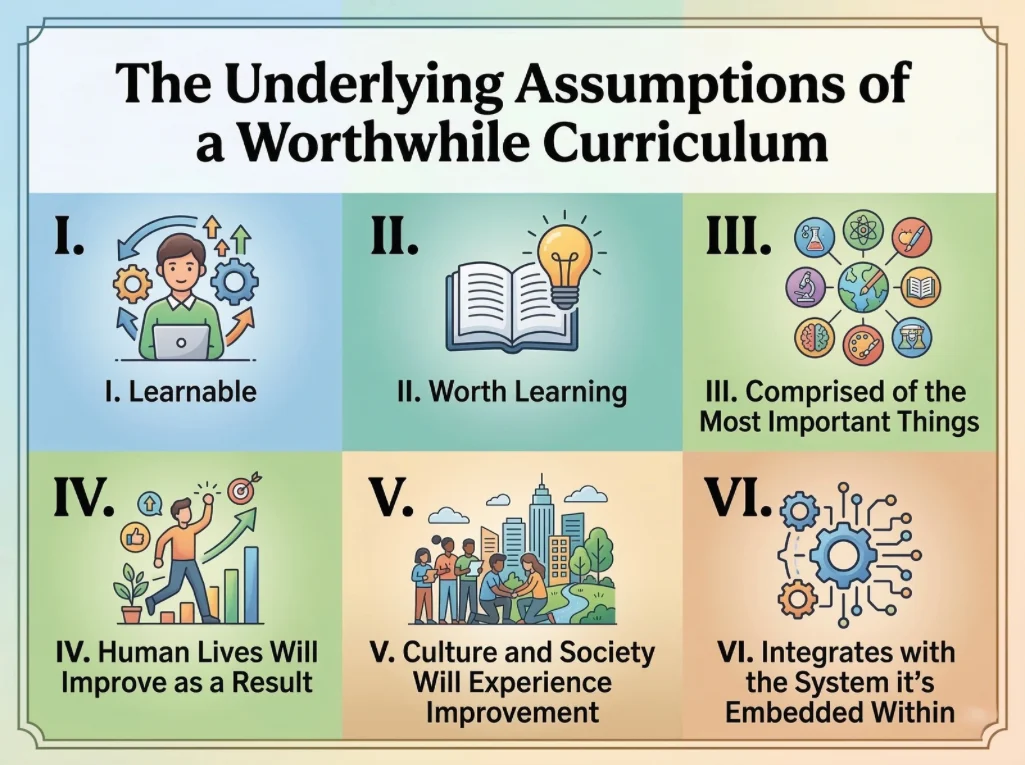
The architectural framework of modern education relies on a complex network of invisible premises that dictate not only what is taught in classrooms but why specific knowledge is prioritized over others. Beyond the explicit lists of standards and learning objectives lies a deeper stratum of philosophy—the "ideas between ideas"—that defines the relationship between data, context, and the eventual outcome of the human experience. In the contemporary educational landscape, a curriculum is rarely a neutral document; it is a manifestation of societal values, systemic constraints, and the underlying assumption that certain information possesses the inherent power to transform both the individual and the collective. To understand the efficacy of modern schooling, one must examine the six fundamental assumptions that serve as the bedrock for curriculum development: learnability, value, prioritization, personal utility, societal evolution, and systemic integration.
The Epistemological Foundation: Context as the Core of Knowledge
Every educational effect has a cause, and every data point exists within a specific context. The pedagogical theory championed by innovators like Terry Heick suggests that separating a concept from its environment risks losing the essence of the idea itself. Knowledge does not exist in a vacuum; it is recursive and non-linear. This understanding has led to a shift in how curriculum designers approach the "spaces between the stars"—the nuanced distinctions between causation and correlation, and the realization that one academic discipline frequently depends upon the presence of another to maintain relevance.
The underlying assumptions brought to a decision-making process in education are often more influential than the decisions themselves. In the pursuit of innovation, the focus must shift from mere epistemology to the practical application of curriculum as a tool for human development. This requires an acknowledgment that the curriculum is a living system, embedded within a larger infrastructure of technology, social norms, and economic requirements.
A Chronology of Curriculum Evolution in the United States
To understand current assumptions, one must view them through the lens of historical progression. The trajectory of curriculum design has moved from rigid classical studies to a more data-driven, competency-based model.
- 1892 – The Committee of Ten: This group of educators established the first standardized curriculum for high schools, emphasizing a classical education (Latin, Greek, Mathematics) to prepare students for college, regardless of their eventual career paths.
- 1918 – The Cardinal Principles of Secondary Education: A shift occurred toward "social efficiency," introducing subjects like health, home membership, and vocation, marking the first major assumption that curriculum should improve daily life.
- 1983 – A Nation at Risk: This landmark report spurred a move toward "excellence" and rigorous standards, assuming that national security and economic prosperity were directly linked to standardized academic performance.
- 2001 – No Child Left Behind (NCLB): This era solidified the assumption that curriculum must be measurable and that data points are the primary indicators of educational success.
- 2010-Present – Common Core and Competency-Based Learning: The modern era focuses on "college and career readiness," assuming that the primary goal of curriculum is economic integration and the mastery of transferable skills.
The Six Pillars of Curricular Assumption
I. The Assumption of Learnability
The most basic premise of any curriculum is that the content is learnable. This aligns with the "Zone of Proximal Development" (ZPD), a concept introduced by Lev Vygotsky, which posits that students can master tasks with appropriate guidance. If a curriculum is designed beyond the cognitive reach of the target demographic or fails to account for the neurodiversity of the student body, it ceases to be a functional tool. Designers must assume that the sequence of information—from foundational scaffolding to complex synthesis—is logically sound and achievable within the allotted instructional time.
II. The Subjective Nature of Worth
A curriculum assumes that the selected material is "worth learning." This is an inherently subjective claim, yet it is the most critical driver of educational policy. If a topic is not deemed valuable for the majority of students, its inclusion becomes a point of contention. Educators must grapple with the question: "Why study this?" The answer usually lies in the belief that the knowledge provides a necessary lens through which to view the world, even if the specific data points are eventually forgotten.
III. The Principle of Prioritization and Opportunity Cost
Because instructional time is a finite resource, every curriculum is a statement of priority. By choosing to teach one subject, an institution is effectively choosing not to teach another. This "opportunity cost" is significant. For example, if a curriculum prioritizes traditional pottery as a core competency in a digital-first economy, it may "feel good" culturally, but it risks becoming destructive if it displaces more urgent skills like digital literacy or financial management. The assumption here is that the curriculum comprises the most important things a person should know at a given point in history.
IV. Personal Transformation and Cognitive Transfer
A robust curriculum assumes that mastery will result in a better life for the student. This is not merely an academic exercise; it is a behavioral one. The assumption is that students will not only be able to use the knowledge (cognitive transfer) but will tend to use it as a matter of habit. Whether it is the ability to analyze a political argument or the skill to manage personal health, the curriculum acts as a catalyst for personal change.
V. Societal Evolution and Growth
Education serves as a mechanism for social change. A primary assumption of curriculum design is that if the individual improves, the society will follow. This rejects the notion that education is purely speculative or academic. If a society is stagnant, it suggests that the curriculum has failed to resonate or that it is too "future-heavy"—focusing on hypothetical jobs of tomorrow while ignoring the skills needed to solve the problems of today.
VI. Systemic Alignment and Infrastructure
Finally, a curriculum must assume it is compatible with the system it inhabits. This includes alignment with physical infrastructure (classrooms, laboratories), technological tools, assessment forms, and teacher capabilities. A curriculum that requires high-speed internet in a region without reliable electricity is fundamentally flawed. Therefore, designers must decide whether to revise the curriculum to fit the infrastructure or to upgrade the infrastructure to support the curriculum—a concept often referred to as "updating the gears of education."
Supporting Data: The Impact of Curriculum on Economic and Social Outcomes
Statistical analysis from the Organization for Economic Co-operation and Development (OECD) highlights the tangible impact of curriculum quality on national success. According to OECD data, a 100-point increase in PISA (Programme for International Student Assessment) scores is associated with a 2% increase in annual GDP growth per capita. This data supports the assumption that "worthwhile" learning has direct macroeconomic consequences.
Furthermore, a 2023 report by the World Economic Forum (WEF) noted that 44% of workers’ skills will be disrupted in the next five years. This has forced curriculum designers to pivot toward "durable skills"—critical thinking, resilience, and agility—rather than static knowledge. The data suggests that curricula focusing on "how to learn" rather than "what to know" result in higher long-term employment stability for graduates.
Responses from Educational Stakeholders
The debate over curriculum assumptions has drawn reactions from various sectors of society.
- The National Education Association (NEA): In recent statements, the NEA has advocated for a "whole-child" approach, arguing that curriculum must go beyond academic standards to include social-emotional learning, reinforcing the assumption that curriculum should improve the quality of human life.
- Industry Leaders: Technology CEOs have frequently criticized traditional curricula for being "infrastructure-friendly" but "innovation-poor," calling for a radical shift toward project-based learning that mimics real-world challenges.
- UNESCO: Through its "Education 2030" framework, UNESCO emphasizes that curriculum must be a tool for global citizenship and sustainable development, supporting the assumption that education is the primary driver of societal evolution.
Analysis of Implications: The Future of Learning Design
As we move further into the 21st century, the underlying assumptions of curriculum are being challenged by the rise of Artificial Intelligence (AI) and decentralized learning. If information is ubiquitous and instantly accessible, the assumption that a person must "know all the things" is being replaced by the assumption that a person must know how to "verify and synthesize" all the things.
The tension between "smart design" and "lowering standards" remains a focal point for educators. If we design schools backward from what they already do well (systemic integration), we risk stagnation. However, if we demand that schools do everything for everyone without regard for context, we risk systemic collapse.
The ultimate success of any curriculum lies in its ability to bridge the gap between the individual and the world. It must be more than a list of facts; it must be a coherent philosophy that acknowledges the "spaces between ideas" and prepares the learner to navigate a reality that is recursive, non-linear, and perpetually changing. The future of education will likely depend on our ability to refine these six assumptions, ensuring that what we teach is not just learnable, but profoundly worth knowing.