
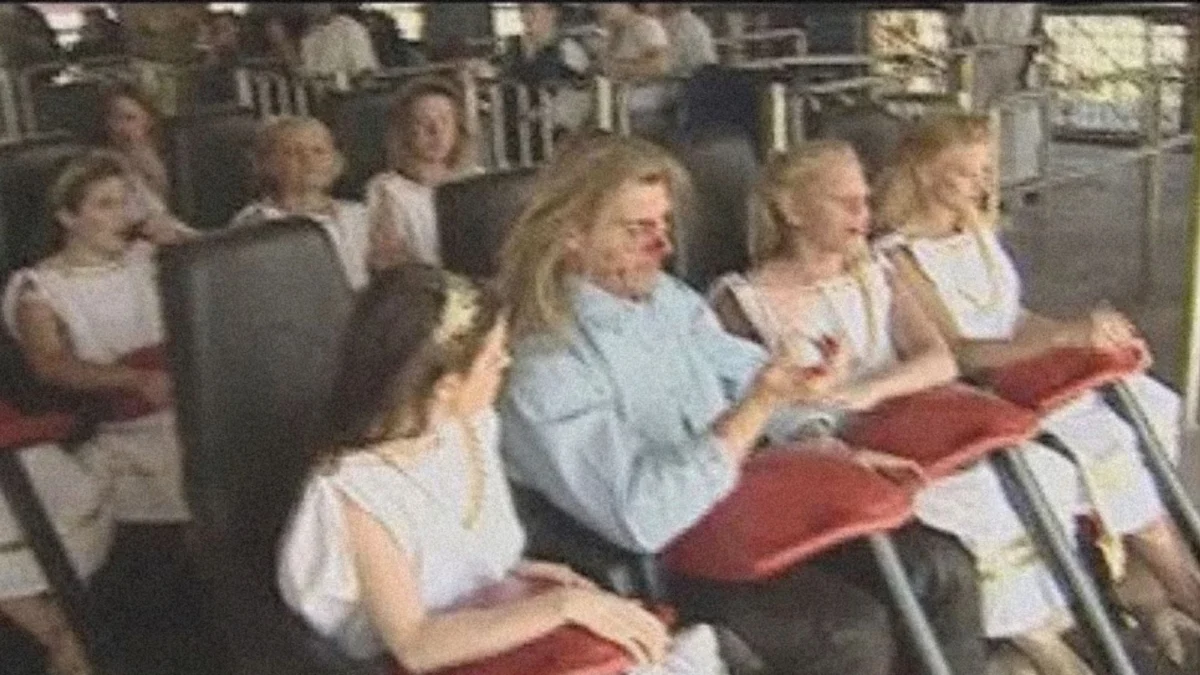
Long before the modern era of social media algorithms, viral video clips, and instant digital dissemination, legendary supermodel Fabio Lanzoni achieved a rare milestone in mass media history: he went viral organically. On March 30, 1999, the iconic model—globally recognized simply by his first name—attended a high-profile promotional event at Busch Gardens Williamsburg in Virginia. The occasion was the grand opening and inaugural run of Apollo’s Chariot, a hypercoaster designed to showcase unprecedented speeds and drops. As Lanzoni participated in the inaugural ride, an unusual mid-air collision occurred, resulting in striking imagery that would permanently cement the event in pop culture lore. For a quarter of a century, the prevailing narrative maintained that a Canada goose had directly struck the supermodel in the face at high speeds, resulting in a dramatic, bloodied aftermath that captured international headlines. However, speaking publicly about the incident in recent years, Lanzoni has thoroughly debunked the urban legend, offering a dramatically revised sequence of events that challenges the foundational myth of the accident and raises questions about early media sensationalism.
The Chronology of an Infamous March Afternoon
To understand the enduring legacy of the Busch Gardens incident, one must examine the precise timeline of events on that brisk spring day in 1999. Busch Gardens Williamsburg had invited a roster of celebrities, journalists, and VIP guests to experience Apollo’s Chariot, a massive steel roller coaster manufactured by Bolliger & Mabillard. Rising 210 feet and plunging riders down a 65-degree drop at speeds reaching up to 73 miles per hour, the ride was engineered to deliver maximum thrills. Lanzoni, at the height of his fame as the undisputed king of romance novel cover models, agreed to ride in the front row of the coaster train.
As the train descended from its primary peak, accelerating over a scenic body of water situated within the park’s grounds, the catastrophe unfolded. According to contemporary reports, a flock of migrating waterfowl was disturbed by the roaring train. Within moments of the ride’s descent, media outlets reported that a large bird—specifically a goose—had collided directly with Lanzoni’s face. Upon the train’s return to the station, photographers and onlookers were stunned to find the model with a laceration on his nose, accompanied by a noticeable amount of blood. The immediate aftermath was captured on film, showing Lanzoni holding a blood-stained tissue while emergency medical personnel assessed the minor injury. Within hours, wire services picked up the story, and the narrative that a supermodel had been assaulted mid-air by a kamikaze goose spread rapidly across global news outlets. Because the incident occurred just two days before April Fools’ Day, a substantial segment of the public initially dismissed the reports as an elaborate spring-holiday marketing stunt orchestrated by the theme park or public relations teams.
Unraveling the Narrative: What Actually Transpired
For decades, the public accepted the standard media version of the collision: a flying bird struck Lanzoni squarely in the face. However, in retrospective interviews, Lanzoni has gone on the record to correct the historical record, asserting that the widely accepted narrative is fundamentally inaccurate. The model maintains that the framing of the event serves as an early prototype for modern media sensationalism and what is colloquially termed "fake news."
According to Lanzoni’s detailed firsthand account, the physical reality of the accident was far more mechanical than biological. As Apollo’s Chariot plummeted toward the park’s water feature at high velocity, the train traversed a natural habitat populated by hundreds of migrating geese. While a collision with the flock was indeed unavoidable, the goose did not make direct facial contact with the passenger. Instead, Lanzoni observed the chaotic scene unfold inches from his eyes. A goose flew directly into a heavy-duty video camera mounted on the front of the train, which was recording the inaugural ride. The impact occurred at extreme velocity, causing the camera chassis to violently shatter upon collision.
It was not the body of the bird that inflicted the facial injury, Lanzoni clarifies, but rather a sharp piece of flying debris—specifically a fragment of metal and shattered glass from the destroyed camera equipment—that struck the bridge of his nose. Despite the dramatic imagery of blood splashed across his face, Lanzoni’s actual physical trauma was remarkably minor, requiring only a single medical stitch to close the superficial cut. Tragically, the goose did not survive the encounter, a casualty of the unfortunate intersection between high-speed amusement park infrastructure and local wildlife migration patterns. Furthermore, Lanzoni has frequently noted a lingering mystery surrounding the event: the official video footage captured by the shattered camera mysteriously vanished from the park’s archives immediately following the incident and has never been publicly recovered.
The Broader Implications: Early Viral Culture and Media Distortion
The 1999 roller coaster incident occupies a fascinating intersection in the history of media sociology. Occurring at the cusp of the consumer internet age—just as dial-up internet was entering mainstream households and digital news aggregation was beginning to take shape—the story possessed all the necessary ingredients to capture the global imagination. It featured a recognizable celebrity, an inherently absurd premise, and striking visual evidence in the form of the bloodied aftermath photographs.
Scholars and media analysts look back at the Busch Gardens event as a primitive case study in viral transmission. In an era before Twitter, Facebook, or smartphones, the story propagated rapidly through traditional mediums: morning television broadcasts, syndicated print tabloids, and evening news segments. The public’s immediate skepticism—fueled by the proximity to April Fools’ Day—demonstrated an early societal awareness of manufactured media spectacles. Yet, unlike a deliberate prank, the event was entirely genuine, even if the mechanics of the accident were heavily distorted by editorial exaggeration in the days that followed.
Lanzoni’s assertion that the incident represents the genesis of "fake news" highlights a broader critique of sensationalized journalism. In the scramble to capture consumer attention, media outlets prioritized the most sensational interpretation of the event—man bites dog, or in this case, model is vanquished by waterfowl—over the nuanced technical reality of camera shrapnel and wildlife habitats. The simplification of complex physics into a punchy, memorable anecdote transformed a routine industrial accident into an urban legend that has endured for a quarter-century.
Theme Park Safety and Wildlife Management Challenges
Beyond the cultural fascination surrounding Fabio Lanzoni and the unfortunate goose, the 1999 incident shed light on a persistent operational challenge faced by large-scale outdoor amusement parks: the management of local wildlife. Major theme parks, particularly those situated on expansive acreage featuring lakes, ponds, and landscaped green spaces, frequently intersect with natural ecosystems. Migratory birds, resident waterfowl, and local fauna routinely traverse these artificial bodies of water, creating potential hazards for high-speed attractions.
In the wake of the Apollo’s Chariot incident, theme park engineering firms and safety regulators implemented enhanced preventative measures across numerous installations worldwide. While roller coasters undergo rigorous testing for structural integrity and passenger safety restraints, environmental hazards such as airborne wildlife remain largely unpredictable. Modern hypercoasters operating at speeds exceeding 70 miles per hour incorporate advanced clearance zones, animal deterrence systems, and strict protocols regarding mounted filming equipment to prevent a recurrence of the mechanical failure that contributed to Lanzoni’s injury. The integration of high-definition action cameras on modern thrill rides is now heavily regulated, ensuring that secure housings protect both riders and equipment from catastrophic failure during high-velocity maneuvers.
Conclusion: The Lasting Legacy of March 30, 1999
Twenty-five years after the fact, the narrative of Fabio and the roller coaster goose remains a staple of pop culture trivia. While the supermodel has successfully moved on to diverse business ventures and continues to maintain his status as a recognizable cultural figure, the ghost of the 1999 incident follows him in interviews and retrospective profiles. By finally setting the record straight regarding the shattered camera and the true source of his facial laceration, Lanzoni has provided a definitive closing chapter to a story that spent decades exaggerated by media folklore. As the amusement park industry continues to push the boundaries of speed, height, and engineering complexity, the legend of Apollo’s Chariot stands as a bizarre reminder of the unpredictable nature of human-animal encounters at 80 miles per hour.

