
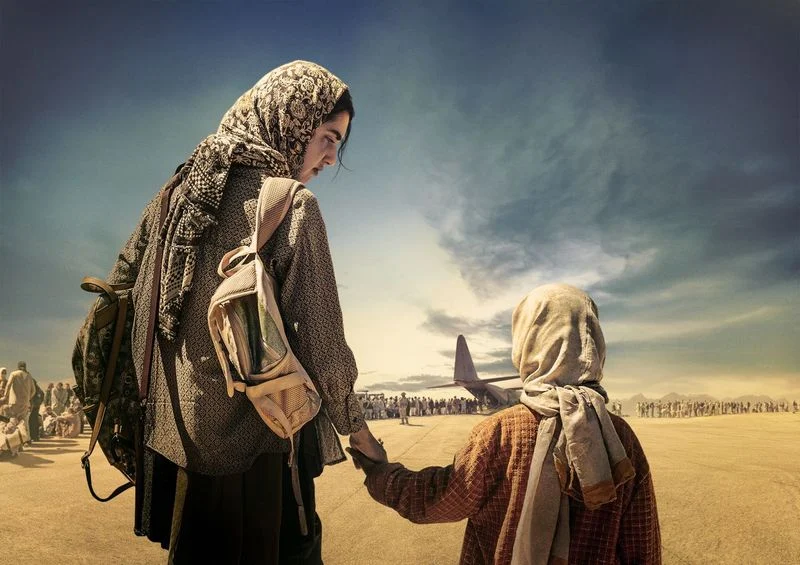
The BBC has secured the broadcast rights for the upcoming series Kabul, a gripping drama set against the harrowing real-life events that unfolded in Afghanistan in 2021. This significant acquisition marks one of the final on-screen appearances of the late Eric Dane, whose passing earlier this year sent ripples through the entertainment industry. The series, a production from Mediawan for the European Alliance of broadcasters, is poised to offer a visceral and deeply human perspective on one of the most tumultuous periods in recent global history.
The narrative of Kabul commences with the precipitous withdrawal of American troops from Kabul, a moment that precipitated the swift re-entry of the Taliban into the capital city. Against this backdrop of seismic geopolitical shift, the Nazany family, representing countless Afghan civilians, finds themselves thrust into a desperate flight for survival. Their fear of reprisal is palpable, amplified by the looming specter of attacks from ISIS, adding another layer of immediate danger to an already untenable situation. Within this maelstrom of chaos and uncertainty, a disparate group of international figures – French police officers, Italian diplomats, German military personnel, and American intelligence operatives – are tasked with the monumental challenge of coordinating efforts to manage the overwhelming influx of civilians seeking to escape the escalating crisis.
Eric Dane, who tragically passed away earlier this year, portrays Martin in the series. His involvement in Kabul adds a poignant layer of poignancy to his final performances, reminding audiences of his talent showcased in acclaimed roles in Euphoria and Grey’s Anatomy. The international ensemble cast is further bolstered by a constellation of accomplished actors, including Darina Al Joundi (The New Look), Shervin Alenabi (Tehran), Vassilis Koukalani (Kandahar), Hannah Abdoh, Jonathan Zaccaï (Le bureau des legends), Gianmarco Saurino (L’estate piu Calda), and Jeanne Goursaud (Pax Massilia). Their collective performances are expected to imbue the series with authenticity and emotional depth.
Kabul is slated to premiere on the BBC next month, a testament to its anticipated impact and broad appeal. The series is a product of Mediawan, with global sales managed by Mediawan Rights. It was originally conceived for the European Alliance of broadcasters, a collaborative initiative that includes prominent public service broadcasters such as ZDF (Germany), Rai (Italy), and France Télévisions (France). While the BBC is not a formal member of this Alliance, its past collaborations on projects like the adaptation of Around the World in 80 Days underscore its commitment to co-producing and acquiring high-quality international drama.
Nick Lee, Head of BBC Programme Acquisition, articulated the series’ profound significance in a statement: "Kabul is a tragedy of the highest stakes. A warzone story which is propelled by the real ticking clock of the evacuation that was just five years ago this summer. Global politics remain complex, but Kabul dramatises the biggest view of history through the smallest window of a human family." This sentiment highlights the series’ dual focus: a broad geopolitical canvas rendered through the intimate lens of individual human experience.
Background and Chronology of the 2021 Afghanistan Crisis
The events depicted in Kabul are rooted in the rapid collapse of the Afghan government and the subsequent Taliban takeover in August 2021. For two decades, following the U.S.-led invasion in 2001, Afghanistan had been the recipient of substantial international military and financial aid aimed at establishing a stable, democratic government. However, persistent challenges, including widespread corruption, internal divisions, and a resilient insurgency, plagued reconstruction efforts.
The Doha Agreement, signed in February 2020 between the United States and the Taliban, stipulated a phased withdrawal of U.S. forces in exchange for security guarantees from the Taliban. As the withdrawal progressed throughout 2021, the Taliban launched a swift and coordinated offensive, overwhelming Afghan national security forces, many of whom were demoralized and under-equipped.
Key Chronological Markers:
- April 14, 2021: U.S. President Joe Biden announces the full withdrawal of U.S. troops by September 11, 2021, marking the end of America’s longest war.
- May 1, 2021: Formal start of the final U.S. troop withdrawal.
- July 2, 2021: U.S. forces evacuate Bagram Airfield, handing over the major military base to Afghan forces.
- August 6, 2021: The Taliban captures their first provincial capital, Zaranj. This marks the beginning of a rapid series of territorial gains.
- August 13-14, 2021: The Taliban advances towards Kabul, capturing key cities like Kandahar and Herat. International efforts to evacuate their citizens intensify.
- August 15, 2021: The Taliban enters Kabul with little resistance. President Ashraf Ghani flees the country, and the Afghan government collapses. Chaotic scenes unfold at Kabul International Airport as thousands of Afghans attempt to flee.
- August 16-30, 2021: A massive airlift operation is undertaken by various nations to evacuate their citizens and at-risk Afghan allies. The United States concludes its evacuation efforts on August 30, 2021, marking the end of its military presence.
- August 26, 2021: A suicide bombing outside the Abbey Gate of Kabul International Airport, claimed by ISIS-K (Islamic State Khorasan Province), kills 13 U.S. service members and scores of Afghan civilians, highlighting the persistent threat of extremist groups.
Supporting Data and Scale of the Evacuation
The scale of the humanitarian crisis and the subsequent evacuation efforts were unprecedented. During the final two weeks of August 2021, an estimated 120,000 people were evacuated from Kabul, primarily through Kabul International Airport. This massive operation involved a coalition of over 50 countries, each striving to extract their nationals, embassy staff, and vulnerable Afghan partners.
The United States alone evacuated approximately 76,000 individuals, including nearly 5,000 U.S. citizens and lawful permanent residents, and over 70,000 Afghan Special Immigrant Visa applicants and their families, as well as other vulnerable Afghans. The United Kingdom evacuated over 15,000 individuals, while other nations, including France, Germany, Canada, and Australia, also conducted significant evacuations.
The logistical challenges were immense, involving coordinating flights, security at the airport, processing evacuees, and dealing with the sheer volume of people desperate to escape. The presence of ISIS-K, an enemy of both the Taliban and the international forces, added a critical security dimension, culminating in the tragic attack on August 26th. This attack underscored the volatile and dangerous environment in which these evacuations were taking place.
Directorial and Writing Credits
The series Kabul is brought to life by a talented creative team. Directed by Kasia Adamik (No Escape) and Olga Chajdas (Imago), the series benefits from their experience in navigating complex narratives and intense subject matter. The writing is helmed by Olivier Demangel (Class Act), Thomas Finkielkraut (Baron Noir), and Joey Lavy (The Shift), whose combined efforts are expected to deliver a nuanced and compelling portrayal of the events. The production is credited to Fabienne Servan-Schreiber and Charlotte Ortiz at Cinétévé, Matthias Weber and Thibault Gast at 24 25 Films, with Sandrine Paquot serving as executive producer.
Broader Impact and Implications
The events of August 2021 in Afghanistan had profound and far-reaching implications, both regionally and globally. The swift collapse of the Afghan government and the return of the Taliban raised significant concerns about human rights, particularly for women and girls, who faced severe restrictions on their freedoms under previous Taliban rule. The potential for Afghanistan to once again become a safe haven for international terrorist organizations also became a pressing global security issue.
The humanitarian crisis that ensued saw millions of Afghans displaced internally and many more attempting to flee the country. International aid organizations have been working tirelessly to provide assistance amidst severe economic hardship and political instability.
From a geopolitical perspective, the withdrawal and its aftermath led to widespread discussions about the effectiveness of international intervention, nation-building efforts, and the complexities of foreign policy. The scenes of chaos at Kabul airport served as a stark visual reminder of the human cost of geopolitical shifts and the challenges of managing transitions in fragile states.
The BBC’s acquisition of Kabul signals a commitment to bringing this critical historical moment to a wider audience, offering an opportunity for reflection and understanding. By focusing on the personal stories within the larger geopolitical drama, the series aims to humanize the crisis, illustrating the resilience, fear, and determination of individuals caught in the crosscurrents of history. The series’ premiere next month will undoubtedly spark further dialogue and analysis of one of the most significant geopolitical events of the early 21st century. The inclusion of Eric Dane’s final performance adds a layer of somber reflection, ensuring his contribution to this important narrative will be remembered. The European Alliance’s initiative, supported by the BBC’s involvement, highlights a growing trend of international co-productions tackling significant global issues, fostering a shared understanding across borders.

