
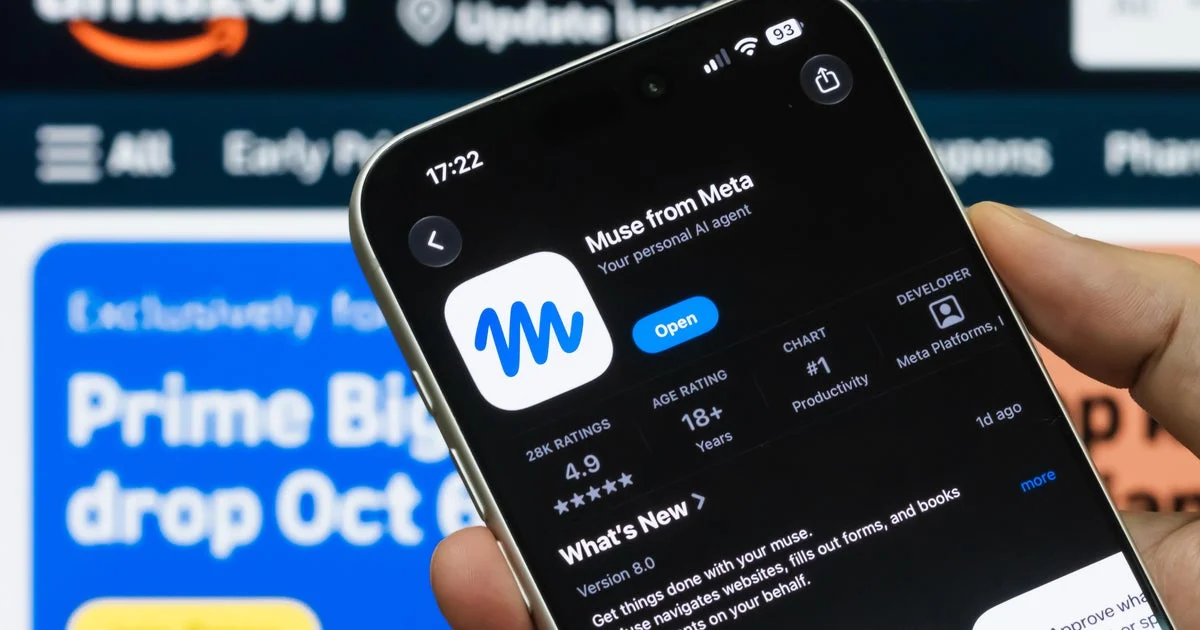
The rapid ascent of Meta’s new personal artificial intelligence agent, Muse, marks a significant turning point in consumer technology, signaling a shift from passive AI chatbots to proactive "agentic" tools. As of late September 2026, Muse has ascended to the top position on the Apple App Store, outpacing established competitors like OpenAI’s ChatGPT. This development reflects a broader societal willingness to delegate complex, time-consuming digital tasks—ranging from price comparison to travel logistics—to autonomous systems, despite lingering concerns regarding data security and the long-term implications of AI autonomy.
The trajectory of Muse’s adoption is stark. Since its public release just two weeks ago, the platform has secured over 2.5 million downloads. In the same timeframe, OpenAI’s ChatGPT recorded 3.1 million downloads, while Anthropic’s Claude reached 200,000. While ChatGPT retains a slight edge in total volume, the velocity of Muse’s growth indicates that Meta’s integration of specific, action-oriented shopping features is resonating deeply with a consumer base eager to offload the cognitive burden of e-commerce.
The Rise of Agentic Commerce
The term "agentic commerce" refers to a new generation of AI tools that do not merely provide information or generate text, but perform discrete, value-driven actions. Unlike traditional large language models (LLMs) that serve as glorified search engines, Muse is engineered to navigate the web, authenticate accounts, track price fluctuations, and execute transactions.
Industry analysts suggest this evolution is the logical next step for the digital economy. Neil Saunders, managing director at GlobalData Retail, emphasizes that this is not an overnight revolution but a fundamental change in the consumer journey. "We are witnessing the acceleration of agentic shopping," Saunders noted. "Consumers are increasingly seeking to hand off the cumbersome, repetitive tasks of modern life—such as scouring multiple retail sites for the best deal or monitoring shipping logistics—to agents that can act with speed and precision."
According to data from the IBM Institute for Business Value, the appetite for such tools is already widespread. Approximately 41% of consumers report using AI assistants to conduct product research, while 31% utilize them specifically for deal-hunting. These figures suggest that the transition from human-led searching to agent-led shopping is already well underway.
A Chronology of the AI Shopping Evolution
The path to the current AI shopping landscape can be traced back through several critical stages of development:
- 2023: The Chatbot Era: The initial surge in generative AI interest focused on conversational search. Users treated tools like ChatGPT as advanced research assistants, though the output was largely static information.
- Early 2025: The Integration Phase: Major tech firms began experimenting with browser plugins and extensions, allowing AI to interact more directly with retail sites, albeit with significant friction and security hurdles.
- Mid-2026: The Agentic Leap: AI architectures evolved to include "tool use" capabilities, allowing models to interface with APIs and perform browser-based tasks. This paved the way for Meta’s Muse to offer a streamlined, app-based interface for commerce.
- September 2026: The Muse Launch: Meta’s deployment of Muse effectively bridged the gap between personal assistance and direct consumer commerce, leading to its current dominance in app store rankings.
Friction in the Ecosystem: The Amazon Standoff
As Muse gains traction, it has encountered immediate resistance from major e-commerce incumbents. In a move that highlights the competitive friction of this new landscape, Amazon confirmed to CBS News that it has blocked Muse from interacting with its platform.
The rationale provided by Amazon centers on "security and user experience." By preventing an AI agent from scraping data or simulating user behavior on its platform, Amazon is protecting its walled garden. This tension highlights a critical challenge for the future of agentic AI: if major retailers refuse to grant access to these agents, the utility of the technology will be restricted to a fragmented subset of the internet, potentially stifling its growth. Analysts warn that this "war of the agents" could force consumers to choose between their preferred AI tool and their preferred retail marketplace.
Consumer Sentiment and the Trust Gap
Despite the enthusiasm surrounding time-saving capabilities, deep-seated anxieties remain. While many consumers are eager to save money through automated promo code detection and price tracking, there is significant hesitancy regarding "agentic mishaps."
A Coresight survey of over 1,000 consumers revealed that while 30% of respondents expressed interest in using AI to optimize holiday shopping, many remain cautious about granting these tools full authorization to handle financial transactions. The fear of "hallucinations"—where an AI might misinterpret a product description or accidentally purchase the wrong item—remains a psychological barrier to widespread adoption.
"People are still a little bit nervous about allowing AI agents to do the purchasing on their behalf," Saunders observed. This suggests that the current phase of adoption is largely experimental. Users are comfortable with AI acting as a consultant, but they are still largely unwilling to cede total control to the agent at the checkout screen.
Broader Implications for the Retail Market
If Muse and its contemporaries can maintain their momentum, the implications for the retail sector are profound. Retailers may soon find themselves competing not just against other brands, but against AI agents that prioritize objective metrics like price, shipping speed, and return policies over brand loyalty or marketing spend.
John Mercer, head of global research at Coresight, believes that if Muse successfully captures a significant market share, it could fundamentally alter the power dynamic in e-commerce. "It’s a natural evolution from search," Mercer said. "By summarizing, discovering, and showcasing only what is relevant to the individual, these agents effectively act as a filter that cuts out the noise of traditional advertising."
For the consumer, this could mean the end of the "infinite scroll" and the beginning of a hyper-personalized shopping experience where the AI, knowing the user’s preferences, budget, and history, presents only the best possible options. For businesses, it creates a new "search engine optimization" challenge—one where they must optimize not just for human eyes, but for the algorithms of agents like Muse.
Looking Toward the Future
As the technology matures, the success of Muse will likely hinge on two factors: the ability of Meta to ensure robust security and the willingness of major e-commerce platforms to integrate with these agents. If the industry can establish standardized protocols for how AI agents interact with retail sites, the current "AI agent gold rush" will likely move from a novelty to a necessity.
For now, the rapid adoption of Muse serves as a clear signal that the public is ready to embrace the promise of automated convenience. While experts caution that we are not yet at a "tipping point" of total market saturation, the trajectory of the last two weeks suggests that the infrastructure of the digital economy is being rewritten in real-time. Whether these tools will ultimately liberate the consumer from the drudgery of shopping or create new, unforeseen vulnerabilities remains a subject of intense debate among industry observers and ethicists alike. As the year draws to a close, all eyes will be on how Muse handles the high-volume traffic of the holiday shopping season—a true test of its reliability and its place in the modern home.

