
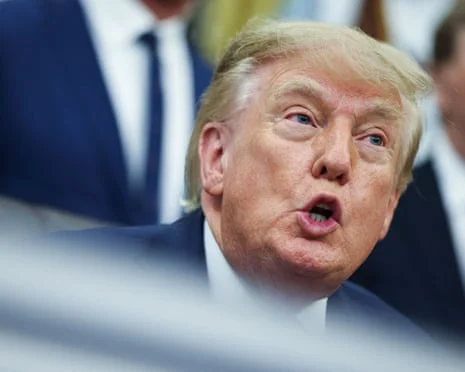
Donald Trump escalated his ongoing hostilities with the American media apparatus on Friday, vehemently defending his administration’s decision to bar major news organizations—specifically CNN, MS Now, and Politico—from accessing the White House grounds and press facilities. Speaking directly to reporters during an Oval Office event ostensibly convened to highlight alterations to the United States healthcare system, drug pricing adjustments, and childhood vaccination schedules, the president doubled down on the exclusionary measures that have triggered widespread alarm among constitutional scholars, press freedom advocates, and congressional Democrats alike.
The directive, initially broadcasted by the president via a series of posts on his personal social media platform, Truth Social, targets outlets that the administration accuses of propagating "FICTION and LIES." During the Oval Office session, when pressed by a correspondent regarding the presidential oath of office and the protections guaranteed by the First Amendment of the U.S. Constitution, Trump expressed deep personal frustration with critical reporting. "You get so tired of reading and seeing fake news," Trump remarked, before issuing an explicit warning that additional mainstream journalistic institutions, specifically alluding to The New York Times and The Washington Post, could soon face identical bans.
The confrontation highlights a dramatic deterioration in executive-press relations as the nation barrels toward high-stakes midterm congressional elections. With control of both chambers of Congress hanging in the balance, the administration’s aggressive posture toward independent media mirrors broader political tensions defined by soaring inflation, voter anxiety over economic metrics, and the compounding foreign policy fallout of an extended regional conflict in the Middle East.
A History of Contentious Press Access and Legal Pushback
The administration’s latest move represents a continuation of restrictive media access policies established during Trump’s first term and reinforced at the onset of his second. In late 2018, the White House infamously revoked the hard pass of CNN chief White House correspondent Jim Acosta following a contentious exchange during a post-midterm press conference. That escalation culminated in a federal lawsuit filed by CNN, after which a U.S. district judge ordered the administration to immediately restore Acosta’s credentials, ruling that the revocation violated due process protections.
When reminded of this judicial precedent on Friday, Trump attempted to rewrite the historical record of the 2018 litigation. He claimed that his administration "didn’t have to take it too far because the reporter that you’re talking about discredited himself." In reality, the administration relented instantly upon the issuance of the judicial order. Expanding on his philosophy regarding judicial oversight of executive press management, Trump asserted, "I don’t think that a court should allow fake news to be written day after day after day. I think that somebody has a right to keep them away if they’re going to write false stories all the time."
Legal experts immediately challenged the constitutional validity of the ban. Jameel Jaffer, executive director of the Knight First Amendment Institute at Columbia University, issued a pointed statement dismantling the president’s legal rationale.
"The First Amendment prohibits the president from punishing journalists because he doesn’t like their coverage, just as it prohibits him from punishing universities because he doesn’t like the courses they offer, or from punishing law firms because he doesn’t like the clients they represent," Jaffer stated. "With so many courts having ruled against him on exactly this point, you’d think President Trump would have learned this lesson by now. If President Trump means to expel these news organizations from the White House press pool, his action is doubly unconstitutional because the press pool is a ‘public forum’ under the First Amendment, which means the president can’t exclude journalists from it on the basis of their viewpoints."

Bipartisan and Institutional Condemnation
The unilateral decision to blacklist accredited news organizations drew immediate, sharp rebukes from Democratic lawmakers and civil liberties organizations. Senate Majority Leader Chuck Schumer took to social media to denounce the administration’s actions, drawing explicit comparisons to authoritarian governance.
"Donald Trump just did what dictators throughout history have done," Schumer wrote, directly addressing the president. "This is a democracy. You will not be able to manipulate the news or hide the truth."
Illinois Governor J.B. Pritzker, a prominent Democrat frequently mentioned as a potential presidential contender for the 2028 election cycle, echoed these sentiments on the platform X. "This is yet another attack on the First Amendment from a president who knows he and his party of bootlickers are deeply unpopular," Pritzker posted. "Donald Trump can’t hide from his failing record, so he’s banning journalists he doesn’t like to keep you from hearing about it."
Arizona Senator Ruben Gallego similarly characterized the restrictions as a page straight out of the "authoritarian playbook." Despite the mounting condemnation, Trump made clear that his grievances stem from a perceived lack of unvarnished praise from non-partisan media outlets, while openly contrasting their coverage with the favorable treatment he receives from right-wing partisan platforms. "I get I don’t get fair press. I get it from Breitbart. I get it from a little bit from Fox," Trump acknowledged during the Oval Office exchange. "But what I do ask is just a semblance of truth."
Broader Domestic Pressures and Midterm Implications
The White House press controversy unfolded against a chaotic backdrop of overlapping domestic and international crises that threaten the Republican party’s legislative majority in the upcoming November elections. Early voting commenced on Friday in several jurisdictions, including in-person early voting in Virginia and absentee balloting options in Minnesota, Idaho, and South Dakota.
Recent economic indicators have exacerbated political vulnerabilities for the administration. Data highlighted by financial analysts, including reports from The Wall Street Journal, indicate persistent cost-of-living pressures facing American households. Mortgage rates hover near 7%, consumer prices registered an annualized increase of 3.4% through August, and retail gasoline prices remain near multi-year highs not seen since 2022. Compounding these domestic anxieties is the prolonged conflict with Iran, which has entered its seventh month. Initially projected by administration officials to conclude swiftly through decisive military action, the war has disrupted global energy supplies via instability in the Strait of Hormuz and drawn intense scrutiny following investigative reports from outlets like The Washington Post, which suggested official military casualty figures may be underreported.
Simultaneously, the administration faces friction on international and domestic policy fronts. Federal law enforcement agencies recently experienced operational fallout when FBI Director Kash Patel temporarily suspended cooperation with the Royal Canadian Mounted Police over language guidelines issued by Canada’s editorially independent public broadcaster concerning the September 11 terrorist attacks. Furthermore, a new poll conducted by The Washington Post and the Schar School revealed that over 60 percent of prospective voters in the critical battleground state of Michigan disapprove of the White House’s ongoing trade tariffs against Canada—a policy that has disrupted regional manufacturing and cross-border supply chains.
Conclusion: Constitutional Standoff on the Horizon
As the legal and political repercussions of the White House press ban ripple outward, the stage is set for another high-stakes constitutional showdown between the executive branch and the federal judiciary. By explicitly targeting accredited news outlets for unfavorable coverage and openly floating the expansion of the ban to other prominent journalistic institutions, the administration has reignited a fundamental debate over the boundaries of executive power and the unalienable rights protected by the First Amendment. With the midterm elections looming and public discontent rising over economic and foreign policy challenges, the administration’s aggressive posture toward the free press underscores a deepening polarization that will likely dominate the national political discourse for the foreseeable future.
