
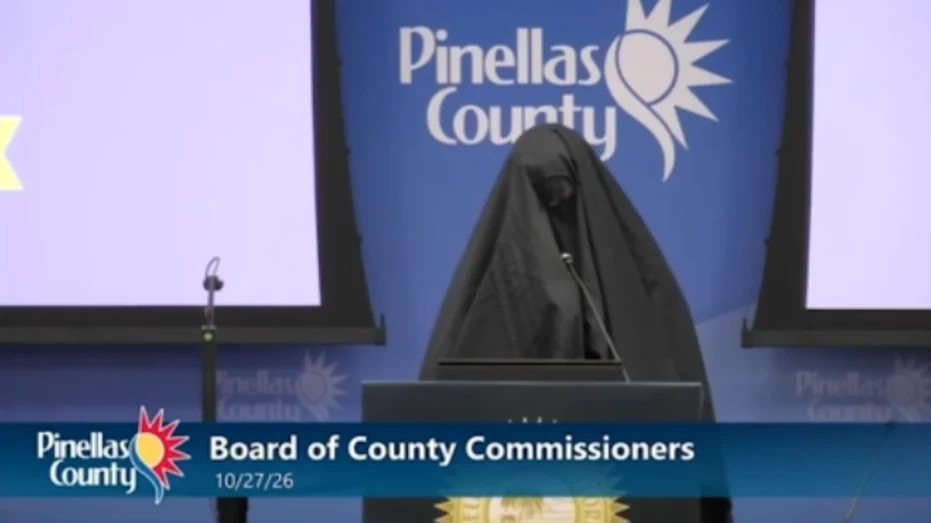
PINELLAS COUNTY, Fla. — A routine local government gathering in Florida transformed into a flashpoint of controversy and debate on Wednesday when a woman wearing a traditional burka was escorted from the chambers by law enforcement. The individual, whose identity has not been publicly released by authorities, approached the public podium during a scheduled meeting of the Pinellas County Board of County Commissioners. Instead of utilizing her allotted time to deliver a spoken public comment, she activated an audio recording of the Adhan—the Islamic call to prayer—which echoed through the chambers for nearly a minute before officials intervened.
The incident has since ignited broader conversations regarding local government decorum, the enforcement of public comment guidelines, and the complex intersection of freedom of expression and municipal procedure at public assemblies across the United States. While local authorities confirmed that the woman complied with deputies and left the premises without facing criminal charges, the episode immediately divided the room, sparking vocal opposition from attendees and prompting a formal defense of meeting rules from the board’s leadership.
Chronology of the Incident
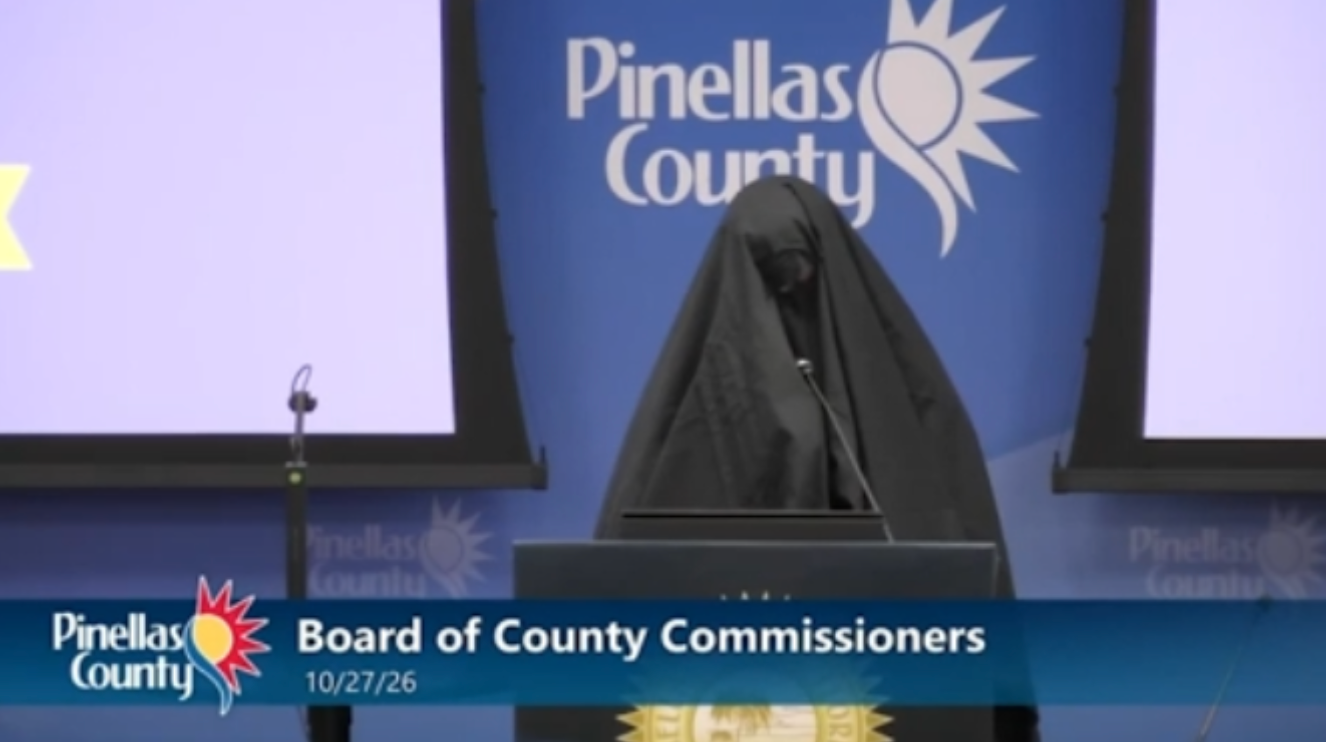
The confrontation unfolded during the public comment segment of the Pinellas County Board of County Commissioners meeting, a standard period designed to allow constituents to address elected officials directly on matters of local concern. According to eyewitness accounts and official meeting recordings, the woman approached the podium completely covered in black garments, with only her left eye visible through the fabric.
Rather than speaking into the microphone, she produced a device and played the Islamic call to prayer. The resonant audio filled the room, continuing uninterrupted for approximately 60 seconds.
Recognizing a breach of standard protocol, Board Chairman Dave Eggers interrupted the broadcast. He directly addressed the speaker, instructing her to halt the audio playback. "Ma’am, you’re going to have to stop… stop the music, stop the tape," Eggers stated from the dais.
When the woman reportedly ignored the directive and continued playing the recording, Eggers signaled for assistance. A deputy from the Pinellas County Sheriff’s Office, stationed at the chambers to maintain order, approached the podium. The deputy escorted the woman out of the meeting room and subsequently off the county property.
The removal, however, triggered immediate friction among the audience members. Several individuals in the gallery began shouting objections, arguing with the chairman over the decision to remove the speaker and questioning whether her rights had been infringed.
In response to the growing unrest, Chairman Eggers paused the proceedings to address the gallery, calling for civility. "Please. Just please exercise some decorum and kindness of your own," Eggers told the crowd. "We’re all people living together here."
Clarifying the Rules of Public Participation
To quell the mounting agitation in the room, Chairman Eggers took the opportunity to clearly articulate the foundational rules governing public commentary at Pinellas County commission meetings. He emphasized that the restriction was content-neutral and based entirely on administrative policy rather than the specific nature or message of the audio played.
"We don’t allow taped things," Eggers explained to the audience. "You can record the meeting, but we don’t allow taped activity like that. We ask you to come here and make comments, and that was not a comment. That’s why she was asked to step out."
Municipal bodies across Florida and the broader United States routinely establish guidelines for public comment periods to ensure that meetings remain orderly, productive, and accessible to all citizens wishing to speak. These rules frequently include time limits—typically two to three minutes per speaker—restrictions against yielding time to other individuals, and prohibitions against disruptive behavior, profanity, or the use of external media devices in place of verbal address. Legal experts note that while local governments must respect First Amendment protections, they also possess the legal authority to enforce reasonable "time, place, and manner" restrictions to prevent meetings from being derailed.
Official Response and Legal Status
Following the conclusion of the meeting, the Pinellas County Sheriff’s Office issued a brief statement clarifying the law enforcement perspective on the event. Officials confirmed that the woman was escorted from the building peacefully and without further incident. Crucially, the sheriff’s office verified that she would face no criminal charges stemming from the episode, as her actions—while in violation of administrative meeting rules—did not constitute a criminal offense.
The lack of criminal charges underscores the administrative nature of the response. Law enforcement’s role was strictly limited to preserving order and enforcing the directives of the presiding board chairman after the speaker refused to comply with venue regulations.
Broader Context: Religious Tensions at Municipal Meetings
Wednesday’s incident in Pinellas County does not exist in a vacuum. In recent months, public comment periods at local government meetings nationwide have increasingly become venues for symbolic protests, religious demonstrations, and high-stakes cultural debates. City councils and county commissions from Florida to Michigan, Texas, and Arizona have frequently found themselves on the front lines of national ideological battles, ranging from disputes over religious displays and holiday celebrations to passionate arguments regarding local ordinances and constitutional rights.
For instance, recent months have seen heated confrontations in cities like Dearborn, Michigan, where local council meetings have repeatedly drawn intense scrutiny, passionate public testimony, and legal challenges involving religious tensions, community representation, and free speech protections. Similarly, municipal bodies in states like Texas and Arizona have grappled with balancing the expansive rights of religious preachers and ideological activists against the administrative necessity of maintaining decorum during public proceedings.
Political scientists and legal analysts suggest that local government meetings have evolved into symbolic proxies for broader societal divisions. Because county commissions and city councils represent the most accessible tier of government, activists and individuals seeking to make a statement often target these local platforms to maximize visibility for their grievances, whether those grievances involve local policy or broader cultural issues.
Analysis of Implications
The Pinellas County incident highlights several critical challenges facing local governance in the modern era:
-
The Balance Between Expression and Efficiency: Local elected officials face the delicate task of protecting citizens’ rights to petition their government while simultaneously ensuring that official business can be conducted efficiently and without undue disruption. When individuals utilize alternative methods of communication—such as pre-recorded audio, theatrical performances, or prolonged silence—boards must draw a clear line between protected speech and procedural obstruction.
-
Content-Neutral Enforcement: To withstand potential legal scrutiny under the First Amendment, public entities must enforce their rules uniformly, regardless of the message, religion, or ideology involved. Chairman Eggers’ immediate focus on the rule against "taped activity" rather than the specific content of the Islamic call to prayer was legally significant, signaling that the intervention was strictly procedural.
-
Community Polarization: The vocal reaction from the audience in Pinellas County demonstrates the fragility of public discourse at the local level. Even minor procedural infractions can rapidly escalate into emotionally charged shouting matches, reflecting a deep-seated public distrust and heightened sensitivity surrounding issues of religion, culture, and public space.
Conclusion
As local governments navigate an increasingly polarized political and cultural landscape, incidents like the one witnessed in Pinellas County serve as a stark reminder of the complexities inherent in public administration. While the immediate disruption was swiftly managed by local deputies and the meeting resumed without permanent consequence, the event underscores the ongoing challenge of maintaining order, civility, and constitutional integrity within the foundational spaces of American civic life.
