
The rapid expansion of curbside food scrap collection across the United States has marked a significant shift in municipal waste management, yet cities face an increasingly stubborn obstacle: participant retention. According to national survey data compiled by BioCycle, approximately 14.9 million U.S. households had access to dedicated food waste collection programs in 2023, representing a remarkable 49 percent increase from the 10 million households reported just two years prior. Despite this surge in infrastructural availability, actual household participation rates remain deeply polarized. While a select group of municipalities report near-universal engagement, other regions struggle with participation falling below 30 percent.
This participation gap poses severe environmental and financial implications. Food waste constitutes roughly 24 percent of all municipal solid waste entering U.S. landfills, according to federal figures. Furthermore, the Environmental Protection Agency (EPA) estimates that decomposing organic waste in these landfills accounts for an alarming 58 percent of total fugitive methane emissions—a potent greenhouse gas with a global warming potential significantly higher than carbon dioxide. Consequently, providing a green bin to a household does not yield neutral results if the bin remains unused; an empty, rejected, or abandoned organics cart represents a missed opportunity to mitigate municipal greenhouse gas emissions and extend the lifespan of local landfills.
Defining the Organics Infrastructure Landscape
To understand the operational hurdles of food waste diversion, municipalities must first navigate a fragmented nomenclature. The curbside cart designated for household organics is colloquially and officially known by a variety of names depending on the jurisdiction. Commonly referred to as the green bin, brown bin, organics cart, compost cart, or food scraps cart, this container is engineered to receive kitchen scraps, spoiled food, and—depending on regional municipal guidelines—yard trimmings and food-soiled paper products.

Unlike conventional municipal solid waste or single-stream recycling, organics collected in these bins are systematically diverted from landfills. Instead, they are transported to specialized industrial composting facilities or anaerobic digestion plants, where they are transformed into nutrient-rich soil amendments or renewable energy. However, the operational success of these programs relies entirely on what consumers deposit into the cart, making consumer behavior the single most critical variable in the waste-diversion chain.
The Psychological and Physical Barriers to Retention
Households typically abandon curbside organics programs due to a confluence of well-documented friction points: confusion regarding accepted materials, forgetfulness concerning collection schedules, and general inconvenience. Yet, waste management experts and community organizers point to an unglamorous and frequently overlooked psychological deterrent: the physical degradation of the bin itself.
Over time, unlined or poorly managed food waste containers accumulate decomposing organic matter, fostering liquid pooling, foul odors, persistent insect infestations, and stubborn residues that demand intensive, recurring manual cleaning. For many residents, the prospect of hosing out a malodorous, maggot-infested cart transforms a civic duty into an onerous weekly chore. When the burden of maintenance outweighs the desire for environmental stewardship, households quietly opt out of the system.
Municipalities have attempted to address these retention barriers through various incentive programs. For instance, between 2023 and 2024, the Essex County Council in the United Kingdom executed a comprehensive, year-long Food Recycling Project aimed at boosting local diversion rates. The initiative distributed an informational toolkit to over 375,000 households, which included an educational leaflet, a waste-bin reminder sticker, and a complimentary roll of certified compostable bin liners. The intervention yielded immediate results: food recycling tonnage surged by an average of 21 percent compared to a control group within the first three months of deployment—more than double the council’s initial 10 percent performance target.

While the Essex County case study underscores the efficacy of providing physical tools to contain mess, it also exposes a systemic limitation. Subsidized, large-scale giveaways of free compostable bags represent a significant municipal expenditure that the vast majority of local governments cannot sustain indefinitely. Therefore, policymakers face a pressing operational challenge: how to facilitate clean, frictionless organic waste containment for residents without relying on continuous public subsidies.
Bridging the Gap Through Hardware Innovation
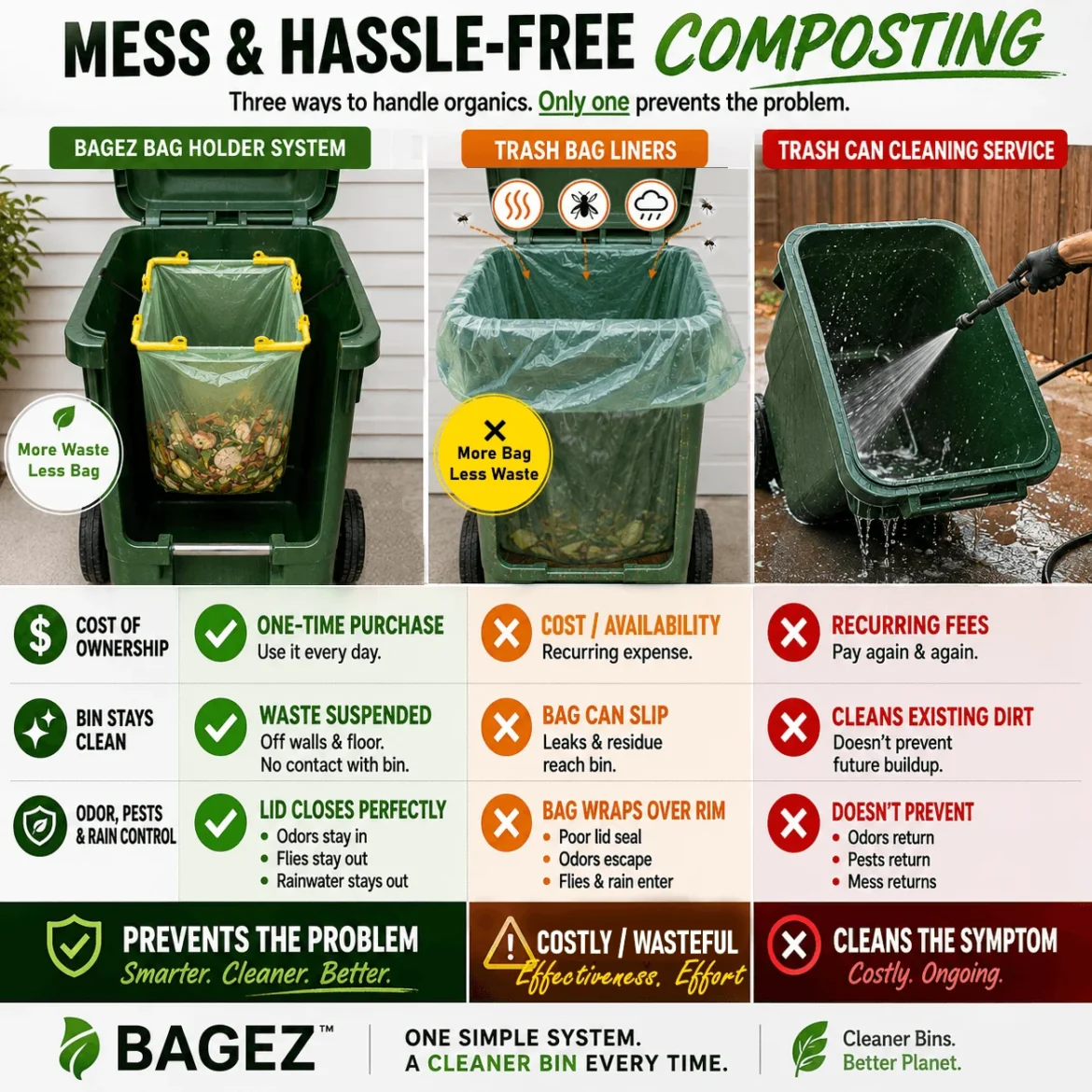
To solve the perennial problem of bin contamination and user fatigue, private innovators have introduced mechanical interventions designed to keep organic waste suspended and isolated from the interior walls of the collection container. One such solution is BagEZ, a folding steel rack equipped with specialized locking clips that secure a standard kitchen or yard waste bag—ranging from 13 gallons (49 liters) and upward—open and suspended inside the curbside cart.
Rather than depositing food scraps directly against the base and sides of the bin, users drop waste into a secured bag. On collection day, the user simply unclips the bag, seals it, lifts out the lightweight steel frame, and wheels the clean, dry cart to the curb. By preventing organic materials from coming into direct contact with the bin’s interior surfaces, the hardware eliminates the primary cause of liquid pooling, sticky residue, and foul odors.
Understanding Household Waste Generation and Sizing

A critical component of optimizing curbside organics management is aligning container size with actual household consumption patterns. Extensive empirical data indicates that consumer perceptions of food waste volume often exceed actual generation rates. The MITRE-Gallup survey, representing the largest household food waste study conducted in the United States to date, surveyed nearly 10,000 households and established that the average American household generates roughly 6.2 cups of edible food waste per week, increasing to approximately 8.8 cups when inedible components such as peels, cores, and bones are included.
This total equates to slightly more than half a gallon per week—a volume vastly smaller than the capacity of a standard 64-gallon or 96-gallon municipal curbside cart. Even households generating waste well above the national average rarely approach filling a large curbside bin with food scraps alone. Consequently, waste management specialists recommend sizing internal collection bags to match realistic household culinary output rather than attempting to line an entire multi-gallon municipal cart. A standard 13-gallon kitchen bag is more than adequate for most families, offering significant cost savings over oversized, full-cart liners while facilitating effective odor-mitigation strategies.
Crucially, however, municipal guidelines must always take precedence over hardware convenience. Program regulations regarding acceptable liners vary widely across North America. While some jurisdictions mandate certified compostable bags, others permit paper or newspaper linings, and a distinct subset requires loose, unbagged food scraps to prevent contamination in industrial composting systems. Residents must verify local regulations through municipal resources or centralized databases such as Earth911’s recycling search tool before altering their waste-disposal routines.
Mitigating Odors, Pests, and the Yuck Factor
The physics of organic waste decomposition dictate that biological materials will naturally release moisture as cellular structures break down. In a traditional curbside bin, this expelled liquid accumulates at the bottom of the container, mixing with loose scraps to create a breeding ground for anaerobic bacteria, pungent odors, and dipteran insects.

Suspension hardware fundamentally alters this dynamic by establishing a continuous perimeter of airflow around the waste bag. Condensation and external moisture evaporate rather than pooling at the bottom of the cart, leaving the structural walls completely dry. Maintaining a dry interior environment enhances the efficacy of traditional odor-neutralizing techniques. A light dusting of baking soda within the confined space surrounding a suspended bag achieves significantly higher concentration and neutralizing power than the same quantity spread across a large, empty bin floor.
Furthermore, dry conditions are an absolute prerequisite for physical pest-control agents such as food-grade diatomaceous earth (DE), which functions by desiccating insect larvae and loses its efficacy upon exposure to moisture. Combined with secondary preventative measures—such as placing a few sheets of absorbent newspaper beneath the suspended bag to catch incidental drips, or attaching a cloth sachet of peppermint and cloves to the exterior of the bin to deter omnivorous wildlife like raccoons and rodents—households can virtually eliminate the nuisance factors that drive program abandonment.
Broader Implications for Municipal Sustainability
As municipalities face tightening landfill capacities and increasingly stringent state and federal emissions targets, the success of curbside organics recycling will depend heavily on consumer retention. Expensive solutions—such as recurring commercial bin-cleaning services or ongoing purchases of oversized, full-bin liners—impose financial burdens that discourage sustained participation. In contrast, durable, one-time hardware investments align consumer convenience with municipal environmental goals.
By preserving the cleanliness of the infrastructure and eliminating the unpleasant labor associated with maintenance, practical innovations demonstrate that high participation rates are achievable without heavy public subsidies. Ultimately, when the green bin ceases to be a domestic chore, organic waste diversion can fulfill its intended promise: transforming municipal refuse into a cornerstone of urban environmental sustainability.
