
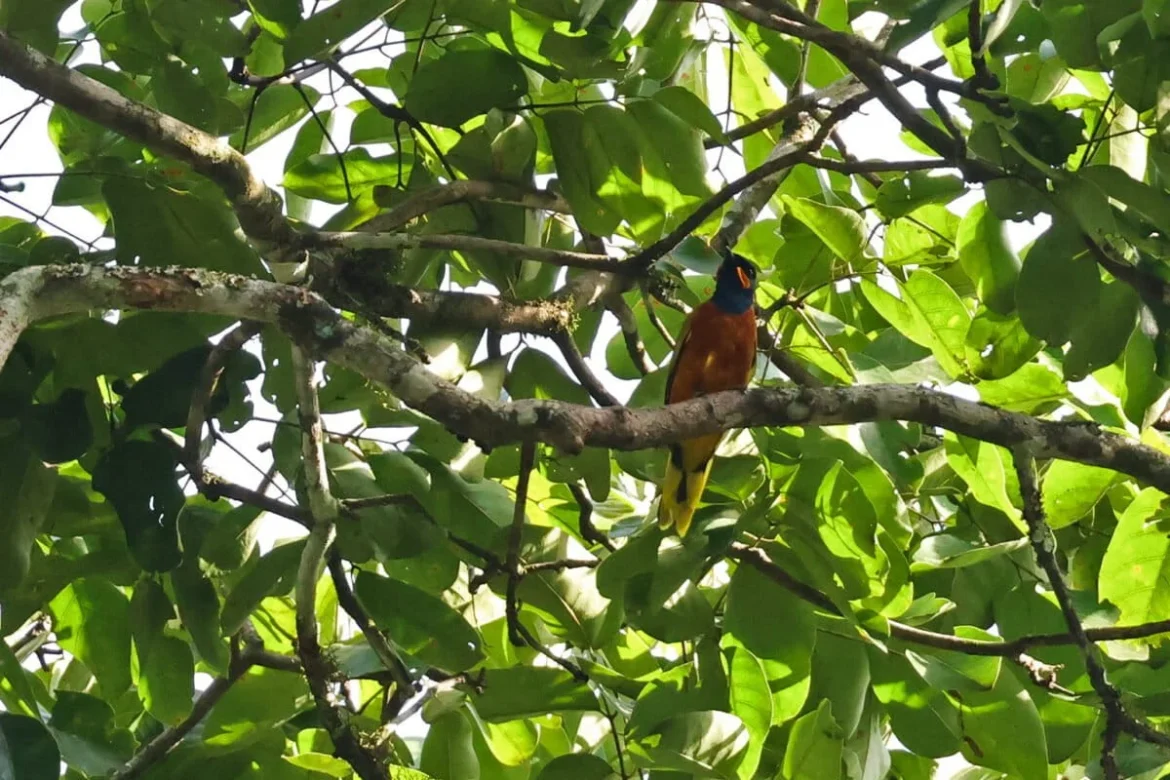
The scientific community is celebrating a significant breakthrough in West African ornithology following the rediscovery of the Ghana cuckooshrike (Lobotos lobatus), a species that had not been documented in over a decade. The bird, characterized by its vibrant orange plumage and distinctive black-and-yellow wing patterns, was located within the dense canopy of Côte d’Ivoire’s Taï National Park. This finding marks a critical milestone for the Search for Lost Birds (SLB), a global initiative dedicated to locating species that have vanished from the scientific record, and provides renewed hope for the conservation of the Upper Guinean Rainforest.
A High-Stakes Expedition in the Upper Guinean Rainforest
The successful identification of the species was the result of a rigorous, months-long field survey conducted by a collaborative team of international and local researchers. The expedition, led by the International Bird Conservation Partnership (IBCP), focused on the biodiversity-rich corridors of Côte d’Ivoire, a nation that serves as a vital refuge for several endangered avian species.
Stephanie Bartlett, a field research fellow with the IBCP, managed to secure the definitive photographic evidence of the bird, while her colleague Paulo Ditzel provided tactical support, tracking the creature’s movements through the foliage. According to Bartlett, the encounter was brief and challenging, emphasizing the inherent difficulty in surveying species that are both rare and notoriously elusive.
"They are incredibly wary," Bartlett noted. "You do not get to approach them easily. In many cases, the camera becomes the primary tool for identification, capturing details that the human eye might miss in the dim, dappled light of the forest canopy." The resulting image provided the first empirical proof that the Ghana cuckooshrike still persists in the wild, effectively ending a 13-year period of uncertainty that began after the last verified sighting in Ghana’s Atewa Forest in 2013.
The Chronology of a Disappearing Species
The Ghana cuckooshrike has long been considered one of the most enigmatic residents of the Upper Guinean Rainforest, a vast ecological region stretching from Guinea to Ghana. The species has historically occupied a precarious position in the records of global ornithology.
- Pre-2013: The species was periodically recorded in the fragmented forests of West Africa, though sightings were always sparse.
- 2013: The last formally documented sighting occurred in Ghana’s Atewa Forest, a site currently facing significant pressure from illegal mining and logging operations.
- 2013–2026: A 13-year "silent period" followed, during which the species was added to the Search for Lost Birds list. During this time, the scientific community struggled to determine whether the population had succumbed to extinction, migrated to inaccessible regions, or simply dwindled to numbers too low to detect.
- September 2026: A dedicated expedition by the IBCP, supported by local researchers, finally confirmed the presence of the bird in Taï National Park, Côte d’Ivoire.
The Ecological Context of the Upper Guinean Rainforest
The Upper Guinean Rainforest is categorized as a biodiversity hotspot, yet it remains one of the most threatened ecosystems in the world. The habitat is characterized by high levels of endemism, meaning many of its species are found nowhere else on Earth. However, the expansion of commercial logging, industrial agriculture, and the encroachment of artisanal gold mining have systematically fragmented the landscape.
For a species like the Ghana cuckooshrike, which relies on intact forest canopies to forage and nest, these disruptions are catastrophic. The fragmentation of the forest creates "islands" of habitat, preventing the genetic flow necessary for a healthy population. The rediscovery in Taï National Park is particularly significant because the park represents one of the largest remaining contiguous blocks of primary forest in the region.
Experts suggest that the bird’s ability to survive in this specific park highlights the necessity of strictly protected areas. While other regions have succumbed to rapid deforestation, Taï remains a bastion of stability, allowing species to persist in niches that have been eradicated elsewhere.

Expert Perspectives on Conservation Strategy
John Mittermeier, director of the Search for Lost Birds and a representative of the American Bird Conservancy (ABC), emphasized the logistical challenges posed by such long-term absences. "You cannot really make an effective conservation plan for a species that nobody has seen in a decade," Mittermeier stated. "Without data on population density, breeding habits, or current range, you are essentially flying blind. You don’t know if you are protecting a thriving population or the last few individuals of a dying lineage."
The rediscovery provides the first vital data point needed to craft a management strategy. By understanding exactly where the bird was found—and identifying the specific micro-habitats it prefers within the park—conservationists can now begin to target their monitoring efforts.
Saint Guillaume Odoukpe, an ornithologist and assistant professor at the Université Félix Houphouët-Boigny, who accompanied the expedition, underscored the collaborative nature of this success. "To say that our local West African researchers were vital for this project is an understatement," he noted. "They possess the intimate knowledge of the forest that makes these discoveries possible. Taï is a treasure for biodiversity conservation, and this finding is a signal that there is still much to explore and much to protect."
Broader Implications for Global Biodiversity
The return of the Ghana cuckooshrike serves as a powerful symbol for the broader conservation movement. In an era dominated by news of environmental degradation and the "sixth mass extinction," the survival of a "lost" species provides a rare, tangible victory.
However, researchers caution against viewing this discovery as an invitation to complacency. The threats that nearly drove the cuckooshrike into oblivion—specifically habitat loss and unregulated resource extraction—remain prevalent. The presence of the bird in Taï National Park is a testament to the effectiveness of the park’s protection, but it also highlights how thin the margin is between existence and extinction.
Furthermore, the methodology used in this search provides a blueprint for future expeditions. By combining high-resolution photography with the expertise of local field researchers and the organizational backing of international conservation bodies, scientists can effectively monitor "at-risk" species that have fallen off the radar.
Looking Toward the Future
The scientific team involved in the search remains optimistic about the potential for further discoveries. As Mittermeier noted, there is a pervasive misconception that the world has been fully mapped and that no new biological wonders remain to be found. The Ghana cuckooshrike proves that, even in heavily studied regions, nature still holds secrets.
"These lost birds are a call to exploration," Mittermeier added. "They remind us that we are the stewards of a living, breathing, and still-surprising planet. The goal now is to ensure that the Ghana cuckooshrike is not just found once, but is given the protection necessary to thrive for generations to come."
Moving forward, the IBCP plans to continue its surveys in the region, using the data from this recent encounter to refine search parameters for other missing species. The focus will remain on the intersection of community-led conservation and rigorous scientific observation, ensuring that the local populations who live in proximity to these habitats are empowered to lead the efforts to safeguard their natural heritage. The Ghana cuckooshrike is no longer lost, but its future—and the future of the forest it calls home—remains a matter of urgent global concern.
