

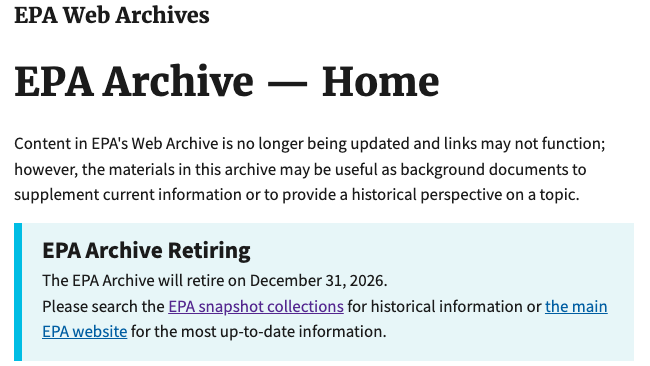
In a move that has sparked significant alarm among environmental scientists, historians, and transparency advocates, the Environmental Protection Agency (EPA) has quietly signaled its intent to decommission its comprehensive online web archive by December 31, 2026. The announcement, relegated to a discreet banner notice on the agency’s archival portal, marks the latest development in a multi-year effort to shutter a repository that serves as a vital digital library of American environmental policy. This impending removal threatens to erase tens of thousands of documents, including technical reports, policy shifts, and regulatory analyses dating back to the 1990s, effectively severing public access to a primary source of institutional memory.
The decision arrives amidst a broader climate of regulatory retrenchment under the current administration. EPA Administrator Lee Zeldin has recently spearheaded a series of aggressive rollbacks, most notably targeting power plant pollution standards and the federal methane regulatory framework. Critics argue that the timing of the archive’s closure is not merely a bureaucratic consolidation, but a strategic effort to restrict the public’s ability to track the evolution of environmental standards—or their systematic dismantling—over the past three decades.
A History of Institutional Friction
The effort to retire the EPA web archive is not a new phenomenon; rather, it is the latest chapter in a long-standing tension between federal data management costs and the necessity of public oversight. In late January 2022, during the early stages of the Biden administration, the agency first signaled its intent to discontinue the repository, citing the high cost of digital maintenance. Freedom of Information Act (FOIA) disclosures at the time revealed that the agency incurred annual costs of approximately $2 million to sustain the site.
The 2022 announcement triggered a swift, nationwide outcry from a coalition of advocacy groups, including the Environmental Data and Governance Initiative (EDGI) and the American Society for Environmental History. These organizations characterized the proposed closure as a severe blow to democratic accountability. Facing intense pressure from the research community, the EPA temporarily relented, announcing a one-year stay of execution to July 2023. By March 2023, the agency further softened its stance, replacing the concrete closure date with an indefinite “retiring” status. This limbo lasted for three and a half years until the recent, abrupt update establishing the final December 2026 deadline.
The Value of the Repository
The archive serves as a critical, albeit imperfect, repository for environmental history. It hosts documentation on landmark policies such as the 2003 Clear Skies Initiative under the George W. Bush administration and the 2015 Clean Power Plan enacted during the Obama presidency. These documents are essential for researchers seeking to understand how pollution standards have been negotiated and modified over the last twenty-five years.
Perhaps most crucially, the archive acted as a vital safeguard during the first term of the Trump administration, when large swaths of federal climate change resources were removed from the agency’s active website. During that period, the archive served as the only public access point for the deleted information, preserving a record of scientific consensus and policy commitments that might otherwise have vanished from the digital landscape.
Beyond policy, the archive has served as a practical tool for environmental justice. A primary example is the documentation regarding the contamination at Marine Corps Base Camp Lejeune in North Carolina. EPA records preserved on the archive allowed affected service members and their families to reconstruct the history of the site’s contamination and the government’s response to it. By maintaining these records, the archive provided a foundation for those seeking to hold authorities accountable for the long-term health impacts of toxic exposure. The ongoing relevance of this information is underscored by recent political rhetoric, including President Trump’s recent suggestion that compensation for Camp Lejeune victims could be linked to congressional election outcomes.
Implications for Transparency and Public Trust
The potential loss of this information comes at a time when public trust in federal institutions is at a historic low. According to data from the Pew Research Center, faith in the government’s transparency and efficacy has been in a steady decline for years. Experts contend that the removal of these archives will exacerbate this trend by forcing citizens, journalists, and scientists to rely on inefficient, high-latency processes to obtain public information.
“Killing easy access to records forces researchers and lawmakers to flood an already underwater FOIA office just to see once-public records,” explains Lauren Harper, the first Daniel Ellsberg chair on government secrecy for the Freedom of the Press Foundation. Harper notes that while the EPA suggests users turn to “snapshot collections,” these static, periodic archives are rarely a substitute for a searchable, indexed database of active government work.
The logistical burden of this transition cannot be overstated. When documents are removed from a centralized, searchable archive, they are essentially relegated to the “dark web” of government records—accessible only to those with the time and resources to navigate the labyrinthine FOIA process. For non-profits, academic researchers, and local community groups, this represents a significant barrier to entry, effectively privatizing the cost of public information by shifting it from the agency’s budget to the time and labor of the public.
Technical Limitations and Future Risks
While the current archive has been criticized for its clunky interface and occasional broken links, it represents the most comprehensive singular repository of EPA history. The agency’s proposal to transition users to “snapshot collections” has been met with skepticism. These snapshots are static captures of the website taken at specific intervals, which often fail to capture the nuance of internal document trees or the complete metadata associated with regulatory filings.
Moreover, the broader context of the current administration’s fiscal policy—characterized by significant budget cuts to federal environmental agencies and personnel—raises questions about the long-term viability of even these snapshot collections. There is a tangible fear among data archivists that the “snapshots” may themselves be subject to future deletions or suffer from technical obsolescence, leading to a permanent loss of historical data.
Official Response and Outlook
To date, the EPA has not issued a formal statement explaining why the archive must be decommissioned now, or why it cannot be migrated to a more modern, cost-efficient hosting infrastructure. The agency’s silence has left many stakeholders concerned that the move is part of a broader, intentional effort to reduce the administrative burden of accountability.
Gretchen Gehrke of EDGI, who has spent over a decade monitoring the preservation of federal environmental data, remains critical of the agency’s trajectory. “The EPA should expand and systematize the archive, not throw it away and expect that three discrete snapshots will suffice,” she argued. Her sentiment is shared by an increasingly concerned scientific community that views the preservation of data as a fundamental component of the agency’s mandate to protect public health and the environment.
As the December 31 deadline approaches, the future of the EPA’s digital legacy remains uncertain. For now, the documents remain accessible, but they represent a fading record of a federal institution’s actions. The loss of this digital archive would not only mean the deletion of files; it would signal a profound shift in the relationship between the federal government and the public it serves—moving toward a model where historical transparency is treated as an optional convenience rather than a democratic necessity. Whether this decision can be reversed through public pressure, as it was in 2022, remains the central question for those fighting to ensure the environmental history of the United States remains an open book.
