
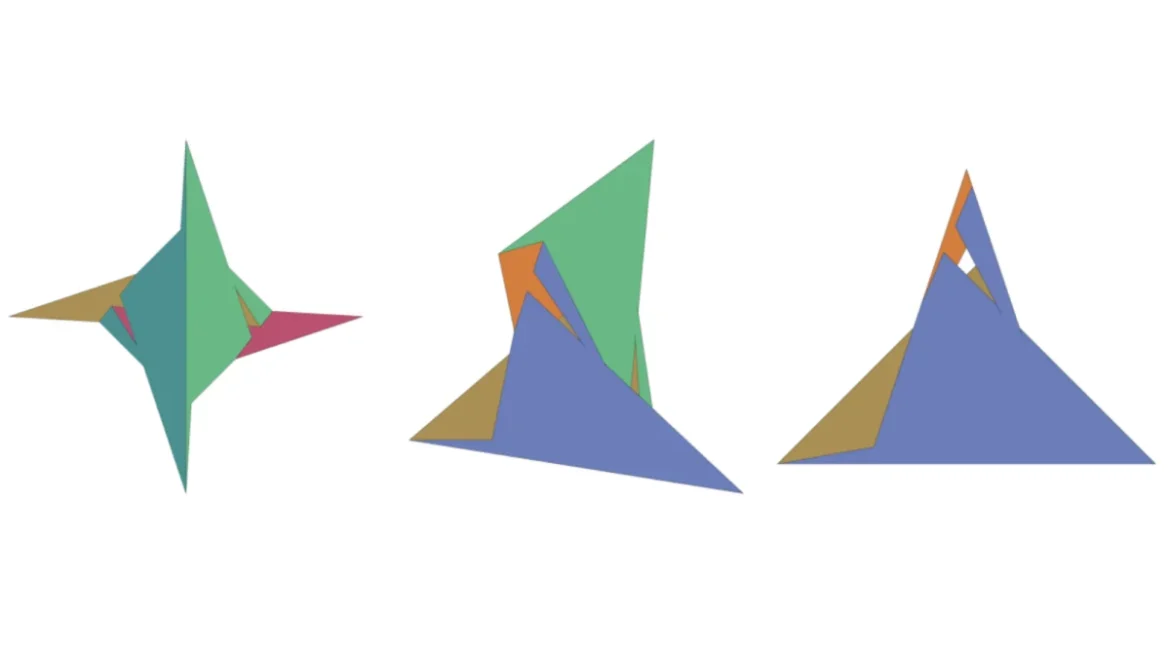
The discovery, spearheaded by independent researcher Ruslan Mizhaev, marks a significant milestone in the field of combinatorial topology. By identifying a structure where eight faces are arranged in a precise configuration—specifically, one where every pair of faces shares at least one edge—Mizhaev has expanded the finite list of known polyhedra that defy traditional Euclidean expectations. This shape is not merely a theoretical curiosity; it is a meticulously calculated object defined by 26 edges, 24 vertices, and a complex topological architecture featuring three distinct holes.
The Anatomy of a Toroidal Polytope
To understand the magnitude of the genus-3 polyhedron, one must first distinguish it from the standard polyhedra encountered in secondary education. A standard polyhedron, such as the Platonic solids, is a solid in three dimensions with flat polygonal faces, straight edges, and sharp corners or vertices. These shapes are convex, meaning any line segment connecting two points on the surface lies entirely within the object.
In contrast, the genus-3 polyhedron belongs to the family of toroidal polytopes. In geometry, "genus" refers to the number of holes in a topological surface. A sphere has a genus of zero, a donut (torus) has a genus of one, and a figure-eight or a coffee mug (often used in topology demonstrations) has a genus of one or higher depending on the number of handles. Mizhaev’s discovery, possessing a genus of three, effectively means the shape is a three-holed torus modeled through the rigid, straight-edged requirements of a polyhedron.
The mathematical properties of this shape are striking:
- Faces: 8
- Edges: 26
- Vertices: 24
- Connectivity: 20 pairs of faces share a single edge, while 8 pairs share two edges.
- Vertex configuration: Exactly three faces meet at every vertex.
Historical Context and Chronological Development
The study of such shapes has a long, albeit niche, history. The quest to find polyhedra with unusual connectivity often begins with the Euler characteristic. For simple convex polyhedra, the formula V – E + F = 2 (where V is vertices, E is edges, and F is faces) holds true. However, for toroidal polyhedra, the formula changes to V – E + F = 2 – 2g, where ‘g’ represents the genus.
The historical trajectory of this field is defined by several key milestones:
- 19th Century – The Foundation: Mathematicians began exploring non-convex shapes, though the focus remained primarily on symmetry rather than high-genus connectivity.
- 1977 – The Császár Polyhedron: Ákos Császár identified a non-convex polyhedron with seven faces, where every face shared an edge with every other face. It had no diagonals and no vertices of the same type.
- 1977 – The Szilassi Polyhedron: Lajos Szilassi discovered a dual to the Császár polyhedron, possessing 14 vertices, 21 edges, and 7 hexagonal faces. It also featured a hole, marking a major jump in topological understanding.
- 2026 – The Mizhaev Breakthrough: Following decades of relative silence in the discovery of new, fundamental toroidal shapes, Ruslan Mizhaev published his preprint, detailing a construction that utilizes integer coordinates to define a genus-3 structure, effectively pushing the boundaries of what is possible in finite, flat-faced, three-dimensional geometry.
Methodology and Mathematical Implications
Mizhaev’s research, currently circulated as a preprint, provides a rigorous coordinate-based proof for the existence of the genus-3 polyhedron. Unlike abstract shapes that exist only in four or more dimensions, this shape is distinctly three-dimensional, though its visual representation often strikes the lay observer as a "glitch in reality."
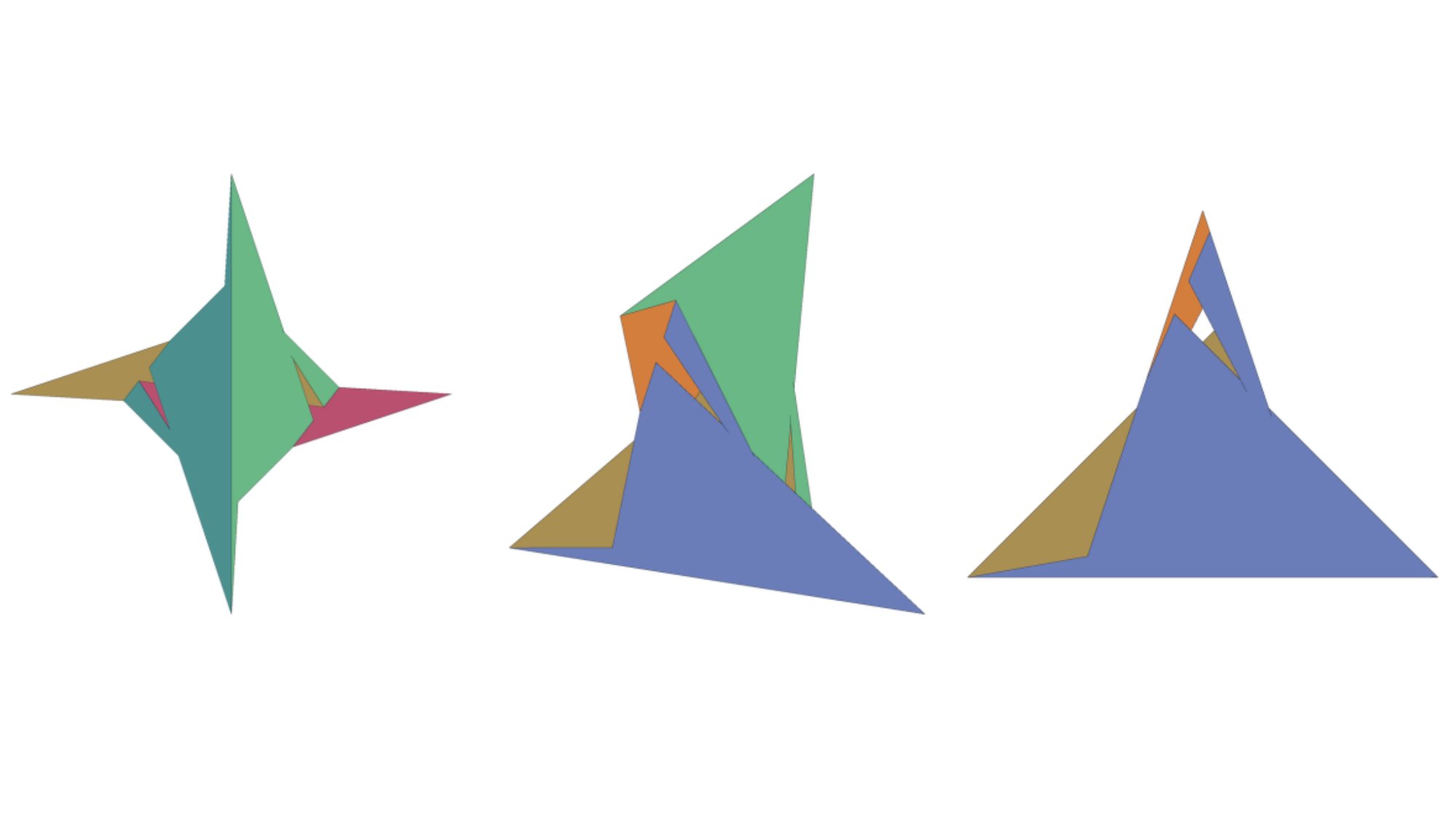
The ability to map this shape using simple integer coordinates is significant. It allows computer scientists and mathematicians to render the object with absolute precision. This is essential for fields like computer-aided design (CAD) and finite element analysis. By providing a coordinate set, Mizhaev has made it possible for the mathematical community to verify the structure independently using computational geometry software.
"The study of these objects is not merely about finding a new shape for the sake of cataloging," says one anonymous researcher in the field of topology. "It is about understanding the limitations of space. By determining how many faces can share edges in a three-holed environment, we are effectively mapping the fundamental rules of combinatorial topology."
The Role of Preprints in Modern Mathematics
The dissemination of the genus-3 polyhedron via an arXiv preprint highlights the shifting landscape of scientific publishing. In the past, a discovery of this nature would have required months, if not years, of peer review before reaching the public eye. Today, the preprint model—though not formally peer-reviewed in the traditional journal sense—allows for rapid feedback from the global mathematical community.
While some critics argue that the lack of formal peer review risks the proliferation of incorrect proofs, proponents suggest that the "crowdsourced" verification process is often more rigorous for highly technical subjects. Since the release of Mizhaev’s paper, the academic community has been actively engaged in stress-testing the coordinates provided. If the structure holds under this scrutiny, it will likely be canonized in future textbooks alongside the Császár and Szilassi polyhedra.
Potential Applications and Theoretical Impact
While the genus-3 polyhedron may appear esoteric, the implications for graph theory and material science are substantial. Understanding how faces connect in a high-genus environment can inform the development of complex lattice structures. These lattices are increasingly important in additive manufacturing (3D printing), where engineers seek to create materials that are both lightweight and structurally rigid.
Furthermore, the study of toroidal polytopes provides insights into the "coloring" of shapes. The Map Color Theorem, for example, dictates how many colors are needed to ensure no two adjacent regions share the same color. For a sphere, the answer is four; for a torus, it is seven. The genus-3 polyhedron serves as a laboratory for testing these conjectures in higher-genus environments, helping mathematicians refine the bounds for map-coloring in complex, multi-holed manifolds.
Broader Scientific Significance
Does the genus-3 polyhedron exist in nature? Current evidence suggests that such complex, high-genus polyhedral shapes are rare in biological or geological formations. Nature tends to favor structures that minimize surface energy, such as spheres or minimal surfaces like the catenoid. However, the discovery suggests that such configurations are mathematically possible, and as synthetic biology and nanotechnology advance, the ability to engineer materials at the molecular level with such specific topological properties could become a reality.
As the scientific community continues to analyze Mizhaev’s findings, the genus-3 polyhedron stands as a reminder that geometry—a field often perceived as complete—remains an active frontier. Each new discovery, whether it is a novel arrangement of eight faces or a complex, multi-holed torus, provides a new lens through which to view the architectural limits of our universe. Whether this shape eventually finds utility in aerospace engineering, architectural design, or simply serves as a foundational building block for future topological inquiry, its introduction into the mathematical canon is a testament to the enduring human capacity for geometric exploration.
