
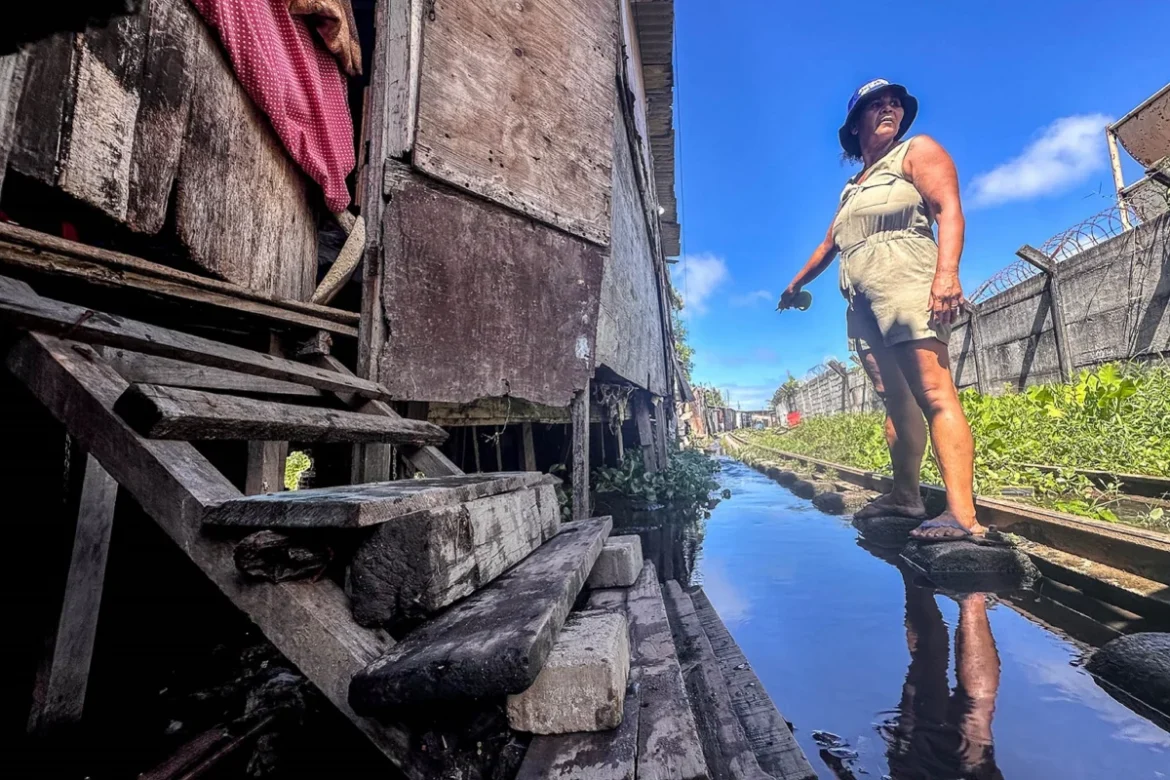
In the neighborhood of Ibura de Baixo, located in the South Zone of Recife, the day for 27-year-old Jeyne Araújo begins at 4 a.m. While the capital of Pernambuco state remains shrouded in darkness, the rhythmic scraping of buckets and drums against concrete signals a grim daily ritual. In a city where running water is a luxury rather than a guarantee, Araújo spends her early hours competing for a limited, erratic flow that lasts, at best, six hours a day. By the time the sun rises, she must have stockpiled enough water to sustain her family, or face the prospect of a completely dry household.

The water that finally trickles from her tap is far from potable. It arrives heavily treated with chlorine, emitting a sharp chemical odor and often appearing as a thick, soapy, white froth. It is, by her account, unusable for cooking or drinking. The health consequences have been severe; her 9-year-old son, Wesley, recently spent months battling persistent vomiting and intestinal distress, which doctors at Areias Hospital attributed to food prepared with the tainted tap water. Forced to divert funds from her 950-reais ($180) monthly Bolsa Família welfare stipend, Araújo now spends a significant portion of her income on bottled water, a tax on poverty that deepens her financial precarity.
The Geography of Inequality
Araújo’s struggle is not an isolated incident of infrastructure failure; it is a systemic reality defined by what researchers characterize as "water racism." Data cross-referenced by environmental investigators between the Pernambuco Sanitation Company (Compesa) supply schedules and the 2022 IBGE census reveals a harrowing "water map" of Recife. The city’s water distribution mirrors its historical racial and economic segregation.

Of the 311 locations surveyed in July 2026, 236 suffer from chronic, long-term supply interruptions. These shortages are not distributed randomly. They are heavily concentrated in neighborhoods populated predominantly by Black and mixed-race residents, where the average per capita income sits between 1,100 and 2,300 reais ($206–$430).
Under guidelines established by the National Water and Basic Sanitation Agency (ANA), a standard of "adequate" service implies that water should be available for more than 18 hours a day, totaling at least 540 hours per month. In practice, however, Recife’s peripheral neighborhoods receive a fraction of this. Ibura, for instance, receives a mere 91 hours of water per month—roughly 17% of the national benchmark. Conversely, affluent enclaves such as Boa Viagem, Apipucos, and Espinheiro—home to predominantly white, higher-income populations—enjoy nearly uninterrupted service, often exceeding 700 hours per month.

A Chronology of Crisis and Climate Vulnerability
The water crisis in Recife is inextricably linked to the city’s broader climate vulnerability. The 2022 floods serve as a grim turning point in the city’s recent history, exposing the deadly intersections of poor infrastructure and environmental neglect. During those disasters, residents like Araújo lost more than just property; they lost lives. Her partner was electrocuted after stepping into a submerged, live power line—a tragedy she notes was exacerbated by a 90-minute delay in the power utility’s emergency response.
The neighborhood of Linha do Tiro offers a stark example of this dual-threat environment. Designated as an area of high (R3) and very high (R4) hydrological risk in the 2026 Contingency Plan, the area is prone to both life-threatening landslides and extreme water scarcity. Residents here exist in a perpetual state of "emergency management": they live in fear of mudslides during the rainy season and scramble for water during the dry months. The juxtaposition is jarring—homes cling to steep hillsides where the lack of retaining walls threatens to pull structures down, while the residents inside are forced to live without the basic sanitation needed to maintain health during heatwaves or to clean up after the mud that inevitably invades their homes.

Privatization and the Question of Accountability
The political response to this crisis has been the signing of a massive, 17.4-billion-reais ($3.3 billion) partial concession contract with BASA Saneamento in April 2026. Governor Raquel Lyra has championed the deal as the only viable path to universalizing sanitation in the state. However, the move has sparked intense pushback from experts and labor associations.
Anderson Quadros, president of the Association of Higher-Level Employees of Compesa (Procompesa), warns that the contract structure is fundamentally flawed. By outsourcing the lucrative distribution and sewage collection segments while leaving the high-cost, high-risk production and extraction operations to the state-run utility, the government may be setting the stage for long-term fiscal collapse. Quadros argues that the private sector’s profit motive is inherently incompatible with the massive engineering challenges of the hillsides. "They didn’t go up a single hill in thirteen years," he says, referencing previous failed public-private partnerships in the region.

The state government, in defense of the contract, maintains that there is no clause authorizing differential service based on profitability. However, the lack of explicit contractual requirements for specific infrastructure investments in marginalized zones remains a major point of contention. While BASA Saneamento claims it will allocate funds based on technical criteria, critics argue that the capital will naturally flow to the easiest-to-reach, high-profit areas, leaving the hillsides in their current state of neglect.
The Scientific Reality of Scarcity
From a hydro-geological perspective, Pernambuco is one of the most water-stressed regions in Brazil. With an average per capita availability of just 1.27 million liters per year—only 3.6% of the national average—the state effectively functions as a semi-arid zone. Professor Maria do Carmo Sobral of the Federal University of Pernambuco (UFPE) notes that the metropolitan area has reached its physical limit for surface water extraction.

"The last major water source was the Pirapama dam," Sobral explains. "We have no other river to tap within a 50-kilometer radius." Given this limitation, the focus must shift from expansion to efficiency. Currently, an estimated 50% of treated water is lost to leaks in the distribution system. Furthermore, the reliance on the Beberibe aquifer—which is currently threatened by saltwater intrusion and industrial contamination—demands more rigorous protection of riparian forest buffers around the region’s seven main reservoirs.
The Human Cost of Systemic Failure
For those living on the front lines of this crisis, the political maneuvering over contracts feels distant from the reality of their daily survival. Residents like Alessandra Maria da Silva, who lives in a stilt shack in the Cacique Chicão settlement, face a total lack of basic infrastructure. Her home is surrounded by stagnant, sewage-filled pools, and her access to water is limited to a makeshift hose hooked into a decommissioned main line.

Similarly, in Linha do Tiro, residents like "Joana" (a pseudonym) spend their lives in a state of high-alert anxiety. When the water does arrive, it is a race to fill every available vessel; when it doesn’t, she must navigate a steep, treacherous path down the hillside to borrow water from a neighbor’s well. For others, like Maria do Bom Parto, the solution has been to fund their own infrastructure—drilling private wells—despite the uncertainty of the water’s safety.
Future Implications
The broader implications for Brazil’s 2020 Legal Framework for Basic Sanitation are concerning. While the law mandates 99% water access by 2033, the initial years of implementation have seen a deceleration in progress. Nationwide water coverage has actually contracted by 0.5% in the last five years, and the pace of sewage expansion has dropped significantly.

In Recife, the reliance on a model that prioritizes the sale of public assets over direct investment suggests that the status quo of inequality may persist. If the current concession leads to the further weakening of Compesa—which analysts predict could suffer billions in losses under the new tariff structure—the city risks losing its capacity to intervene in future emergencies.
The cycle of "water poverty" in Recife is not merely a technical failure of pipes and pumps; it is a manifestation of social and racial exclusion that has been decades in the making. As the climate continues to shift, bringing more extreme floods and more severe droughts, the gap between the city’s affluent, water-secure neighborhoods and the forgotten, thirsty hillsides will likely widen. Without a radical change in policy that treats water as a human right rather than a commodity, the morning routine of Jeyne Araújo—the desperate, pre-dawn scramble for a bucket of water—will remain a permanent feature of life in Recife.
