
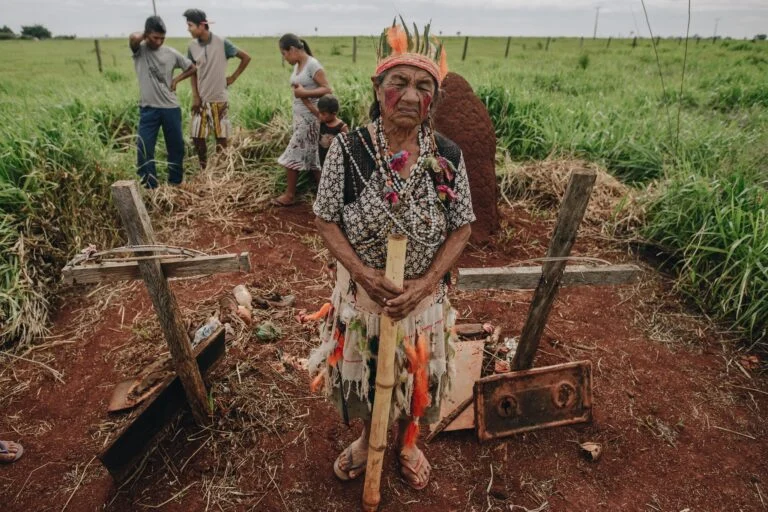
Following the October 25 reelection of President Luiz Inácio Lula da Silva, a wave of targeted hostility has swept through the state of Mato Grosso do Sul, placing the Guarani-Kaiowá Indigenous people at the center of a volatile political backlash. While the election was celebrated by many as a victory for human rights and environmental protection, the transition period has been marked by a series of chilling threats, including the alleged planning of chemical attacks on communal water supplies. This surge in aggression underscores the deep-seated tensions that persist in Brazil’s interior, where land rights, political polarization, and historical grievances collide with the rights of the country’s original inhabitants.
The most disturbing incident occurred in the municipality of Tacuru, where two municipal employees were caught allegedly circulating audio messages via WhatsApp that called for the mass poisoning of the water supply used by local Guarani-Kaiowá communities. The audio recordings, which were swiftly reported to the Ministry of Indigenous Peoples (MPI) and the Federal Public Ministry (MPF), contained explicit calls to "kill those pests in the water" as retaliation for the community’s electoral support for President Lula. The discovery of these messages has ignited a national conversation regarding the normalization of hate speech and the physical vulnerability of Indigenous populations in an increasingly polarized Brazil.
A Chronology of Escalating Tensions
The political climate in Mato Grosso do Sul has been deteriorating for months, culminating in the aftermath of the October run-off election. The timeline of recent events highlights a rapid shift from political discourse to overt acts of violence:
- Late October 2026: Immediately following the declaration of President Lula’s victory, reports of post-election violence began to emerge across the state. Indigenous communities, which had mobilized heavily to support the incumbent, found themselves identified as primary targets by local political factions.
- Late October 2026 (Tacuru Incident): WhatsApp audio messages surfaced, revealing that local government employees in Tacuru were inciting violence by suggesting the poisoning of water sources utilized by Indigenous residents.
- Early November 2026: The Tacuru municipal government issued a 20-day suspension for the two employees involved. Administrative proceedings were initiated, and the Federal Police began a formal investigation into the threats.
- Post-Election Weeks: Concurrent with the verbal threats, physical attacks were reported, including hit-and-run incidents targeting Indigenous individuals and the arson of a home belonging to Ñandesy Roberta, a 90-year-old Guarani-Kaiowá spiritual leader.
The Context of the Guarani-Kaiowá Struggle
The Guarani-Kaiowá are the second-largest Indigenous group in Brazil, numbering roughly 50,000 people. For decades, they have been locked in a protracted, often violent, struggle to reclaim their ancestral lands, which have been largely encroached upon by the massive expansion of the soy and cattle industries. Mato Grosso do Sul is frequently cited by human rights organizations as one of the most dangerous places in Brazil for Indigenous activists.
The conflict is not merely about land; it is about the erasure of cultural identity and the systematic denial of basic resources. The threat to poison water is particularly symbolic and tactical. In many of these territories, the water supply is the lifeblood of the community, and contaminating it would serve as a brutal method of forced displacement. Matias Benno Rempel, coordinator of the Indigenous Missionary Council (Cimi) in Mato Grosso do Sul, noted that these threats are not merely empty words. "Talking about poisoning the water in Mato Grosso do Sul is not just verbal racism; it is not merely a message of hate," Rempel stated. "It is grounded in concrete reality, drawing from numerous instances where this has been a recurring tactic used against the state’s Indigenous peoples."
Institutional Responses and the Fight for Accountability
In response to the growing violence, federal agencies have scrambled to establish a security presence. The Federal Public Ministry (MPF) has opened comprehensive investigations into the wave of attacks, treating the Tacuru incident as a potential crime against humanity. Meanwhile, the National Indigenous People Foundation (Funai) has officially classified the situation as a grave human rights crisis.
"The reports are extremely concerning," Funai stated in an official release, emphasizing that these actions constitute potential instances of discrimination and hate speech that violate both the Brazilian Constitution and international human rights law. The Ministry of Indigenous Peoples has responded by establishing a specialized task force to track and investigate political violence against Indigenous and Afro-Brazilian groups. A dedicated hotline (+55 11 98202.5433) has been set up to allow victims and witnesses to report threats directly to federal authorities.

Despite these efforts, the response from local authorities, such as the 20-day suspension of the Tacuru employees, has been widely criticized by civil society groups as insufficient. Activists argue that temporary suspensions fail to address the culture of impunity that emboldens perpetrators. Rempel and other human rights advocates are calling for full criminal prosecution, arguing that anything less than severe legal consequences will only encourage further aggression.
The Legacy of Bolsonarism and Political Polarization
Analysts often point to the rise of "Bolsonarism"—the far-right political movement championed by former President Jair Bolsonaro—as a catalyst for the current volatility. During his term, the rhetoric regarding Indigenous rights shifted significantly, with federal protections often weakened and environmental regulations rolled back to favor industrial agriculture.
The movement created a landscape where local political actors felt empowered to challenge the rights of Indigenous peoples openly. According to researchers, the current post-election climate represents an "additional layer" of a long-standing crisis. The political identity of the Guarani-Kaiowá—who are increasingly organized, politically active, and vocal in their demands for land demarcation—is viewed by some rural landowners and local political elites as an existential threat to their economic interests. This clash of worldviews has turned the democratic process itself into a flashpoint for violence.
Economic and Social Implications
The economic stakes in Mato Grosso do Sul are immense. The state is an agricultural powerhouse, and the competing claims over territory—between large-scale, capital-intensive farming and small-scale, traditional Indigenous land use—create a persistent cycle of instability. The violence reported recently is not isolated; it is a manifestation of the structural tension inherent in Brazil’s current development model.
Beyond the immediate physical danger, the psychological impact on Indigenous communities is profound. The constant threat of arson, hit-and-runs, and environmental sabotage forces communities to live in a state of perpetual emergency. This limits their ability to practice their culture, farm their traditional crops, and educate their children, effectively trapping them in a cycle of poverty and marginalization.
Looking Forward: A Path to Protection?
The situation in Mato Grosso do Sul serves as a litmus test for the current administration’s ability to protect its most vulnerable citizens. Minister of Indigenous Peoples Eloy Terena has pledged that the government will "continue to combat all forms of violence against Indigenous communities." However, the path forward remains complex. To truly curb the violence, the government must move beyond investigative task forces and address the underlying issues:
- Land Demarcation: The legal recognition of ancestral lands is the most effective way to provide security and sovereignty to Indigenous groups.
- Judicial Reform: Strengthening the ability of the Federal Police to prosecute local officials and private citizens who engage in hate crimes is essential to breaking the cycle of impunity.
- Social Dialogue: Developing mechanisms for conflict resolution that involve local stakeholders, while ensuring the primacy of constitutional Indigenous rights, could help mitigate the extreme polarization seen in municipalities like Tacuru.
As the investigation into the Tacuru threats continues, the eyes of the international human rights community remain fixed on Brazil. The resilience of the Guarani-Kaiowá, who continue to vote, protest, and advocate for their rights despite the threat of violence, serves as a testament to their enduring struggle. Whether the Brazilian state can provide the necessary protection for these communities will likely define the success of the current administration’s commitment to human rights and the rule of law. The events in Mato Grosso do Sul are a stark reminder that democratic elections, while a necessary step, are only the beginning of a much larger effort to secure justice and safety for all of Brazil’s diverse populations.
