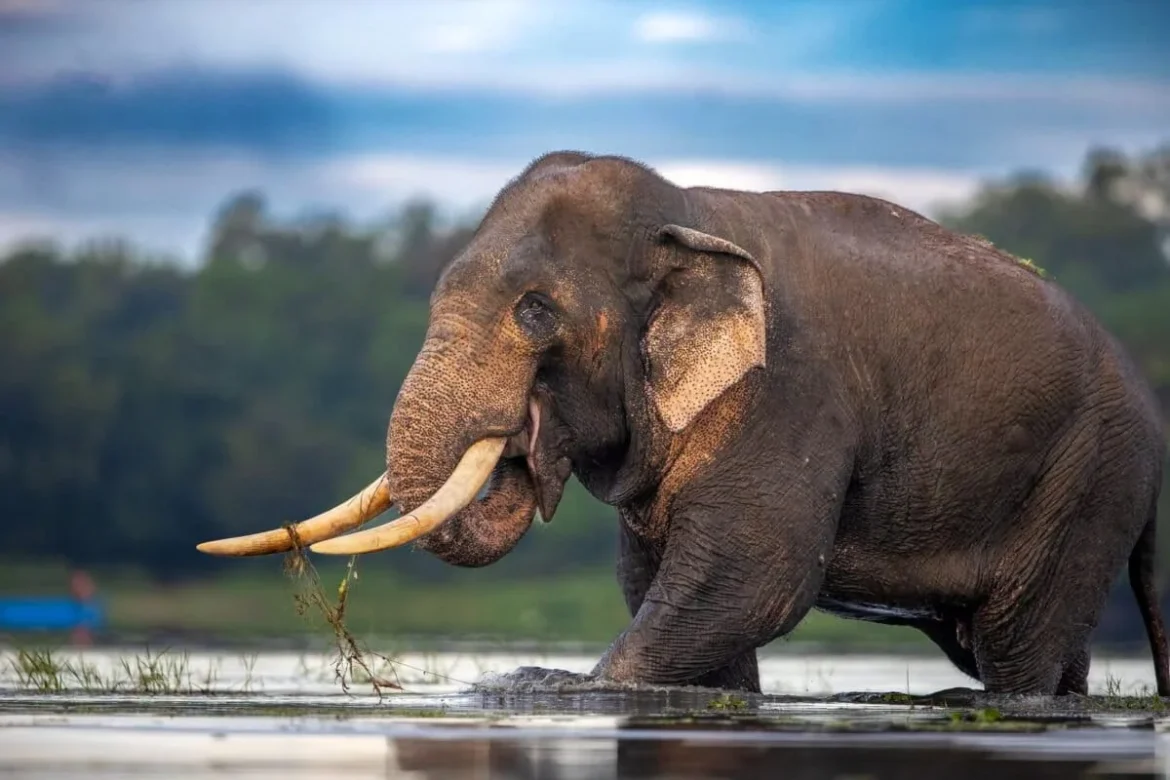
The death of Kavantissa, one of Sri Lanka’s most legendary wild tuskers, following a fatal gunshot injury, has triggered an extraordinary wave of public grief, intense political scrutiny, and a fierce national debate regarding the efficacy of wildlife management and the ongoing human-elephant conflict (HEC). The demise of the majestic elephant—named after an ancient Sinhala king—has served as a tragic flashpoint, uniting Buddhist monks, high-ranking politicians, and conservationists in a collective, albeit unsuccessful, bid to preserve a symbol of the nation’s dwindling natural heritage.

Kavantissa’s final days were marked by a frantic race against time. As his condition deteriorated, the elephant became the focal point of a massive public mobilization. Images of the leader of the opposition, Sajith Premadasa, visibly mourning the creature, and the Minister of Environment, Dhammika Patabendi, visiting the site amidst torrential rain, were widely circulated. These moments were accompanied by spiritual interventions, as Buddhist monks performed traditional Pirith chants to invoke healing, while prominent business leaders offered financial backing for emergency veterinary intervention, including the potential procurement of international specialists. Despite these efforts, Kavantissa succumbed to cardiac arrest on October 16 at approximately 6:18 p.m., marking the end of a life that had come to represent the precarious existence of elephants in a rapidly urbanizing landscape.
A Chronology of the Tragedy
The decline of Kavantissa was not an overnight occurrence but a prolonged, painful process that began in late September. Wildlife enthusiasts and local villagers first observed the tusker exhibiting signs of distress in the Galgamuwa region of northwestern Sri Lanka.

- September 22: Kavantissa was first observed limping, indicating a physical injury that would later be identified as a gunshot wound, likely inflicted by a "trap gun"—a crude, illegal, but common weapon used by farmers to deter crop-raiding elephants.
- September 24: The Department of Wildlife Conservation (DWC) initiated formal medical intervention, administering antibiotics via dart.
- September 25: Veterinarians proceeded to sedate the tusker to conduct a more thorough examination of his wounds.
- October 2: Following an initial period where he appeared to be responding to treatment, the elephant disappeared from the sight of observers, sparking concern among trackers and enthusiasts.
- October 5: Medical staff observed severe symptoms, including acute diarrhea, indicating a systemic failure or severe infection.
- October 15: The elephant’s health reached a critical threshold, and he collapsed, unable to stand again.
- October 16: Despite a desperate attempt by senior veterinary surgeons to perform manual cardiopulmonary resuscitation (CPR) on the massive animal, Kavantissa passed away.
The Controversy Surrounding Veterinary Care
The aftermath of Kavantissa’s death was characterized by public anger directed squarely at the Department of Wildlife Conservation (DWC). Critics on social media platforms, fueled by video footage showing wildlife officers repeatedly darting the already weakened animal, alleged that the treatment protocol was flawed. Speculation regarding the potential for antibiotic overdose or improper anesthesia techniques circulated widely, turning the digital sphere into a courtroom of public opinion.
In response, DWC Director General Ranjan Marasinghe issued a robust defense of his department. "When an iconic tusker like Kavantissa is injured, our team of veterinarians acts as a collective unit," Marasinghe stated. "We invite the opinions of other senior veterinarians in the country who specialize in pachyderm care. This was a planned, deliberate, and expert-led operation, not a haphazard attempt."

Dr. Tharaka Prasad, the former director of wildlife health, urged for a more clinical approach to the tragedy. He emphasized that the symptoms—specifically the lack of defecation and subsequent severe diarrhea—must be analyzed through the lens of a formal necropsy and medical history rather than emotional conjecture. "The clinical questions raised by his final symptoms require an assessment of his complete medical records and the post-mortem findings," he noted, echoing the call for an independent, evidence-based investigation to ensure that procedural failures, if any, are identified and rectified.
The Scale of the Crisis: Data and Statistics
Kavantissa’s death is not an isolated incident but a symptom of a systemic crisis. Sri Lanka’s elephant population remains under constant threat from habitat fragmentation and lethal retaliation from farmers. According to data provided by the DWC, the annual death toll for wild elephants remains alarmingly high:

- 2023: 488 elephant deaths, with 98 confirmed as the result of gunshot injuries.
- 2024: 388 elephant deaths, with 84 confirmed as the result of gunshot injuries.
- 2025: 455 elephant deaths, with 79 confirmed as the result of gunshot injuries.
While the raw number of shooting-related deaths has seen a marginal decline over the last three years, the persistent use of illegal firearms remains a primary driver of the conflict. The issue is deeply tied to the economic desperation of rural communities. The practice of issuing firearms to farmers to protect agricultural yields—a move meant to secure livelihoods—has inadvertently created a proliferation of weapons in areas where human-elephant overlap is absolute. Conservationists argue that while the protection of human property is a valid concern, the current reliance on lethal force is unsustainable and serves to exacerbate the cycle of violence.
Implications and the Path Forward
For Prithiviraj Fernando, a lead scientist at the Center for Conservation and Research (CCRSL), the national mourning for Kavantissa provides a vital, yet narrow, window of opportunity to address the root causes of the human-elephant conflict. He warns against the "celebrity elephant" trap, where public attention is fixated on single, majestic individuals while the broader population continues to dwindle.

"From an ecological standpoint, the death of an iconic tusker is no different from the death of any other elephant," Fernando explained. "The loss is tragic, but the fixation on one individual obscures the fact that hundreds of elephants die every year due to the same systemic failures. We cannot protect these animals through round-the-clock surveillance or by assigning individual guards. The habitat is too vast, and the threats—like hidden trap guns—are too pervasive."
Fernando argues that the only viable solution is landscape-level management. This includes creating corridors that allow for natural movement, compensating farmers for crop losses through insurance schemes rather than weaponry, and implementing sustainable land-use policies that reduce forest clearing.

Ethical Debates on Conservation Practice
The aftermath of the death also sparked an ethical debate regarding the treatment of the tusker’s remains. Following the post-mortem, the DWC separated the head from the body to secure the ivory, while the remainder was cremated.
Dr. Fernando criticized this move, suggesting that it contradicts the conservation ethos. "Retaining the tusks, even for ‘official’ reasons, keeps the focus on the value of the ivory," he argued. He suggests that in the future, the cremation of the entire carcass, including the tusks, would send a powerful message: that an elephant’s life is priceless and that its ivory has no place in the human market, not even as a trophy or a relic.

Conclusion
The death of Kavantissa has served as a poignant reminder that Sri Lanka’s natural heritage is being eroded by the friction between human progress and wildlife preservation. While the public’s emotional response demonstrates a deep-seated cultural affinity for these animals, the transition from grief to meaningful policy reform remains the primary challenge. Whether the government will move beyond commemorative ceremonies and into the realm of structural change—addressing the availability of illegal firearms, improving habitat connectivity, and providing genuine support for farmers—remains to be seen. For now, the legacy of Kavantissa stands as a cautionary tale of a giant lost to a conflict that, with sufficient political will and scientific application, could be managed and eventually mitigated.