
For decades, the standard paradigm for detecting neutron star collisions—the cataclysmic mergers of the universe’s densest stellar remnants—has relied almost exclusively on the detection of short-duration gamma-ray bursts (GRBs). These fleeting signals, often vanishing in less than two seconds, serve as the primary "siren" for such events. However, groundbreaking research recently published in the journal Science Bulletin suggests that our understanding of these collisions has been incomplete. A collaborative international study, centered on a remarkable event observed on July 4, 2025, has provided the first compelling evidence that these mergers can produce intense X-ray flashes lasting not for a mere fraction of a second, but for nearly ten minutes. This discovery, centered on the transient event designated EP250704a/GRB 250704B, opens a new window into the extreme physics of the cosmos and the enigmatic lifecycle of magnetars.
The Chronology of a Celestial Discovery
The identification of this event was a triumph of rapid-response astronomy. On July 4, 2025, a global network of specialized satellites—including the Einstein Probe (EP), the SVOM mission, and the Insight-HXMT observatory—registered a sudden, intense burst of energy. The gamma-ray component of the signal lasted for approximately 0.5 seconds, fitting the classic profile of a short-duration gamma-ray burst. Under normal circumstances, this might have been logged and relegated to the archives of known stellar behavior.
However, the Einstein Probe satellite, launched in January 2024 with the specific mission of monitoring the high-energy X-ray sky, captured something unexpected. While the gamma rays faded, the X-ray emission persisted, glowing brightly for nearly ten minutes. This divergence between the gamma-ray duration and the prolonged X-ray tail was the first clue that researchers were observing something fundamentally different from standard merger models.
The response from the scientific community was instantaneous. Niccolò Passaleva, a graduate student at the University of Rome Tor Vergata, was alerted to the transient while traveling by train. Utilizing a laptop and a secure connection to the European Southern Observatory’s (ESO) infrastructure, Passaleva and his colleagues initiated a high-stakes coordination effort. They triggered observations with the Very Large Telescope (VLT) in Chile and the Very Large Array (VLA), effectively "commandeering" the instruments to capture the fading glow of the event in real-time. By acting within minutes of the initial trigger, the team was able to obtain high-resolution spectral data that would have otherwise been lost to the vacuum of space.
The Anatomy of the Event: A Magnetar Birth
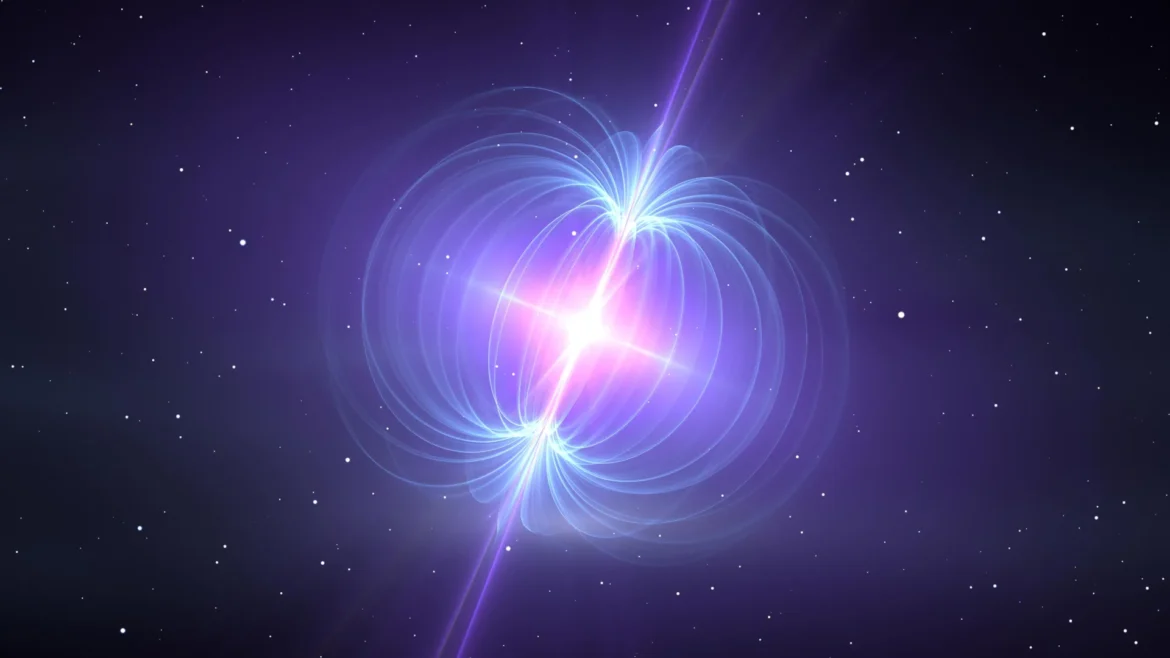
The core of this discovery lies in the identity of the object created during the merger. When two neutron stars collide, they typically result in the formation of either a heavier, single neutron star or a black hole. If the resulting remnant is a magnetar—a highly magnetized neutron star with a rotation period measured in milliseconds and magnetic fields trillions of times stronger than Earth’s—the physics of the aftermath change dramatically.
Professor Eleonora Troja, a lead investigator on the project, explains that a magnetar acts as a central engine, injecting energy into the surrounding debris. "When they damp their magnetic power into the surroundings, they can make any explosion brighter and longer-lasting," Troja notes. The X-ray data collected from EP250704a revealed a signature consistent with this energy injection, suggesting that the merger did not result in an immediate collapse into a black hole, but rather a brief, violent, and highly magnetic phase of stellar evolution.
Measuring the Infinite: Distance and Absence
To confirm the origin of this flash, the team had to establish its distance and rule out alternative explanations. Using the X-Shooter instrument on the VLT, the astronomers performed a spectroscopic analysis of the light. By identifying specific absorption patterns, they calculated a redshift of z=0.6610. This measurement places the source at a distance of more than six billion light-years from Earth. Consequently, the light we observed today began its journey when the universe was significantly younger, long before the formation of our solar system.
A critical hurdle in identifying such transients is the potential for confusion with the deaths of massive stars. When a massive star reaches the end of its life, it typically ends in a core-collapse supernova, which can also produce long-duration X-ray signals. If EP250704a had been a supernova, the researchers would have expected to see a distinct, bright optical signature in the days and weeks following the burst.
The team utilized the VLT’s FORS2 instrument to conduct a deep-field search for any such supernova signature. Their results were definitive: no supernova appeared. The combination of the event’s distance, the characteristic X-ray decay, and the complete absence of a supernova provided a "smoking gun" for the neutron star merger hypothesis. The lack of a supernova effectively eliminated the "massive star death" theory, leaving the magnetar-merger scenario as the most scientifically sound explanation.
Implications for Multi-Messenger Astronomy
This research significantly expands the toolkit available to astrophysicists. For years, the field of "multi-messenger astronomy"—the practice of combining gravitational wave data with electromagnetic observations—has been limited by the ephemeral nature of merger signals. The discovery of long-lasting X-ray flashes provides a much larger window of opportunity for telescopes to pivot, observe, and gather data.
The broader implications are twofold. First, it suggests that the population of neutron star mergers may be more diverse than previously thought. If a portion of these mergers produces long-lasting X-ray transients, our current catalogs of these events may be undercounting them significantly. Second, it provides a direct pathway to studying the formation of magnetars. Magnetars are among the most extreme objects in the universe, and observing their birth in real-time allows for the testing of high-energy physics models that cannot be replicated in a terrestrial laboratory.
"Finding more of these X-ray flashes could help reveal how often neutron star mergers create magnetars," says Passaleva. "I am really excited for the next run of gravitational wave observations, when we could finally pair one of these X-ray flashes with a burst of gravitational waves from the same source."
A Global Collaborative Effort
The success of this study was made possible by an international coalition of researchers and institutions. The lead authors, including An Li of Beijing Normal University, Chen-Wei Wang of the Chinese Academy of Sciences, Niccolò Passaleva, and Jie An, represent a diverse range of expertise. The research effort, supported by a European Research Council (ERC) Consolidator grant, underscores the importance of global cooperation in modern observational astronomy.
The specific program utilized for the VLT observations, titled "QUEENB: a QUEst for Elusive Neutron star and Black hole mergers," highlights the proactive approach the team took toward solving these cosmic mysteries. By anticipating the need for rapid follow-up protocols, the researchers were able to transition from passive observers to active participants in the detection of a rare astronomical phenomenon.
Future Perspectives
As the Einstein Probe continues its survey of the X-ray sky, the scientific community anticipates that EP250704a will not be an isolated case. By refining the criteria for "fast X-ray transients," astronomers now have a clear roadmap for identifying future merger events. The next generation of gravitational wave detectors, combined with the continuous monitoring provided by satellite missions like SVOM and the Einstein Probe, will likely usher in a new era of understanding regarding the life and death of neutron stars.
Ultimately, the study published in Science Bulletin serves as a poignant reminder of the scale of the universe and our evolving ability to decipher its most energetic secrets. While these events occur billions of light-years away, their impacts on our understanding of fundamental physics—how matter behaves under extreme gravity, density, and magnetic intensity—are immediate and profound. As researchers look toward future observation cycles, the hope is to finally bridge the gap between the invisible ripples of gravitational waves and the brilliant, long-lasting flashes of X-ray light that mark the violent birth of a magnetar. Through this synthesis of data, the mysteries surrounding the end-stages of stellar evolution are slowly, but surely, coming into focus.
