
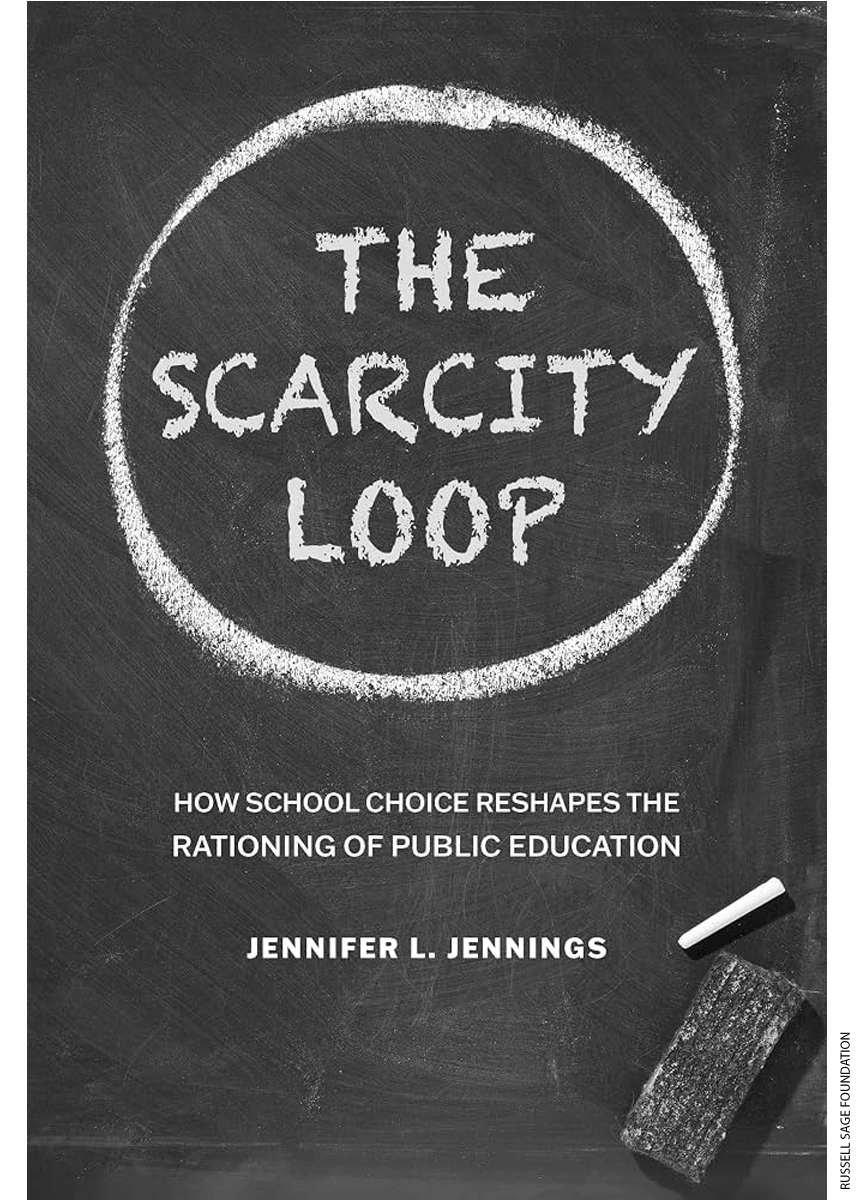
Public education systems across the United States have long wrestled with a fundamental dilemma: how to distribute access to high-performing schools when demand far exceeds the available supply of seats. A newly published book by Princeton University sociologist Jennifer L. Jennings, titled The Scarcity Loop: How School Choice Reshapes the Rationing of Public Education (published by the Russell Sage Foundation, $35.00, 309 pages), brings this enduring tension back into the national spotlight. Drawing on a decade-long empirical study of New York City’s public school system, Jennings examines the intricate mechanics of how students and families navigate centralized choice algorithms, and she interrogates the broader societal implications of managing educational scarcity through market-inspired mechanisms.
The core of Jennings’s work is built upon extensive qualitative research. Over the course of her decade-long investigation, she and her research colleagues conducted 452 in-depth interviews with New York City public school students, parents, guidance counselors, and district administrators. Through these firsthand accounts, the researchers captured a vivid, often stressful picture of how the city’s centralized assignment process operates in practice. Rather than simply evaluating student test scores or institutional outcomes, the project explores the human element of educational rationing—detailing the anxiety, confusion, and strategic calculations that families experience as they rank-order their preferred schools within the nation’s largest public school district.
Background Context: The Evolution of Assignment Policies in Urban Districts
To understand the weight of Jennings’s study, it is necessary to examine the historical trajectory of urban school assignment policies. For generations, most large American school districts relied on a default neighborhood assignment model, where children automatically attended the public school geographically closest to their homes. While this system provided predictability, it frequently reinforced residential segregation, as housing markets mirrored deep racial and socioeconomic divides.
Beginning in the late 1990s and accelerating throughout the 2000s, major urban districts—most notably New York City under Mayor Michael Bloomberg and Chancellor Joel Klein—pioneered structural reforms. They dismantled rigid geographic boundaries, closed failing comprehensive high schools, and opened dozens of smaller, specialized, and charter schools. To manage the influx of options, districts adopted sophisticated, centralized matching algorithms based on game-theory principles to process student preferences.
Proponents argued that these systems would democratize access by allowing families to look beyond their zip codes for quality education. However, as Jennings points out in her book, the fundamental supply of high-quality educational seats did not magically expand to meet the newfound demand. Instead, the architecture of the system shifted.
Mechanics of the Scarcity Loop

In The Scarcity Loop, Jennings argues that transitioning away from default neighborhood assignments did not eradicate scarcity; rather, it altered where the administrative and emotional burdens of scarcity landed. When families are required to actively research, rank, and apply to schools, the outcome is frequently perceived not as a systemic public allocation failure, but as a personal reflection of a family’s own navigational skill or misstep.
Jennings emphasizes that school choice policy, as implemented in contexts like New York City, strictly governs assignment mechanisms rather than the underlying production or supply of schools. Consequently, the rationing process produces deeply inequitable outcomes. Several structural factors drive this disparity:
- Formal Admission Barriers: Test-based criteria for elite magnet schools and screened programs favor students who have access to early academic enrichment.
- Geographic Disparities: Physical proximity to high-performing options varies drastically across boroughs and neighborhoods.
- Navigational Inequality: Disparities in family social capital, language proficiency, and time availability heavily influence application success.
- Institutional Signaling: Subtle and overt cues from schools regarding student "fit" alienate marginalized applicants.
According to Jennings, high-quality educational seats under this framework are not distributed according to clear principles of societal need or equity. Worse still, the system obscures public accountability. When school seats are rationed through centralized choice programs rather than explicitly debated public policies, the state effectively insulates itself from criticism regarding chronic shortages of good schools. This dynamic creates what Jennings defines as the "scarcity loop"—a self-reinforcing cycle where scarcity sparks administrative reform, reform introduces novel rules of access, and those very rules ultimately preserve the inequalities they were ostensibly designed to dismantle.
Critical Analysis: The Missing Element of Market Competition
Despite the empirical rigor of Jennings’s qualitative interviews and the conceptual elegance of her "scarcity loop" framework, policy analysts and education economists have raised fundamental questions regarding the generalizability of her conclusions to the broader American school choice movement.
The primary critique of Jennings’s thesis centers on a critical definitional mismatch: the system she studies in New York City lacks the defining characteristic of school choice as conceptualized by economists like Milton Friedman and implemented in dozens of other states across the country—namely, market competition.
In Friedman’s original vision, true school choice operates as a dynamic ecosystem where multiple independent providers compete for students, and public education funding follows the child across organizational boundaries. If a school underperforms or fails to meet community demand, families can take their per-pupil funding to a competing institution, exerting financial pressure on failing entities to improve or face closure.
By contrast, the New York City public school system analyzed by Jennings operates entirely within a closed municipal framework. Whether a student enrolls in District School A or District School B, the overarching district retains the tax revenue. There are no competing providers siphoning students away, and consequently, individual school choices exert zero financial or institutional pressure on the district to expand its overall capacity of high-quality seats.
Drawing an economic parallel, critics suggest that New York City’s district choice model functions similarly to a fast-food menu at a major restaurant chain. A consumer may choose between a variety of items on the menu, but the money ultimately flows to the same corporate entity regardless of the selection. Because the corporation faces no external market competition from alternative suppliers, it feels no systemic urgency to upgrade the overall quality of its entire product line.
Broader Implications for Education Policy
This structural distinction strikes at the heart of whether Jennings’s critique applies universally to school choice. Her argument assumes that choice mechanisms inherently fail to expand the supply of good schools, leaving policymakers to merely shuffle students around a fixed pool of desirable options.
However, empirical evaluations of state-level voucher programs, tax-credit scholarship initiatives, and robust charter school sectors in states like Florida, Arizona, and Indiana suggest a different trajectory. In environments where genuine provider competition exists, supply-side dynamics often shift. New educational entrepreneurs enter the market, underperforming public and private options face enrollment declines that force operational changes, and the aggregate supply of quality educational seats can expand over time.
When researchers analyze closed-system district choice—such as the intra-district lotteries found in New York City, Chicago, or Boston—they are observing the rationing of a fixed public monopoly. To label this phenomenon as an indictment of "school choice" writ large conflates bureaucratic assignment management with market-based educational pluralism.
As The Scarcity Loop enters public circulation, it serves as a valuable cautionary tale regarding the limits of administrative redesign in resource-constrained environments. It underscores the undeniable truth that procedural equity in admissions can never serve as a substitute for substantive investments in school quality. Yet, as the academic and political debate continues, policymakers must carefully distinguish between the bureaucratic rationing of fixed urban districts and the dynamic, competitive supply-side reforms driving the national school choice movement.