
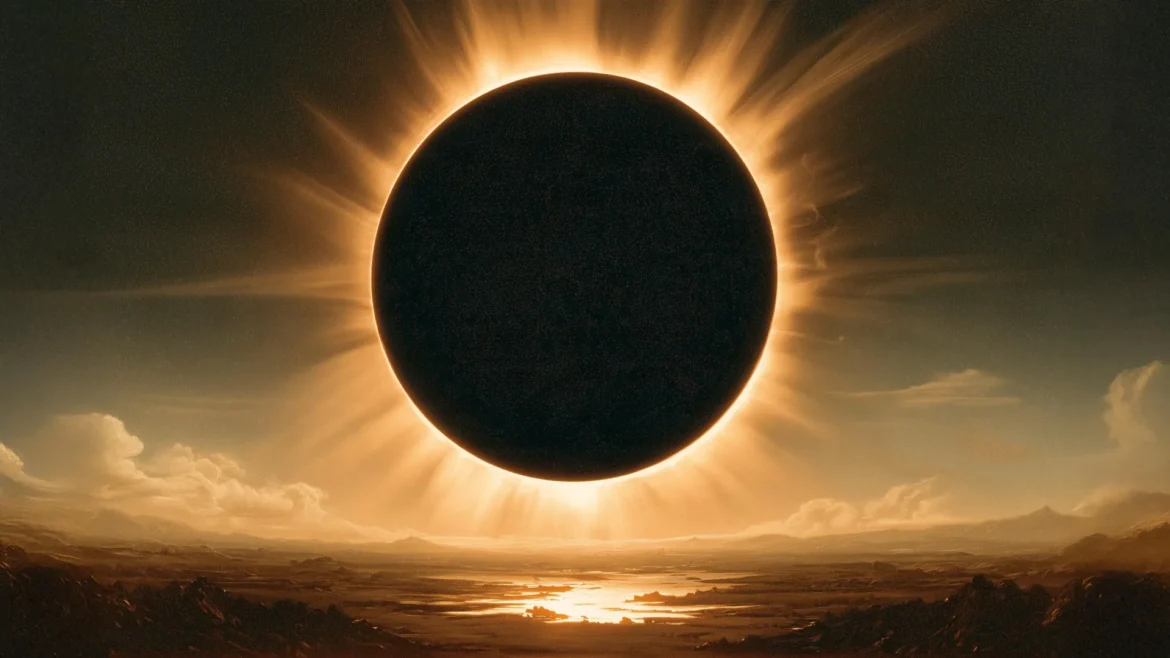
In a remarkable convergence of ancient history and cutting-edge astrophysics, an international research team has successfully re-examined one of the oldest precisely dated records of a total solar eclipse, yielding unprecedented insights into the historical rotation of the Earth and the long-term behavior of the Sun. By synthesizing historical geography, archaeological data, and modern astronomical simulation, the team has reconstructed the total solar eclipse of 709 BCE, an event observed by the court of the Lu Duchy in ancient China. This study, recently published in the Astrophysical Journal Letters, not only resolves long-standing discrepancies in Earth’s rotational history but also provides a potential window into the solar cycle as it existed over 2,700 years ago.
The Historical Context: Astronomy in the Lu Court
The eclipse of July 17, 709 BCE, is a landmark event in the history of astronomy. It was documented in the "Spring and Autumn Annals," a foundational chronicle of the State of Lu. In an era where celestial events were viewed as direct messages from the heavens, the Lu court employed specialized astronomers to track the movements of the Sun, Moon, and stars. This practice, often termed "omenology," was deeply embedded in the political fabric of Chinese dynasties. An unexpected disappearance of the Sun was interpreted as a grave warning regarding the conduct of the sovereign, necessitating meticulous documentation.
The preservation of this record is particularly significant because the "Spring and Autumn Annals" were compiled centuries after the event, yet they maintained a level of precision that has allowed modern researchers to pinpoint the eclipse. Furthermore, an addendum found in the "Hanshu" (Book of Han)—written seven centuries after the initial event—contains a cryptic yet evocative description of the Sun appearing "completely yellow above and below." Scientists have long theorized that this phrase describes the solar corona, the faint, shimmering outer atmosphere of the Sun that only becomes visible during the brief totality of an eclipse. If this interpretation holds, it stands as one of the earliest human observations of the Sun’s corona in recorded history.
Correcting the Geography: Resolving the 8-Kilometer Discrepancy
A significant challenge faced by the research team was an initial mismatch between historical records and modern astronomical calculations. When scientists applied standard models of Earth’s rotation to the coordinates of Qufu, the ancient capital of the Lu Duchy, the simulation suggested that the total eclipse would not have been visible from that location. This created a paradox: if the "Spring and Autumn Annals" were accurate, why did the model indicate the eclipse was merely partial or invisible from the capital?
The researchers identified the source of this error as a long-standing geographic miscalculation. Through a rigorous examination of archaeological excavation reports and historical records, the team discovered that previous studies had placed the ancient capital of Qufu approximately eight kilometers away from its true historical site. By adjusting the geographic coordinates to reflect the actual location of the city during the 8th century BCE, the team achieved a perfect alignment. The recalculated path of the eclipse moved directly over the court of the Lu, confirming the historical accuracy of the ancient observers.
The Physics of Time: Earth’s Changing Rotation
This correction provided more than just historical validation; it served as a precise data point for measuring the deceleration of Earth’s rotation. The Earth does not spin with clockwork consistency. Its rotation is subject to tidal friction—a process driven by the gravitational interaction between the Moon and the Earth’s oceans. As the Moon pulls on the oceans, it creates a drag that acts as a brake on the planet’s spin. Consequently, the length of an Earth day has been slowly increasing over millions of years.
By using the 709 BCE eclipse as a fixed anchor, the researchers were able to constrain the value of delta T (ΔT), which represents the difference between Terrestrial Time—a uniform scale—and Universal Time, which is based on the Earth’s rotation. The study calculated ΔT for the 709 BCE event to be between 20,264 and 21,204 seconds. This measurement provides a crucial benchmark for geophysicists, allowing them to refine models of how the Earth’s rotation speed has fluctuated from the 8th through the 6th centuries BCE. This level of precision is vital for reconstructing the history of other astronomical events throughout human antiquity.
Decoding the Sun’s Distant Behavior
Beyond the mechanics of our planet, the study offers a compelling analysis of the Sun’s magnetic activity during the 8th century BCE. The researchers compared the "Hanshu" description of the corona to data derived from radiocarbon (14C) measurements in tree rings. Radiocarbon is produced in the upper atmosphere by cosmic rays; when the Sun is highly active, its stronger magnetic field deflects more cosmic rays, leading to lower levels of radiocarbon in the rings of trees living at the time.
The eclipse occurred shortly after the conclusion of the "Homer Grand Minimum," a period of suppressed solar activity that lasted roughly from 808 to 717 BCE. During grand minima, the Sun exhibits very few sunspots, and the typical 11-year solar cycle becomes erratic or dormant. The 709 BCE record suggests that the Sun was, at that time, emerging from this long quiet phase and returning to a state of heightened magnetic activity. The description of the corona—a structure that forms and changes shape based on magnetic fields—is consistent with a Sun nearing the peak of its solar cycle. This provides independent validation for the dendrochronological models used to map solar history, suggesting that ancient human observations and modern chemical data are in alignment.
Collaborative Scientific Perspectives
The implications of this study extend across multiple disciplines, from space physics to classical history. Lead author Hisashi Hayakawa, an assistant professor at Nagoya University’s Institute for Space-Earth Environmental Research, emphasized that the strength of the study lies in its multidisciplinary approach. "What makes this record special isn’t just its age, but also the rare addendum that allows us to peer into the solar atmosphere of the past," Hayakawa noted.
Co-author Mitsuru Sōma of the National Astronomical Observatory of Japan highlighted the technical contribution of the work, noting that the correction of coordinate errors allows for a more reliable "dating and reconstructing [of] historical astronomical events." This sentiment was echoed by Mathew Owens, a professor of space physics at the University of Reading, who underscored the importance of the corona description as a "spot reference" for validating complex solar models. Dr. Meng Jin of the Lockheed Martin Solar and Astrophysics Laboratory further added that the success of this research demonstrates the enduring value of ancient observations, which remain essential for filling gaps in our knowledge that modern sensors cannot reach.
Broader Implications for Future Research
The successful integration of the 709 BCE record serves as a model for how historians and scientists can collaborate to enrich the global record of Earth’s past. By treating historical documents not merely as literature, but as empirical datasets, researchers can unlock new details about the Earth-Sun system. The ability to verify the timing of ancient eclipses with such high precision allows for the re-evaluation of other historical events, potentially correcting chronologies that have been debated for centuries.
Furthermore, understanding how the Sun behaved during the Homer Grand Minimum helps scientists improve their predictions regarding the Sun’s future. Grand minima are rare but significant events; knowing how the Sun recovers from these periods of low activity is critical for understanding current climate trends and potential space weather impacts. The 709 BCE study proves that even 2,700 years after the fact, the meticulous record-keeping of the Lu Duchy astronomers continues to offer profound insights into the fundamental forces that govern our planet and our star.
In conclusion, this research marks a significant leap forward in our understanding of deep-time astronomy. By correcting a minor geographic error, the team has illuminated a major piece of historical and physical evidence. As researchers continue to scan ancient chronicles for similar astronomical notations, the combination of historical inquiry and rigorous data analysis promises to reveal further secrets hidden within the records of our ancestors, proving that the sky above, while ever-changing, remains a permanent archive of our history.
