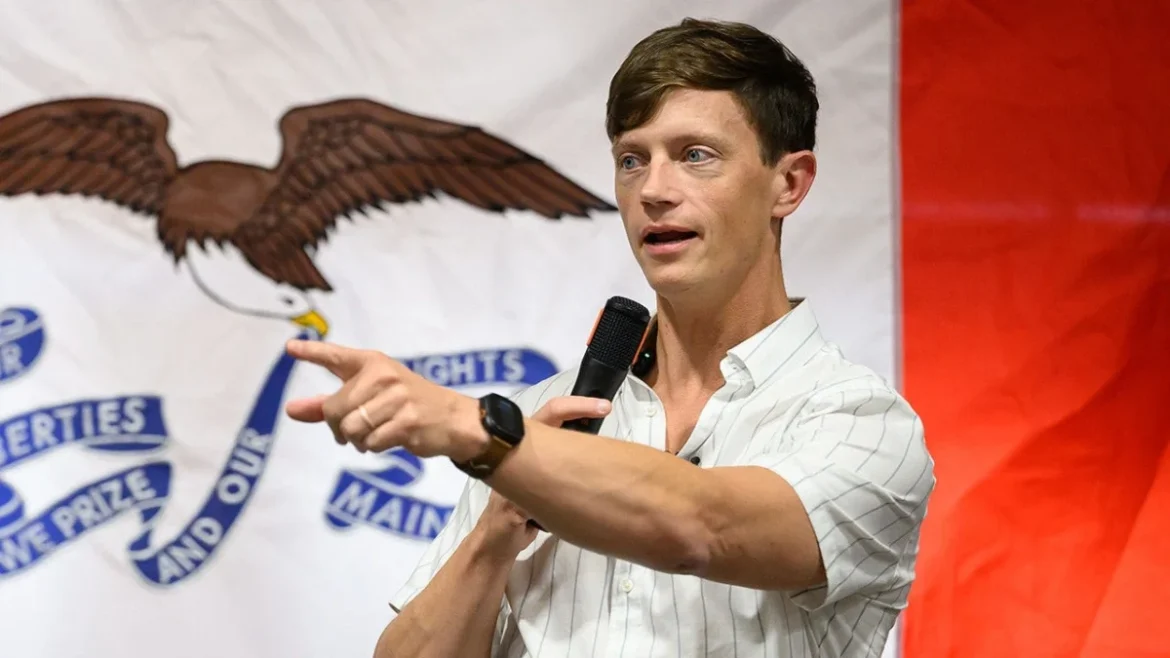
The high-stakes political landscape in Alaska has become the epicenter of a national controversy as allegations of "ballot-siphoning" schemes have drawn the attention of senior political figures and federal authorities. At the heart of the dispute is the presence of two candidates with nearly identical names on the ballot for a critical U.S. Senate seat, a situation that has prompted accusations of intentional voter deception. Rob Sand, the Democratic gubernatorial nominee for Iowa, has emerged as an unlikely critic of the tactic, labeling the effort to elevate an unaffiliated challenger to confuse voters as a dangerous manipulation of the democratic process.
The controversy centers on the race between incumbent Republican Senator Dan S. Sullivan and an unaffiliated challenger who shares his name, identified on the ballot as Daniel J. Sullivan Jr. The proximity of these two names has led to an escalating legal and political confrontation, with the U.S. Department of Justice, under the Trump administration, intervening to challenge the integrity of the ballot.
A Chronology of the Alaska Ballot Dispute
The tension began earlier this year when an unaffiliated candidate, Daniel J. Sullivan Jr., filed to run for the Senate seat currently held by Senator Dan S. Sullivan. As the primary and general election cycles progressed, Republican operatives and legal experts began to voice concerns that the inclusion of the unaffiliated Sullivan was not a coincidence but a calculated strategy designed to fracture the incumbent’s base.
By mid-2026, the Republican Party of Alaska filed formal complaints alleging that Democratic operatives had provided support to the unaffiliated candidate to ensure his presence on the ballot. The core of the allegation is that the confusion generated by the similar names would cause a percentage of voters intending to support the Republican incumbent to instead mistakenly cast their ballots for the challenger, thereby acting as a "spoiler" to aid the Democratic nominee, Mary Peltola.
In late June 2026, the situation moved from the campaign trail to the courtroom. The Department of Justice, led by Attorney General Todd Blanche, initiated a lawsuit seeking to block the certification of the Alaska Senate election results should the incumbent Republican lose. The legal argument posited that the potential for widespread voter confusion constituted an infringement on the fairness of the federal election.

The Perspective of Rob Sand and Political Norms
In an exclusive interview, Iowa’s Rob Sand addressed the broader implications of these tactics on the American electoral system. Sand, who has often positioned himself as an advocate for government transparency and ethical governance, expressed deep skepticism regarding the use of "spoiler" candidates, regardless of which party employs them.
"Both parties are doing it and neither party should be doing it," Sand stated. "To me, it’s manipulating the political system, and it’s not a good thing to do."
Sand’s critique touches upon a growing concern among political analysts: the normalization of "dirty tricks" in high-stakes midterm elections. By focusing on the systemic harm of such tactics, Sand emphasizes that when parties prioritize short-term electoral gains over the clarity of the ballot, the ultimate victim is the voter’s ability to participate in an informed democracy. This perspective highlights a divide within political discourse, where some view such maneuvers as standard "hardball" politics, while others, like Sand, view them as an existential threat to the legitimacy of electoral outcomes.
Legal Challenges and Federal Intervention
The intervention of the Department of Justice represents a significant escalation in this dispute. Attorney General Todd Blanche has defended the move as a necessary measure to ensure that voters are not intentionally misled. Federal attorneys argue that the ballot design, which identifies the incumbent as "Dan S. Sullivan" and his opponent as "Daniel J. Sullivan Jr.," creates a high risk of "accidental crossover voting."
However, the intervention has been met with fierce resistance from Democrats and the Peltola campaign. Former Representative Mary Peltola has publicly dismissed the lawsuit as "flagrant corruption," arguing that the federal government is attempting to undermine the electoral process to favor a specific partisan outcome. Senate Minority Leader Chuck Schumer has echoed this sentiment, characterizing the DOJ’s actions as an "outrage" and a sign of desperation from an administration fearing a loss.
"This is an outrage," Schumer noted in a public statement. "It shows they know they’re going to lose. We will fight tooth and nail. And we will win."

Legal scholars have noted that the case presents a complex question for the courts: at what point does a candidate’s right to run for office conflict with the public’s right to a ballot that is not designed to deceive? While name-sharing in politics is not unprecedented, the strategic elevation of a candidate with a near-identical name to a prominent incumbent is a rare, though increasingly documented, phenomenon.
Data and Electoral Implications
While the legal battle continues, political analysts are looking at historical data to determine if "spoiler" name candidates actually move the needle in national elections. In past contests, even a margin of less than one percent has been enough to alter the outcome of a Senate race. In a state like Alaska, where the electorate is famously independent and results can be razor-thin, even a small shift of a few hundred votes caused by name confusion could be the difference between a Republican hold and a Democratic gain.
Current polling data for the Alaska Senate race suggests that the race between the incumbent and his Democratic challenger is exceptionally close. The addition of the unaffiliated Daniel J. Sullivan Jr. to the ballot has added a layer of uncertainty that pollsters are struggling to quantify. Surveys conducted in recent weeks indicate that a segment of the electorate remains confused about which candidate represents which platform, confirming the fears raised by the incumbent’s legal team.
The Broader Impact on Midterm Strategy
The Alaska controversy is not an isolated incident. Across the country, the 2026 midterm cycle has seen an uptick in accusations of "trickery" and strategic maneuvering. From funding third-party candidates to complicate the field, to legal challenges regarding ballot access and certification, both major parties are utilizing increasingly aggressive tactics to secure narrow margins.
This environment has prompted a debate about the role of federal oversight in local elections. While the Constitution grants states primary authority over the administration of elections, the Justice Department’s involvement in Alaska asserts that federal interests are at stake when the integrity of a U.S. Senate race is perceived to be compromised.
Fact-Based Analysis of the Controversy
The core of the issue lies in the definition of "voter confusion" versus "voter responsibility." Supporters of the incumbent argue that the state has an obligation to provide a ballot that is clear and unambiguous. Conversely, defenders of the current ballot argue that voters are responsible for researching their choices and that the state should not be in the business of vetting the "seriousness" of a candidate based on their name.

The implications of this case extend beyond the current cycle. Should a federal court rule in favor of the Justice Department, it could set a precedent for future interventions in state-run elections, potentially shifting the balance of power between state and federal election authorities. If the lawsuit fails, it may embolden future campaigns to employ similar "name-siphoning" strategies, as the barrier to entry for using such tactics would be seen as low and legally defensible.
As the legal proceedings advance, the focus remains on whether the court will grant an injunction to alter the ballot or if the current status quo will persist through Election Day. For now, the people of Alaska are caught in the middle of a struggle that is less about the individual merits of the candidates and more about the fundamental mechanics of how power is contested in the United States.
Rob Sand’s intervention in the discussion serves as a reminder that the conversation regarding election integrity is not confined to the specific state in which the conflict is occurring. It is a national dialogue, and as candidates across the country look toward the final days of the campaign, the Alaska Senate race will likely be studied as a primary example of the vulnerabilities—and the intense partisan friction—inherent in modern American electoral politics. Whether the result is decided at the ballot box or in the chambers of the federal judiciary, the case of the two Sullivans is poised to leave a lasting mark on the 2026 electoral landscape.