
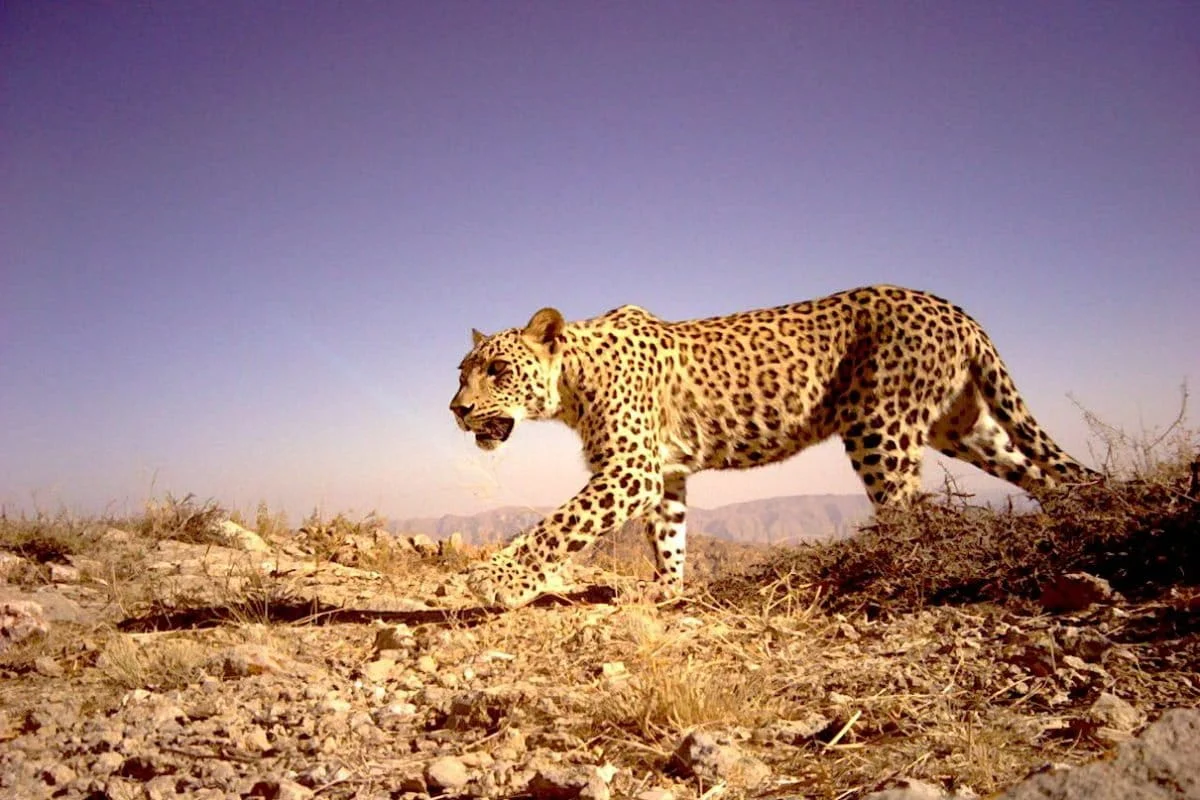
In the rugged, high-altitude terrain of the Caucasus region—a geographical corridor bridging the Black and Caspian Seas—the survival of the Persian leopard (Panthera pardus tulliana) has become a symbol of resilience in the face of anthropogenic conflict. Over the last two decades, sightings of this endangered subspecies have been exceptionally rare, with only three confirmed records in Georgia and ten in Armenia. Among these fleeting glimpses, one individual has captured the attention of the international conservation community: a male leopard known as Aren. Presumed to have traversed approximately 240 kilometers (150 miles) through treacherous, snow-covered mountain ranges, Aren’s survival is made all the more remarkable by the fact that he is missing a limb, a disability experts strongly attribute to the pervasive legacy of landmines left behind by decades of geopolitical conflict in the region.
The Persian leopard, once widespread across the Caucasus, is currently classified as endangered, with fewer than 1,100 individuals estimated to remain in the wild. Approximately 80% of this population resides within the borders of Iran, leaving the remaining small, fragmented groups in countries like Georgia, Armenia, Azerbaijan, and southern Russia highly vulnerable to extinction. The story of Aren is not merely a tale of a single animal; it is a lens through which the complex intersection of border politics, historical warfare, and biodiversity conservation can be examined.
The Geography of Conflict and Its Impact on Wildlife
The Caucasus region is characterized by deep, vertiginous valleys, expansive forests, and steep mountain ridges that provide the necessary habitat for apex predators like the Persian leopard. However, this same landscape is scarred by the remnants of the Soviet era and subsequent regional disputes. Thousands of kilometers of barbed-wire fencing, such as the Soviet-era "Sistema" barriers, remain standing across the region. While the electrical currents that once powered these fences have largely been deactivated, the physical infrastructure persists, creating lethal traps for migrating wildlife.
Furthermore, the presence of uncleared landmines along the borders of Armenia and Azerbaijan continues to pose a severe threat. These explosive remnants of war do not distinguish between combatants and wildlife. When a leopard wanders into these zones, the risk of injury is extreme. For Aren, this reality became a permanent physical burden. When he was first identified in the Apra Protected Landscape in Armenia’s Vayots Dzor Province, he was a healthy, four-limbed adult. Subsequent camera trap footage captured the harrowing transition: Aren was later observed missing a limb, a life-altering injury that experts associate with the impact of an explosive device.
Chronology of an Extraordinary Survival
The tracking of Aren provides a unique case study in animal dispersal patterns. Initially identified by local rangers and monitored by the World Wide Fund for Nature (WWF) in Armenia, the leopard was named after the Areni village, a site famous for its local viticulture. Aren’s journey began in the arid, "Martian-like" landscapes of the Apra region, where the population of Bezoar goats—a primary prey species—is relatively stable.
Following his injury, Aren’s movement patterns changed significantly. He navigated from the border regions of Armenia through dense forests in the Ijevan area, moving toward the Dilijan region. His trek eventually led him onto the border with Georgia, where he traversed the Trialeti Ridge and entered Algeti National Park. This journey, covering roughly 1,000 kilometers of total movement when accounting for his dispersal routes, defied biological expectations for a predator suffering from a severe physical impairment. Camera traps in Algeti—a location where leopards had not been recorded in recent memory—caught the leopard on video, providing the first hard evidence of his survival and presence in Georgia.
Conservation Under Extreme Constraints
The conservation of the Persian leopard in the Caucasus is primarily managed by non-governmental organizations (NGOs) that operate under severe financial and geopolitical pressure. The Centre for Biodiversity Conservation & Research (NACRES), founded in Georgia in 1991, has been at the forefront of this effort. Despite their significant contributions to wildlife monitoring, the organization functions with a skeleton crew of only three people, led by zoologist Bejan Lortkipanidze.
The challenges faced by NACRES and similar organizations are compounded by the broader withdrawal of international funding, including the recent closure of USAID initiatives in the region. This "tightening of purse strings" has forced conservationists to prioritize essential monitoring over more proactive outreach and educational programs. According to Lortkipanidze, if resources were unlimited, the priority would shift toward community education in remote regions like Tusheti. By engaging local villagers and implementing mitigation strategies for human-wildlife conflict, conservationists hope to curb the retaliatory killings of leopards, which often occur when these cats are perceived as threats to livestock.
Broader Implications and the Moral Imperative of Hope
The survival of Aren has sparked a necessary conversation regarding the role of borders in environmental management. As noted by experts like Hana Raza of Leopards Beyond Borders, "Leopards do not recognize political boundaries." The survival of the subspecies depends entirely on the connectivity of their habitats. When political instability or militarized borders disrupt these corridors, the ecological cost is paid by the species.
The situation in the Caucasus serves as a stark reminder of the "shadowy" nature of wildlife conservation in conflict zones. Beyond landmines and border fences, leopards face the constant threat of poaching, illegal trapping, and habitat fragmentation. Yet, the persistence of these animals offers a glimmer of hope that ecosystems can heal if given the space and protection to do so. Journalists and scientists alike have begun to frame this hope as a "moral imperative." By acknowledging that humans are a part of nature rather than separate from it, there is a theoretical potential to restore the delicate balance of the Caucasus environment.
Scientific Analysis: The "Umbrella Species" Concept
From an ecological perspective, the Persian leopard is considered an "umbrella species." Protecting the leopard and its habitat inevitably results in the protection of a wide array of other species, including the Bezoar goat, the Caucasian deer, and the regional wolf population. By maintaining healthy prey populations and ensuring that predators can move safely across the landscape, conservationists are effectively working to restore the functionality of the entire ecosystem.
However, the strategy in the Caucasus is currently limited by the lack of data. Because sightings are so infrequent, the focus remains on "holistic monitoring"—recording all wildlife activity to understand the health of the food chain. As Lortkipanidze demonstrated during field studies, even signs of wolf scat or the behavior of deer can provide critical indicators of ecosystem health. The goal is to create conditions where, if the environment is sufficiently restored, the leopard population might naturally expand and stabilize.
Conclusion: A Future for the Persian Leopard
The journey of Aren remains an outlier, but it is one that provides essential data on the endurance of the species. While the geopolitical climate of the Caucasus remains volatile, the work of dedicated individuals at organizations like NACRES and the WWF ensures that the story of the Persian leopard is not yet at its end. Whether or not Aren survives to breed and contribute to the population, his journey has served to highlight the desperate need for cross-border cooperation, the clearing of landmines, and the necessity of sustainable funding for biodiversity protection.
In a world where environmental news is often dominated by reports of loss and decline, the persistence of a three-legged leopard navigating a mine-laden landscape is, in the words of those who monitor him, an inspiring testament to the will to survive. It challenges humanity to look beyond the rigid, often violent boundaries of nation-states and recognize the shared responsibility of stewarding the natural world. As long as the leopards continue to walk these ridges, the possibility for a kinder, more balanced coexistence remains.

