
The landscape of American public education has undergone profound shifts over the past two decades, with states increasingly turning toward accountability metrics, standardized testing, and data-driven performance evaluations to elevate instructional quality. Among these sweeping legislative and policy overhauls, Tennessee’s comprehensive reform initiative—launched at the turn of the 2010s—stands as one of the most thoroughly documented and rigorously analyzed educational experiments in modern United States history. A comprehensive new study examining longitudinal data from the Volunteer State sheds critical light on the complex mechanics of teacher evaluation systems, revealing how the dual application of enhanced performance reviews and high-stakes tenure incentives shapes educator effectiveness, student achievement, and long-term professional development.
By tracking approximately 11,000 math and English language arts teachers alongside roughly 720,000 students across grades four through eight from the 2007–08 academic year through the 2014–15 school year, researchers have been able to isolate the distinct impacts of two major policy instruments. The first mechanism is the expanded and intensified performance evaluation system, which extended annual reviews to cover every teacher in the district, regardless of their tenure status. Under the legacy framework, veteran and tenured educators rarely faced comprehensive annual scrutiny. The reformed system transformed this paradigm by implementing multi-tiered classroom observations grounded in a far more rigorous and comprehensive rubric. Crucially, these qualitative observations were paired with quantitative value-added measures (VAM)—statistical models designed to gauge a teacher’s specific contribution to student academic growth over the course of an academic year.
The second mechanism introduced by the state legislature involved performance incentives tied directly to these new metrics, fundamentally altering the pathway to permanent job security. Under the revised tenure rules, novice teachers could no longer secure tenure simply by surviving a probationary window of a few years. Instead, aspiring tenured educators were required to achieve performance ratings of "above expectations" or "significantly above expectations" across both their fourth and fifth years on the job. This dual-requirement hurdle transformed tenure from an administrative rubber stamp into a rigorous performance-based milestone.
Chronology and Research Design of the Tennessee Reform
To understand how these reforms shifted classroom outcomes, researchers divided the educator population into distinct treatment groups based on their career stage when the policies took effect. The evaluation and tenure landscape in Tennessee shifted dramatically in 2012, serving as a watershed moment for school districts statewide.
For the purposes of empirical analysis, teachers hired between the 2009–10 and 2010–11 academic years formed the primary cohort of novice educators who experienced both the comprehensive evaluation system and the strict new tenure incentive structure. For these newer instructors, the tenure incentive clock began ticking in their fourth year in the classroom and concluded at the end of their fifth year, provided they successfully met the mandated value-added score thresholds.
Conversely, early-career educators who were already in their fourth through seventh years of service when the new rules were instituted experienced a very different policy environment. Because these teachers had already attained tenure under legacy guidelines, they were subjected to the newly intensified performance evaluations and comprehensive observation rubrics, but they were entirely insulated from the high-stakes tenure incentive structure. This structural divergence allowed analysts to parse out the independent effects of feedback and evaluation versus the psychological and professional pressures of future tenure requirements.
By meticulously tracking these cohorts, the study captured what economists and education policy experts term "anticipation effects." Because the high-stakes tenure evaluations did not officially factor into employment decisions until years four and five, researchers could observe how novice teachers reacted to the looming threshold during their first, second, and third years in the classroom. Furthermore, by evaluating performance trajectories after year five—once the tenure incentives had either been successfully met or forfeited—the study identified the persistent effects of the performance incentives on long-term instructional capacity.
Deconstructing the Data: Performance Gains Across Disciplines
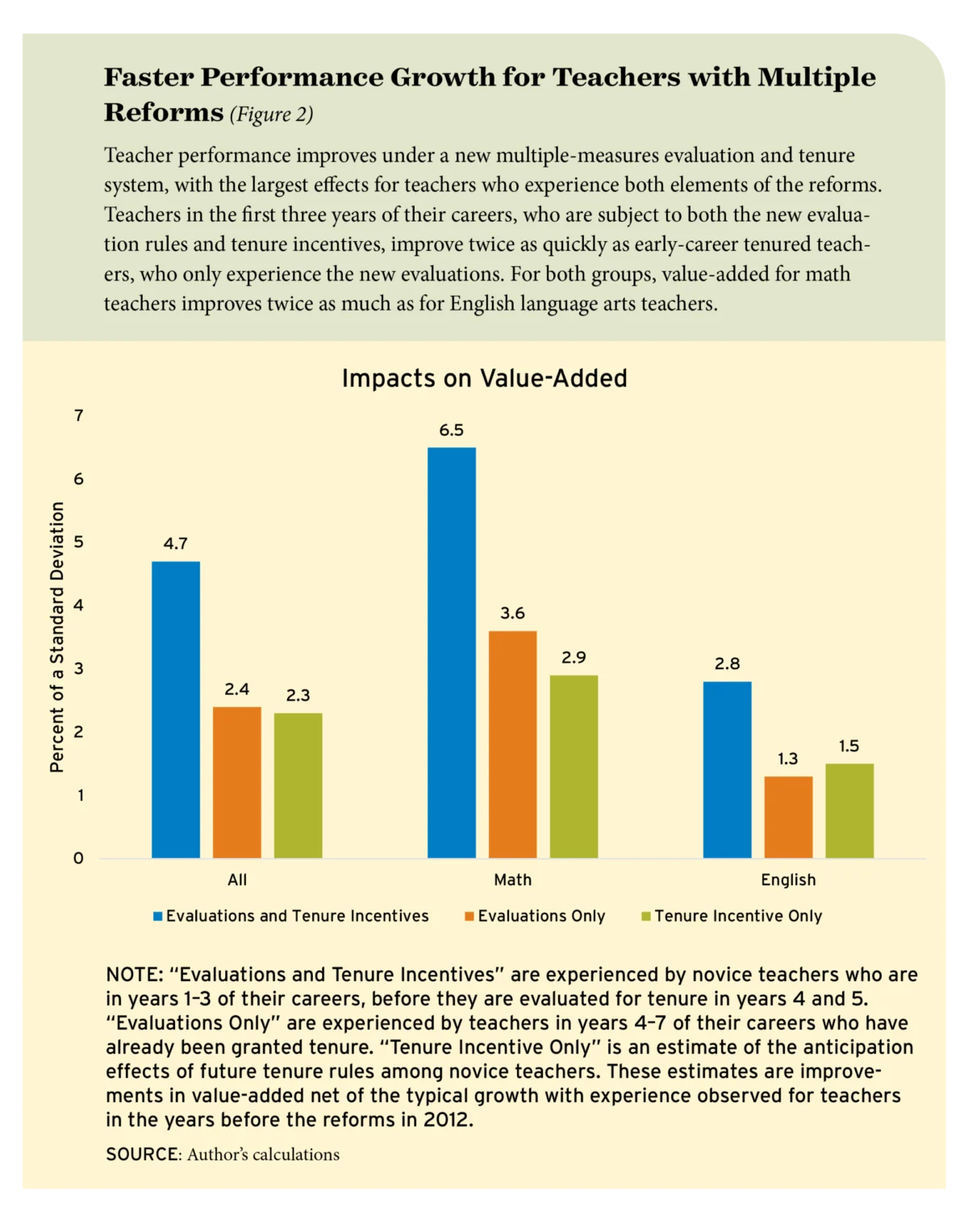
The empirical findings offer a nuanced portrait of how educators respond to accountability pressures. According to the data, novice teacher value-added scores improved by 4.7 percent of a standard deviation during the inaugural year of Tennessee’s sweeping reforms. This upward trajectory represented genuine performance growth over and above the typical learning curve experienced by educators in the earliest stages of their careers.
However, a deeper dive into the disciplinary breakdown reveals a stark divergence between subjects. While both mathematics and English language arts (ELA) instructors demonstrated measurable performance gains, math teachers outpaced their ELA counterparts by a factor of more than two. Specifically, value-added scores for math educators surged by 6.5 percent of a standard deviation, compared to a more modest 2.8 percent gain for English language arts teachers.
This disciplinary disparity is a recurring theme in educational accountability research. Math curricula are frequently characterized by more linear, cumulative skill development and standardized assessment structures, which may make pedagogical adjustments more readily detectable through quantitative value-added models. ELA instruction, by contrast, often involves complex, multifaceted competencies—such as critical reading comprehension, stylistic nuance, and subjective writing assessments—that can be more challenging to capture cleanly within traditional value-added frameworks.
Isolating the Mechanisms: Feedback Versus Future Incentives
One of the central questions confronting education policymakers is whether performance improvements are driven primarily by the formative value of rigorous evaluations or by the pecuniary and professional leverage of future incentives like tenure. Robust evaluations and targeted feedback inherently reduce the transaction costs associated with professional self-improvement, helping teachers identify pedagogical weaknesses and adopt evidence-based strategies. On the other hand, future incentives magnify the expected returns on investing time and energy into mastering one’s craft.
To disentangle these competing forces, the study examined the trajectory of tenured early-career teachers who navigated the new evaluation rubrics without facing the threat or promise of tenure incentives. The data revealed that value-added scores for these tenured instructors improved at roughly half the rate of their novice peers, registering a 2.3 to 2.4 percent improvement in standard deviation. Within this group, math teachers saw their performance improve by 3.6 percent of a standard deviation, while ELA teachers advanced by 1.3 percent.
These findings suggest that robust evaluations and constructive feedback alone are powerful drivers of professional growth, accounting for a substantial portion of overall performance gains. However, the significantly steeper performance curves observed among novice teachers indicate that the anticipation of high-stakes tenure rewards provides an additional, potent catalyst for skill acquisition.
The Paradox of Year Four: When Do Gains Actually Occur?
Given that novice teachers faced the daunting prospect of high-stakes evaluations in their fourth and fifth years, conventional economic and psychological theories would predict a sharp spike in performance right as those high-stakes evaluations take effect. Yet, the data tells a surprisingly counterintuitive story.
When novice teachers crossed the threshold into year four—the precise moment their performance scores officially began counting toward their tenure bids—the estimated increase in teacher value-added was a modest and statistically imprecise 1.3 percent of a standard deviation. Because this estimate carries a relatively wide margin of error, analysts cannot definitively rule out the possibility of zero change in value-added during that specific transition.
This revelation upends conventional assumptions about immediate deterrence and incentive alignment. Rather than scrambling to improve only when their jobs are immediately on the line, novice teachers appear to front-load their professional development. The vast majority of performance gains overwhelmingly accrue during a teacher’s earliest years in the classroom—years one through three—while they are actively anticipating future tenure hurdles, even though their numerical scores do not yet dictate their formal employment security. In essence, the psychological weight of the upcoming evaluation system compels educators to sharpen their instructional methodologies well before the official audit takes place.
Post-Incentive Persistence and the Fate of Probationary Educators
As the policy cycle reached its conclusion for the studied cohorts, approximately two-thirds of novice teachers successfully navigated the criteria, earning permanent tenure status by the end of their fifth year on the job. For these successful educators, year six brought a fundamental change in status: their performance scores were no longer tethered to tenure acquisition.
Standard economic models of human behavior might predict a moral hazard or a reversion to baseline effort once the carrot of tenure has been securely captured. Under such a hypothesis, teacher value-added would be expected to decline sharply after year five. However, the empirical data refutes this pessimistic outlook. Researchers found robust suggestive evidence that tenured teachers continued to maintain their elevated performance levels, allowing analysts to definitively rule out any notable post-incentive performance collapse.
This persistence of higher value-added scores strongly implies that the evaluation reforms did more than merely induce temporary, strategic compliance. Instead, the framework appears to have permanently altered educators’ human capital, permanently upgrading their pedagogical toolkits through sustained skill acquisition.
Meanwhile, what became of the roughly one-third of novice teachers who failed to clear the stringent tenure hurdles by the conclusion of their fifth year? State policy did not mandate immediate dismissal for these educators. Instead, teachers who missed consecutive "above expectations" designations were permitted to continue working in classrooms under probationary contracts. Under the reformed guidelines, these probationary teachers retain a pathway to eventual tenure, provided they manage to exceed the required performance score cutoffs in any two consecutive future years. This provision attempts to balance institutional accountability with programmatic flexibility, granting developing educators a second chance to meet the state’s elevated standards without instantly destabilizing local staffing pipelines.
Broader Implications for Education Policy and Future Research
The comprehensive examination of Tennessee’s mid-2010s policy overhaul offers profound lessons for school districts, state legislatures, and federal policymakers grappling with how best to structure educator accountability. For decades, the debate surrounding teacher tenure has often been polarized into simplistic camps: defenders arguing that tenure is an essential shield for academic freedom and professional stability, and critics contending that traditional tenure rules enshrine complacency and protect ineffective instructors.
Tennessee’s empirical experiment demonstrates that tenure need not be an immutable binary choice between permanent protection and unmitigated at-will employment. By conditioning permanent job security on rigorous, data-informed performance metrics, policymakers can successfully motivate early-career educators to accelerate their professional development during their formative years in the classroom.
At the same time, the research underscores the vital importance of formative feedback. The measurable performance gains registered by tenured teachers—who faced no tenure incentives but were subjected to rigorous observation rubrics—prove that professional growth can be systematically stimulated through structured evaluation and transparent performance standards.
As school systems across the nation continue to refine their human capital strategies in the wake of pandemic-era disruptions and shifting educational priorities, the Tennessee model provides an empirical roadmap. It highlights the reality that while accountability mechanisms can successfully drive skill acquisition and elevate student learning, their success depends heavily on the careful balancing of formative support, transparent metrics, and meaningful, performance-linked milestones. Future research will undoubtedly continue to explore the long-term career trajectories of educators governed by these systems, examining whether sustained high performance persists across decades in the classroom and how student achievement outcomes evolve over the entirety of a teacher’s professional life cycle.

