
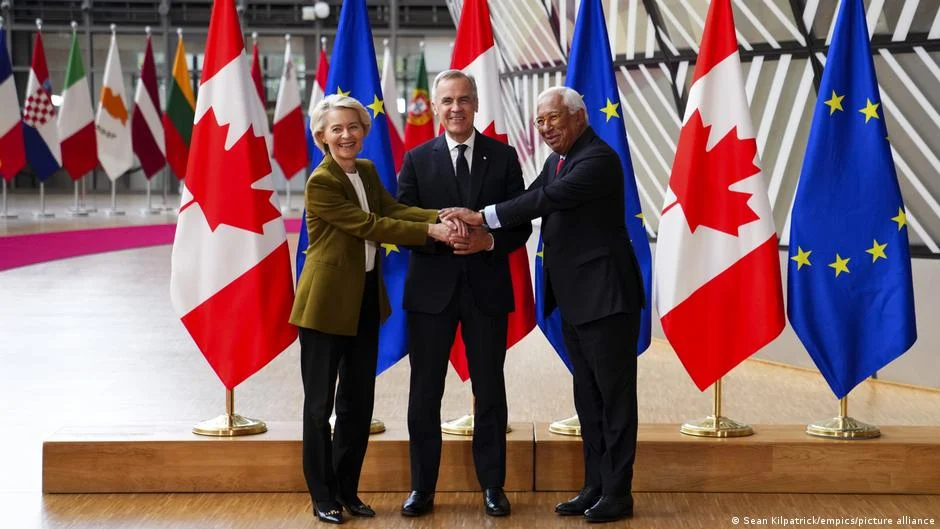
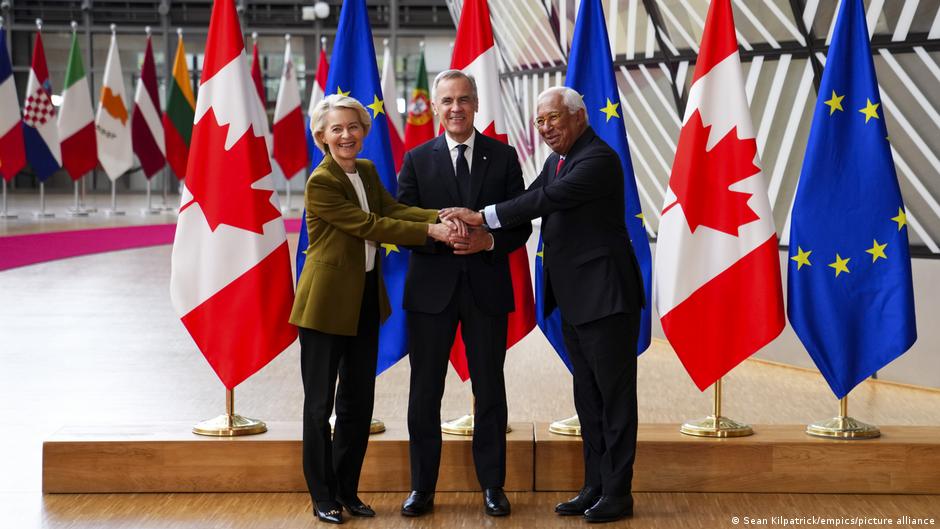
The diplomatic landscape between Ottawa and Brussels is undergoing a seismic shift as Canadian Prime Minister Mark Carney pursues an unprecedented "associate" partnership with the European Union. While the move falls short of full membership, the initiative represents a strategic pivot designed to insulate Canada from the volatility of the current global order and to establish a robust framework for shared economic and security interests. This move follows a period of mounting international instability and a notable deterioration in North American trade relations, prompting Canada to look across the Atlantic for a more reliable, like-minded coalition.
The push for this deepened relationship gained significant momentum during the annual State of the European Union address this week, where European Commission President Ursula von der Leyen signaled that the EU is ready to welcome a closer, more formal association with Canada. Speaking to lawmakers in Strasbourg, von der Leyen framed the potential partnership as a fundamental exercise in democratic sovereignty. "We believe that power does not belong to the strongest, the richest or the loudest, but to all of us," she stated, emphasizing that democracies maintain the inherent freedom to choose their partners.
A Chronology of Converging Interests
The trajectory toward this partnership did not occur in a vacuum. It is the culmination of years of geopolitical recalibration:
- September 2017: The EU-Canada Comprehensive Economic and Trade Agreement (CETA) enters into force on a provisional basis, establishing the foundation for tariff-free trade and market access.
- January 2026: Prime Minister Mark Carney delivers a landmark address at the World Economic Forum in Davos, where he warns of a "rupture in the world order," famously noting that nations must either be at the table or risk being "on the menu."
- Late 2026/Early 2027: Escalating trade tensions and the implementation of restrictive tariffs between the United States and Canada accelerate the urgency for Ottawa to diversify its economic dependencies.
- September 2027: Prime Minister Carney formally proposes a "unique alliance" with the European Union, initiating high-level discussions in Brussels.
- October 2027: President von der Leyen confirms in her State of the Union address that the EU is open to an expanded, multi-sectoral partnership.
The Scope of the Proposed Alliance
While official details regarding the legal architecture of this alliance remain under negotiation, the scope is expansive. The partnership is expected to transcend traditional trade, moving into the realms of critical infrastructure, defense, and emerging technology.
Key areas identified for cooperation include advanced manufacturing, artificial intelligence, quantum computing, and the secure procurement of critical minerals—a sector where Canada possesses a massive competitive advantage. Furthermore, the collaboration aims to address cybersecurity and energy security, with Canada’s vast natural gas and oil reserves potentially serving as a strategic buffer for European energy needs.
Defense Cooperation: Moving Beyond the US Umbrella
A central pillar of the proposed alliance is the modernization and integration of defense capabilities. For decades, both Canada and the EU have relied heavily on the United States for security guarantees. However, recent shifts in US foreign policy have necessitated a transition toward self-reliance.
Patrick Leblond, an expert on international economic relations at the University of Ottawa, notes that the current era of "underinvestment" in military readiness is drawing to a close. "We have, in a way, taken the US security umbrella for granted on both sides," Leblond explained. The goal is now the joint production of military hardware and the collaborative development of next-generation defense technologies.
Canada’s involvement in the EU’s Security Action for Europe (SAFE) program serves as a tangible example of this pivot. By paying a membership fee to participate, Canada has secured access to the bloc’s €150 billion ($173 billion) procurement fund. This allows Canadian firms to bypass some of the stringent local-content requirements that typically hinder non-EU entities, provided they meet specific criteria regarding component sourcing.
Analytical Perspective: An Underrated Power
Analysts argue that the European Union has a vested interest in this partnership, primarily due to Canada’s often-overlooked defense capacity. Anand Sundar, a security analyst at the European Council on Foreign Relations, points out that Canada is an "underrated defense power."
Data supports this assessment: Canada currently invests 2% of its GDP into its military, a figure that dwarfs the combined spending of the EU’s 14 smallest member states. More importantly, Canada has set an ambitious target of increasing this to 5% of GDP by 2035, with a significant 3.5% allocation dedicated specifically to hardware and equipment. For the EU, integrating a partner with this level of fiscal commitment to defense offers a significant boost to the bloc’s overall security posture.
Challenges and Structural Realities
Despite the optimism in Brussels and Ottawa, experts urge a measured approach to what "association" actually implies. The legal framework of the EU is rigid, and analysts like Leblond caution against assuming this will lead to the adoption of European law or integration into the EU single market.
"It is unlikely that Canada would adopt European laws or join the EU customs union," Leblond noted. Such a move would require Canada to impose common external tariffs, which would be fundamentally incompatible with its North American economic obligations. Instead, the alliance is expected to be a functional, high-level cooperation agreement focused on policy alignment rather than legislative integration.
Furthermore, Canadian companies must overcome internal hurdles. Despite the existence of CETA, many Canadian businesses remain heavily tethered to the US market. The Canadian government faces the task of educating its domestic industries on the untapped potential of the European market, which remains the world’s largest single economic bloc.
Broader Geopolitical Implications
The move toward a Canada-EU alliance carries significant weight for the United Kingdom and Norway, both of which maintain unique but distinct relationships with the EU. If the EU establishes a successful "associate member" model with Canada, it could set a precedent for how the bloc manages relationships with other non-member, high-income democracies in an increasingly fractured world.
As Prime Minister Carney prepares to address the European Parliament, the focus will remain on whether these high-level sentiments can translate into concrete, actionable projects. The shift is not merely economic; it is a defensive hedge against a future where the traditional transatlantic consensus can no longer be guaranteed.
For Europe, Canada offers a stable, resource-rich partner with a shared commitment to democratic values and a significant, growing defense budget. For Canada, the EU provides a necessary counterbalance to the unpredictability of its southern neighbor, offering a pathway to diversify trade, technology, and security.
As the negotiations progress, the world will be watching to see if this "unique alliance" can evolve from a diplomatic vision into a robust, institutionalized reality that reshapes the Atlantic economic and security architecture for the next generation. Whether through joint satellite operations, shared Arctic research, or unified procurement of critical AI components, the path forward appears increasingly collaborative. The success of this endeavor may well determine the resilience of middle powers in the coming decades.

