
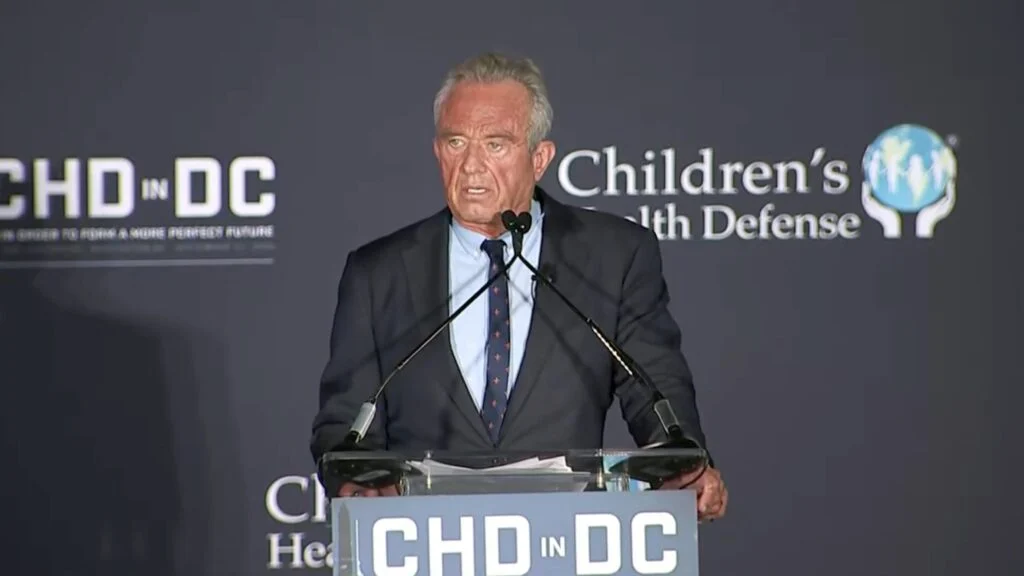
WASHINGTON — Health and Human Services Secretary Robert F. Kennedy Jr. returned to his ideological origins on Thursday, delivering a high-profile keynote address at a conference hosted by Children’s Health Defense (CHD). The organization, an anti-vaccine nonprofit co-founded by Kennedy, served as the platform for what many political analysts are describing as a definitive victory lap for the Make America Healthy Again (MAHA) movement. As the nation approaches pivotal midterm elections, the event signaled a hardening of the administration’s stance on public health, placing vaccine safety—a topic previously downplayed by the secretary during his early tenure—at the very center of his legacy.
The speech, held in a crowded ballroom, functioned as both a progress report and a rallying cry. While Kennedy spent the first half of his address outlining his agency’s broader agenda—including efforts to reform the food pyramid, scrutinize chemical additives in processed foods, and improve hospital nutrition standards—the tone shifted dramatically once he turned his focus to what he described as the "hidden risks" of the American childhood immunization schedule.
A Chronology of the MAHA Shift
The trajectory of federal health policy under the current administration has been marked by a series of aggressive departures from established scientific consensus.
- Early 2025: The administration initiates a review of the childhood immunization schedule, sparking immediate friction with major medical associations.
- April 2025: Secretary Kennedy publicly questions the efficacy and transparency of the Vaccine Adverse Event Reporting System (VAERS), proposing automation to increase data collection.
- September 2025: Following a year of intense debate, the administration formally ends the policy of universal newborn hepatitis B vaccination.
- December 2025: The CDC updates its recommendations, reflecting the administration’s push to move away from the previously standard schedule of 18 childhood vaccines.
- August 2026: President Trump issues an executive order aligning federal policy with the MAHA platform, cementing Kennedy’s influence over the HHS.
- October 2026: The current midterm election cycle emerges as a de facto referendum on these systemic changes to health care.
The Science of Vaccine Safety and Adverse Reporting
During the CHD conference, Kennedy utilized a Hepatitis B vaccine package insert as a primary visual aid to challenge the rigorousness of FDA approval processes. Pointing to a study of 147 infants used in clinical trials, he argued that the sample size was insufficient to establish long-term safety profiles.
"The question is: Should we be looking at the potential that some of these chronic illnesses are associated with vaccines?" Kennedy asked the audience. He asserted that the current reporting systems fail to capture the full scope of potential side effects, such as autoimmune disorders, asthma, and sudden infant death syndrome.
However, public health experts and federal data indicate a different reality. The FDA’s initial approval of the hepatitis B vaccine relied on the 147-participant study only as a subset of broader clinical data, which included thousands of infants vaccinated with older formulations. Post-market surveillance conducted over decades has consistently reaffirmed the safety profile of the vaccine. Data from the Centers for Disease Control and Prevention (CDC) shows that the implementation of universal newborn vaccination led to a 99% reduction in chronic hepatitis B infections among children and teenagers, a success story now overshadowed by the current policy reversal.
Furthermore, medical professionals emphasize a critical distinction regarding vaccine package inserts: they list any event reported after vaccination, regardless of whether a causal link has been established. As the insert itself states, "It is not possible to reliably estimate their frequency or establish a causal relationship to a vaccine exposure." By framing these disclosures as proof of harm, critics argue that the Secretary is misinterpreting the very regulatory language intended to maintain transparency.
Broader Public Health Implications
The implications of the administration’s stance are being felt across the scientific and medical community. Biotechnology companies and academic research institutions have expressed deep concern that the politicization of vaccine safety will lead to a decline in immunization rates. This anxiety is not theoretical; the United States is currently experiencing a rapid spread of measles, with health officials in Pennsylvania recently confirming at least four deaths linked to an outbreak.
Despite these developments, Kennedy’s focus remains on what he terms the "epidemic of chronic illness." He announced that the Department of Health and Human Services is currently conducting research into more than 150 serious adverse events to determine if they correlate with childhood vaccinations. Additionally, he detailed plans to create a more "user-friendly" VAERS system, which would include financial incentives for physicians to report potential injuries, aiming to bridge what he perceives as a massive data gap.
The Political Landscape and Presidential Support
The political durability of Kennedy’s agenda is underscored by his direct line to the Oval Office. Throughout his speech, Kennedy reminded his base that his initiatives have the full backing of the White House. "Let me be clear: You have a strong and steadfast friend at the White House," he declared to a cheering audience.
This alignment with the President has created a significant divide in American health policy. While the administration views its actions as a necessary "correction" to decades of institutional capture by pharmaceutical interests, the public health establishment views the rhetoric as a dangerous erosion of foundational science. The ongoing lawsuit regarding the Trump administration’s changes to the childhood immunization schedule serves as the primary legal battleground where these two visions of public health will be tested.
Analysis: A Shift in Governance
The appearance of Andrew Wakefield, the physician whose 1998 study linking the MMR vaccine to autism was later retracted and debunked, as the post-speech speaker, underscored the ideological continuity of the CHD movement. For the mainstream medical community, this represents a retreat from evidence-based medicine into a paradigm where personal conviction and suspicion take precedence over clinical data.
For the HHS, the challenge ahead is to manage a health system where the Secretary is at odds with the consensus of the medical bodies he oversees. As the midterms approach, the impact of these policies on public health outcomes—ranging from vaccination coverage rates to the control of infectious diseases—will likely be a central theme in the political discourse.
The Secretary’s commitment to "flipping the food pyramid" and investigating electromagnetic frequencies alongside his crusade against the current vaccine schedule suggests that the MAHA movement is not a temporary political pivot, but a fundamental restructuring of federal health priorities. Whether this approach leads to the "healthier nation" Kennedy envisions or exacerbates the current public health crises remains the most significant question facing the American healthcare system in the coming years.
As the event concluded, the atmosphere remained one of triumph. For the supporters gathered in Washington, the conference was not merely a meeting of like-minded individuals, but a validation that their long-standing skepticism has now reached the highest levels of federal power. For the broader public, however, the day highlighted a deepening chasm between the government’s health agency and the scientific community, leaving the future of national health infrastructure in a state of unprecedented uncertainty.

