
The grand narrative of life on Earth is often characterized by a one-way street: the arduous, millions-of-years-long migration from the primordial oceans to the terrestrial landscapes of the continents. Yet, the history of vertebrates is punctuated by startling U-turns. Numerous groups of mammals and reptiles, having conquered the land, eventually retreated back into the depths, undergoing radical physiological transformations to thrive in aquatic environments. A groundbreaking new study published in the journal Current Biology by researchers at Yale University has now provided a definitive framework for understanding when, how, and why these evolutionary reversals occurred.
By marrying modern computational power with a statistical technique originally developed for military radar during World War II, the research team—led by Caleb Gordon, a former doctoral student at Yale’s Graduate School of Arts and Sciences—has created a rigorous methodology to distinguish between creatures that were fully aquatic and those that remained semi-aquatic. This work, which utilized more than 11,000 data points, photos, and CT scans of specimens at the Yale Peabody Museum and institutions globally, settles long-standing paleontological debates regarding iconic prehistoric animals.
The Mechanism of Convergent Evolution
The phenomenon at the heart of this study is convergent evolution—the process by which unrelated or distantly related organisms evolve similar traits as a result of having to adapt to similar environments or ecological niches. In the case of "secondarily aquatic" groups, the pressures of water density, buoyancy, and locomotion forced diverse lineages to develop flippers, streamlined body shapes, and specialized bone densities.
"These secondarily aquatic groups adapted in strikingly similar ways to their new aquatic home," says lead author Caleb Gordon, now a postdoctoral researcher at the Florida Museum of Natural History. "As a result, they’ve become textbook examples of convergent evolution, which can tell us a lot about the processes driving and constraining adaptive change in response to similar environmental cues."
This study serves as a critical bridge between the incomplete fossil record and the biological reality of these animals. For decades, paleontologists have been stymied by "ambiguous fossils"—skeletal remains that possess a mix of features, some suggesting a life spent in water and others pointing to terrestrial locomotion. By quantifying skeletal proportions and training machine learning models on the known lifestyles of extant animals, the team has successfully removed the subjectivity that has long plagued the field.
Revisiting the Spinosaurus Controversy
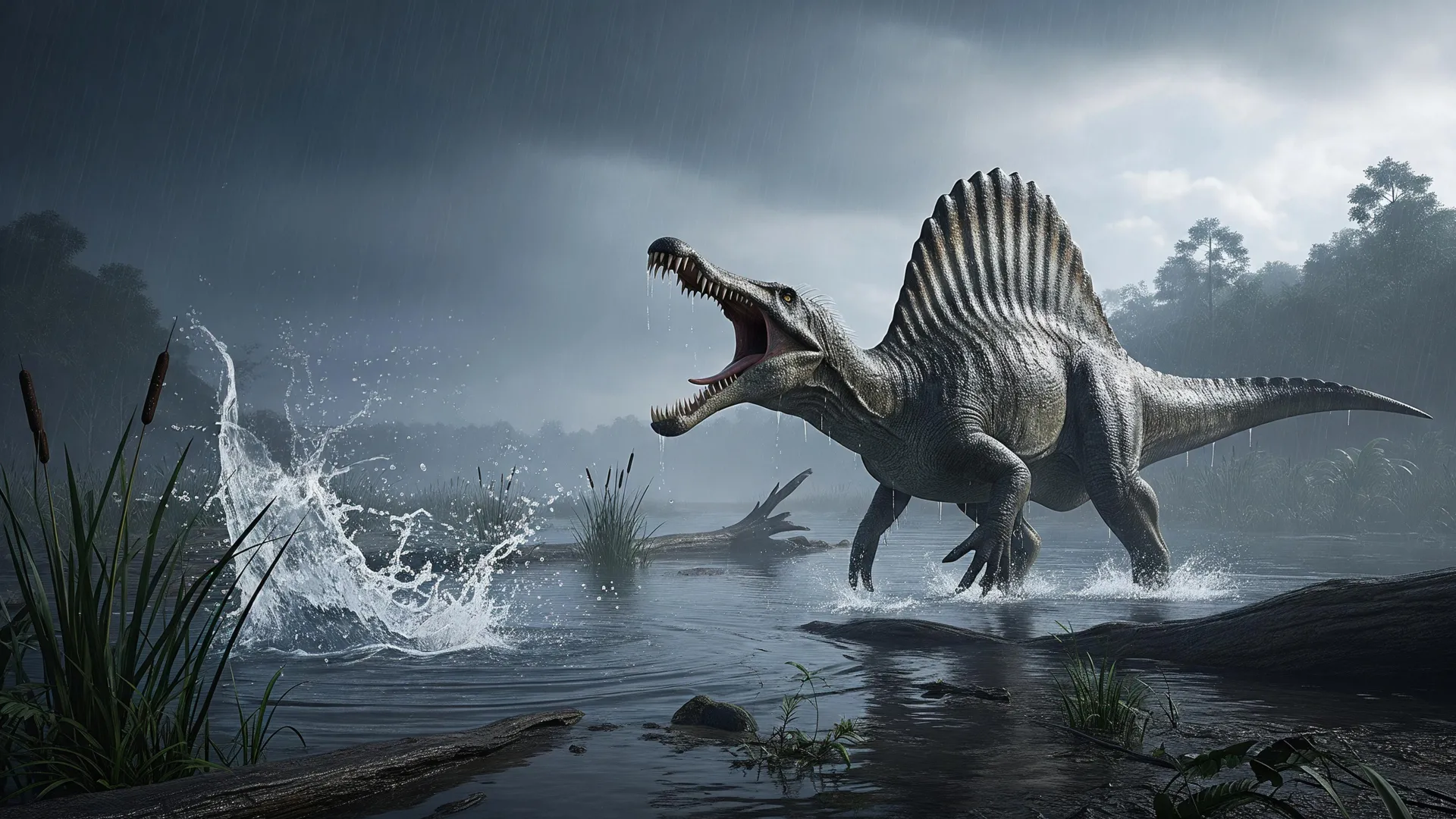
Perhaps the most significant application of this new analytical tool involves Spinosaurus, the gargantuan theropod that stalked Northern Africa between 113 and 94 million years ago. For years, the scientific community has been divided over the habits of this dinosaur. Did it act as an apex predator of the rivers, hunting submerged like a modern-day penguin or seal? Or was it a wader, content to stand on the banks like a giant heron, plucking fish from the shallows?
The Yale-led team’s findings provide substantial weight to the former theory. Using their predictive model, which assesses skeletal data to estimate lifestyle, the researchers recovered strong evidence for a highly aquatic existence. The data suggests that Spinosaurus spent the vast majority of its life submerged. This finding helps resolve the debate by confirming that the dinosaur was not merely a shoreline visitor, but an animal fundamentally structured for a life in the water, marking it as one of the most extreme examples of an evolutionary reversal in the dinosaur record.
The Paleozoic Limit: Lessons from the Mesosaurs
While Spinosaurus represents a successful transition to the water, the study also highlights the limits of such evolution. The team analyzed mesosaurs, small marine reptiles from the Permian period, roughly 290 to 274 million years ago. Despite their presence in aquatic environments and their ability to bear live young—a trait often associated with fully aquatic marine life—the Yale team found that their limb anatomy was not specialized for a life entirely divorced from land.
"They spent a lot of time on land, like a modern-day alligator or platypus does," Gordon explained. The study indicates that none of the marine reptiles from the Paleozoic era—the time before the dinosaurs emerged—achieved a fully aquatic existence. Even the most water-adapted species of that era remained amphibious, tethered to the land for reproduction or resting. This suggests that the physiological "barrier" to becoming fully aquatic was significantly higher for these ancient creatures than it was for later groups.
A Technological Time Machine: From Radar to Paleontology
The methodology underpinning these findings is as fascinating as the results themselves. The researchers utilized a statistical approach developed by naval forces during World War II to calculate the probability that a radar blip represented an incoming enemy aircraft.
Jacques Gauthier, a co-author and curator-in-charge for vertebrate paleontology at the Yale Peabody Museum, highlights the ingenuity of this approach. "Caleb resurrected a statistical technique from a bygone era. It was developed during WWII to estimate the probability that an approaching blip on the radar screen was an enemy plane. Caleb cleverly used it to get at whether or not an extinct animal had limbs modified for swimming."
By repurposing this Bayesian-style statistical framework, the researchers could assign a probability score to the likelihood that a fossilized limb was intended for paddling or walking. When combined with machine learning models that can predict soft-tissue features—such as the presence of flippers that rarely fossilize—the team achieved an accuracy rate of over 90% in identifying aquatic versus terrestrial habits.
Implications for Evolutionary Biology
The broader impact of this research extends far beyond the study of extinct reptiles and dinosaurs. It offers a standardized, empirical framework for evaluating evolutionary transitions that were previously categorized based on "storytelling" or consensus among experts. By allowing the data to speak for themselves, the study minimizes human bias.
Bhart-Anjan Bhullar, senior author and associate professor of Earth and planetary sciences at Yale, emphasizes the importance of this rigor. "Reconstructing the lives of extinct life forms in a scientifically rigorous way, as opposed to just telling stories, is a precise and delicate undertaking. It requires a careful interweaving of data from modern organisms, of which our understanding is necessarily far deeper, and knowledge of these living organisms’ genealogy relative to fossil forms."
The potential applications of this machine learning-based framework are extensive. Future research could apply this same model to other major evolutionary transitions, such as the development of bipedalism in early human ancestors or the transition from flightless theropods to the ancestors of modern birds.
Conclusion: A New Era of Paleontological Inquiry
As the scientific community continues to grapple with the mysteries of the fossil record, the Yale team’s work represents a milestone in the digitization of natural history. By integrating machine learning and historical statistical methods, researchers are no longer limited by the fragmentary nature of bone preservation. They are now able to "reconstruct" the soft tissue and behavior of creatures that vanished millions of years ago with unprecedented confidence.
This study, supported by the Yale Institute for Biospheric Studies, the International Union for Conservation of Nature’s Crocodile Specialist Group, and the National Science Foundation, underscores a vital shift in paleontology. We are moving away from an era of qualitative description and into an era of quantitative prediction, where the secrets of our planet’s lost worlds are increasingly decoded by the algorithms of the future. As we continue to refine these models, our understanding of the deep, cyclical history of life on Earth will undoubtedly become clearer, revealing the complex ways in which all species—past and present—respond to the unrelenting demands of their environments.

