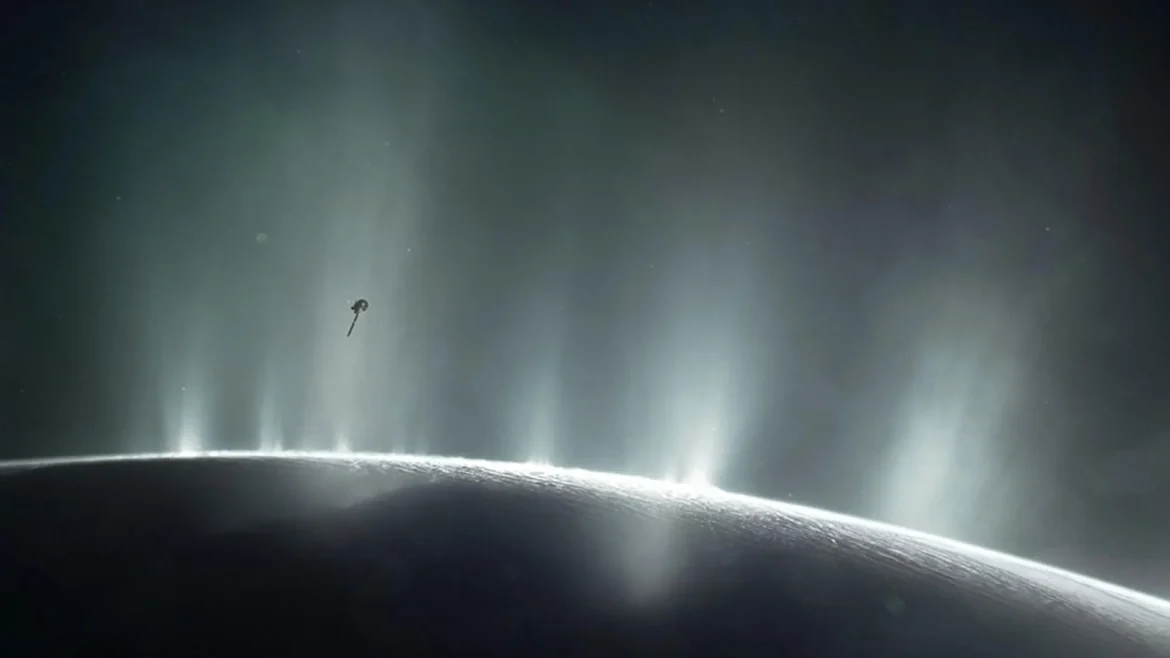
Saturn’s moon Enceladus has long been a primary target in the search for extraterrestrial life, largely due to the dramatic plumes of water vapor and ice particles that erupt from its southern polar region. These "tiger stripe" fractures act as natural conduits to a hidden, global liquid ocean buried beneath a thick shell of ice. For years, scientists have relied on data collected by NASA’s Cassini spacecraft to analyze this oceanic chemistry without the need for an expensive and technically daunting landing mission. However, a persistent mystery remained: why did the ice grains captured by Cassini show such startling chemical diversity? New research, conducted by an international team including experts from the Earth-Life Science Institute (ELSI) at the Institute of Science Tokyo, suggests that the secret lies in the physics of freezing.
The Cassini Legacy and the Salt Mystery
Between 2004 and 2017, NASA’s Cassini spacecraft conducted a series of daring flybys through the plume of Enceladus and the resulting E-ring of Saturn. The spacecraft’s Cosmic Dust Analyzer (CDA) was instrumental in characterizing the composition of these particles. By the time the mission concluded with the spacecraft’s intentional plunge into Saturn’s atmosphere in September 2017, it had provided an unprecedented dataset of chemical signatures.
A team led by Professor Frank Postberg of Freie Universität Berlin performed a rigorous retrospective analysis of 961 mass spectra collected by the CDA, specifically focusing on "Type 3" particles, which are known to be salt-rich. Standard geological models would suggest that these grains, if originating from the same body of water, should reflect a relatively homogenous chemical profile. Instead, the data revealed a striking lack of uniformity. Some grains were dominated by sodium chloride, while others favored carbonates, phosphates, or potassium chloride. Most notably, researchers observed that chloride and carbonate rarely appeared together in the same sodium-rich particle, a geochemical anomaly that defied simple explanation.
Laboratory Simulations: Recreating the Plume
To reconcile these observations with the known environment of the moon, Professor Yasuhito Sekine and his colleagues at ELSI designed an experiment to simulate the formation of these ice grains. The team hypothesized that the chemical sorting was not occurring within the ocean itself, but during the transit of water droplets through the icy crust.
The researchers created laboratory droplets mimicking the composition of Enceladus’ ocean, containing the primary salts identified by Cassini. These droplets were subjected to varying cooling rates to observe how salt distribution changed during solidification. The findings were definitive: the speed of freezing is a critical variable in determining the chemical composition of the resulting ice.
When droplets of approximately 200 micrometers were frozen slowly—at rates of 10 K per minute or less—the salts successfully separated into distinct regions within the solid grain. Conversely, rapid freezing resulted in a more uniform distribution of ingredients. This provided the "smoking gun" for the Cassini data: the ice grains detected in space were likely fragments of larger droplets that had undergone slow, fractional crystallization as they migrated toward the surface.
A Slow Journey Through the Icy Crust
The traditional scientific consensus held that seawater spray from Enceladus’ ocean erupted violently and froze almost instantaneously upon hitting the vacuum of space. The ELSI research suggests a far more complex and protracted journey.
Under this new model, the ocean spray likely forms droplets that traverse the moon’s internal vent system at a much slower pace. These droplets follow intricate, labyrinthine pathways through fractures in the ice. As they move through the cooler, deeper sections of these vents, they undergo a slow freezing process, allowing for the segregation of salts.
As these partially or fully frozen droplets approach the surface, the increase in gas pressure and velocity causes them to impact the walls of the narrower icy channels. This physical collision breaks the larger, segregated droplets into smaller fragments. Because each fragment is derived from a different "region" of the original droplet, the resulting ice grains exhibit the chemical diversity recorded by Cassini. This effectively transforms the moon’s subsurface vent system into a natural chemical refinery, sorting and separating compounds long before they reach the space environment.
Implications for Future Astrobiology Missions
The ability of Enceladus to act as its own laboratory for sample preparation is a significant boon for future exploration. In traditional planetary science, the primary challenge of analyzing extraterrestrial liquids is the high degree of dilution; trace organic compounds are often masked by a sea of common minerals.
However, the natural concentration effect observed by the ELSI team suggests that specific, highly diluted compounds may be naturally "packed" into individual ice grains. If a future spacecraft were equipped with advanced mass spectrometers, it could theoretically target these enriched particles to detect organic signatures that would otherwise be invisible. This process mimics the laboratory techniques used by researchers on Earth to isolate and concentrate chemical samples, suggesting that the moon is performing "pre-analysis" for us.
Prebiotic Chemistry and the Search for Life
Beyond the immediate chemical analysis, the process of slow freezing has profound implications for the potential habitability of Enceladus. As ice crystals grow within these droplets, small pockets of liquid brine are often trapped in the interstices. These pockets become sites of extreme chemical concentration, where salts and organic molecules are squeezed into tiny, high-density volumes.
For astrobiologists, this is a critical observation. One of the most significant hurdles in prebiotic chemistry—the study of the processes that lead to the origin of life—is the requirement for dilute molecules to interact at high enough concentrations to form complex chains. If these pockets of brine exist within the crust of Enceladus, they could serve as "micro-reactors" where chemical reactions are accelerated.
Because much of the material ejected by the plumes eventually falls back onto the surface, this process of freezing, concentration, and recycling could potentially repeat over geological timescales. This creates a recurring, dynamic chemical environment that may be conducive to the synthesis of complex organic precursors.
Conclusion and Future Outlook
The findings from the ELSI and Freie Universität Berlin collaboration represent a paradigm shift in how we interpret data from icy moons. By shifting the focus from the ocean’s bulk chemistry to the physics of the transport process, researchers have unlocked a new understanding of how to read the geological history of Enceladus.
As NASA, ESA, and other international space agencies look toward future missions—such as the proposed Enceladus Orbilander—these insights will be vital. Understanding that the ice grains are not simple, uniform samples but complex, segregated fragments allows for better mission design and more sophisticated instrument calibration.
The journey of an ice grain from the deep, dark ocean of Enceladus to the rings of Saturn is a tale of physical transformation. By deciphering this story, scientists are moving closer to answering one of humanity’s most profound questions: whether the conditions for life are unique to Earth or a common feature of the icy worlds orbiting our gas giants. As we continue to refine our models of this "ocean world," every new particle captured in the E-ring serves as a piece of a larger, extraterrestrial puzzle.