
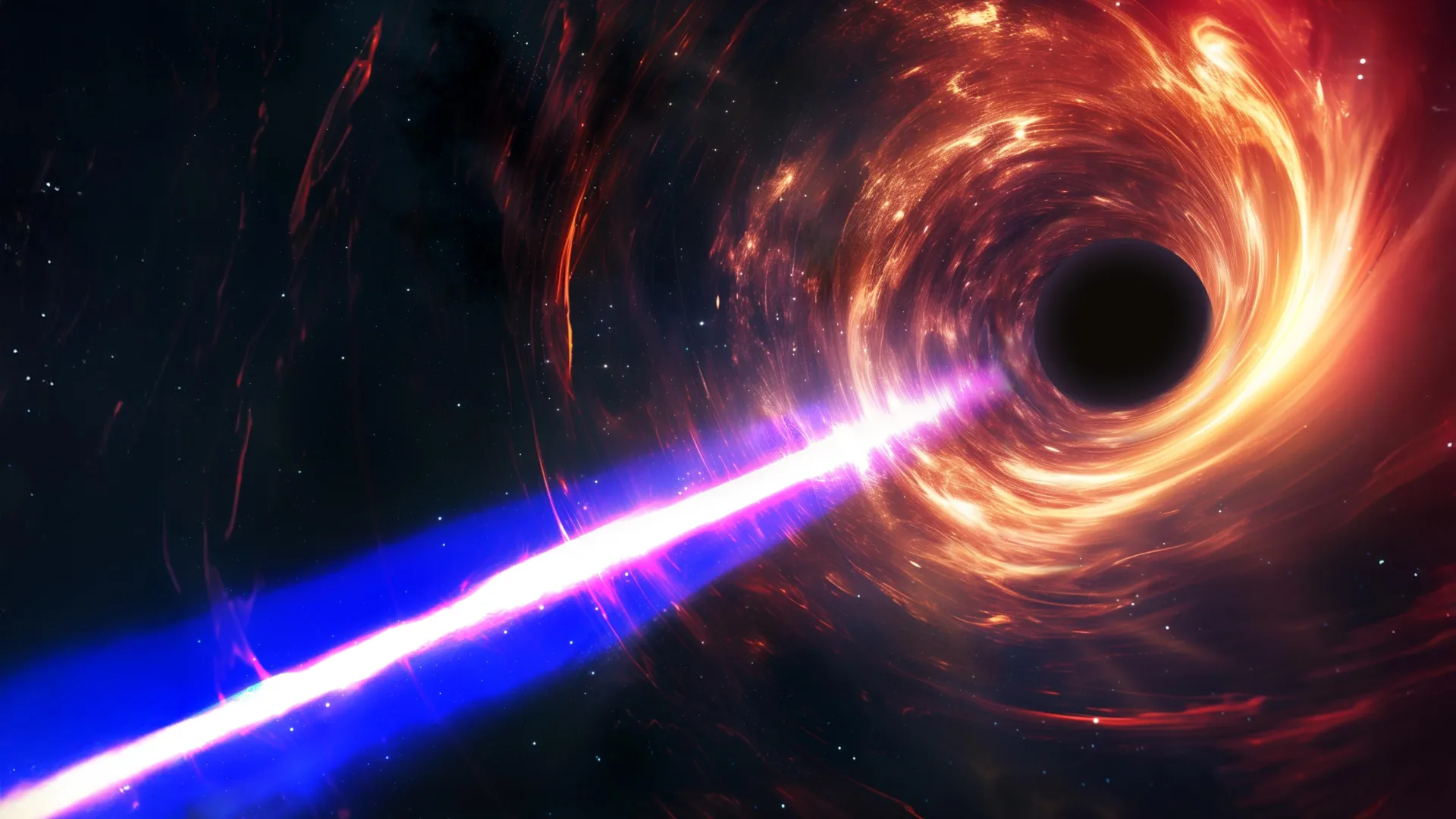
Researchers have achieved a groundbreaking milestone in comprehending the profound influence of black holes on the universe by directly quantifying the immense power of their relativistic jets. A global network of radio telescopes, meticulously coordinated by a team spearheaded by Curtin University, has yielded incredibly detailed imagery that vividly illustrates the sheer energetic output of these cosmic phenomena. This pivotal discovery not only validates long-held theoretical models but also significantly advances our understanding of the fundamental role black holes play in sculpting the structure and evolution of galaxies across the cosmos.
The Cygnus X-1 System: A Cosmic Laboratory
The focus of this groundbreaking study, published in the esteemed journal Nature Astronomy, was the well-studied binary system known as Cygnus X-1. This system is distinguished by its possession of the first black hole to be unequivocally confirmed by scientific observation, alongside a colossal supergiant star. Through sophisticated radio astronomy techniques, the research team was able to determine that the powerful jets emanating from Cygnus X-1’s black hole are expelling energy at a rate equivalent to approximately 10,000 times the total energy output of our Sun. This staggering figure underscores the immense power inherent in these black hole phenomena.
A Novel Approach: Harnessing Stellar Winds
The innovative methodology employed by the researchers involved leveraging a precisely synchronized array of radio telescopes strategically positioned across the globe. This distributed network effectively functioned as a single, colossal telescope, providing the necessary resolution to observe subtle interactions. The team observed how the powerful jets, which travel at speeds approaching half the speed of light, were being dynamically influenced and distorted by the intense stellar winds originating from the companion supergiant star. This interaction, akin to how strong terrestrial winds can dramatically alter the trajectory of a water jet from a fountain, provided a unique opportunity for measurement.
By meticulously calculating the precise strength of the stellar wind and simultaneously tracking the degree to which the black hole jets were deflected, scientists were able to derive the instantaneous power of these jets at a specific point in their trajectory. This direct measurement marks a significant departure from previous methods, which relied on inferring jet power from long-term averages of accretion disk activity, thereby offering a more dynamic and accurate portrayal of these energetic outflows.
Quantifying Cosmic Colossi: Jet Speed and Energy Transfer
Beyond their power, the study also provided a much-needed direct measurement of the jets’ speed. The research confirmed that these cosmic projectiles are accelerating to approximately half the speed of light, a staggering velocity of around 150,000 kilometers per second. Accurately determining this speed has been a persistent challenge for astrophysicists for many years, and this new measurement provides a crucial benchmark for theoretical models.
The project was a collaborative effort, spearheaded by the Curtin Institute of Radio Astronomy (CIRA) and the Curtin node of the International Centre for Radio Astronomy Research (ICRAR), with significant contributions from the University of Oxford. This international cooperation highlights the global nature of modern astrophysical research.
"Dancing Jets": A Visual Metaphor for Dynamic Processes
Dr. Steve Prabu, the lead author of the study and formerly of CIRA, now affiliated with the University of Oxford, described the observed phenomenon as "dancing jets." This evocative term captures the visible, dynamic shifting of the jets’ direction as they are buffeted by the supergiant star’s powerful outflow. By analyzing a sequence of captured images, the team could meticulously track these subtle yet significant movements.
Dr. Prabu elaborated on the profound implications of these observations, stating that they provide unprecedented insight into the efficiency of energy transfer from the accretion process around a black hole into its surrounding environment. "A key finding from this research is that about 10 per cent of the energy released as matter falls in towards the black hole is carried away by the jets," Dr. Prabu stated. He further emphasized that this figure aligns with critical assumptions made in large-scale cosmological simulations, but had, until now, remained difficult to confirm through direct observational evidence.
Validating Theoretical Frameworks: Anchoring Black Hole Physics
Professor James Miller-Jones, a co-author from CIRA and the Curtin node of ICRAR, underscored the significance of this direct measurement in the context of established astrophysical theories. He explained that prior observational techniques were limited to estimating jet power over immensely long timescales, sometimes spanning thousands or even millions of years. This temporal limitation made direct comparisons between jet energy output and the X-ray emissions produced by infalling matter into the black hole a considerable challenge.
"And because our theories suggest that the physics around black holes is very similar, we can now use this measurement to anchor our understanding of jets, whether they are from black holes 10 or 10 million times the mass of the Sun," Professor Miller-Jones articulated. This statement highlights the universal applicability of the findings, suggesting that the principles governing jet formation and power are consistent across a vast range of black hole masses.
The implications extend to future observational capabilities. With the ongoing development of next-generation radio telescope projects like the Square Kilometre Array Observatory (SKAO), currently under construction in Western Australia and South Africa, astronomers anticipate the detection of jets from millions of distant galaxies. The precise calibration of jet power provided by this new measurement will be invaluable in interpreting these future observations and understanding the overall energy budgets of these extragalactic phenomena.
Professor Miller-Jones concluded by reiterating the fundamental importance of black hole jets: "Black hole jets provide an important source of feedback to the surrounding environment and are critical to understanding the evolution of galaxies." This statement encapsulates the overarching significance of the research, positioning black hole jets as key drivers of cosmic evolution.
Other esteemed institutions that contributed to this landmark research include the University of Barcelona, the University of Wisconsin-Madison, the University of Lethbridge, and the Institute of Space Science, underscoring the collaborative and interdisciplinary nature of modern scientific inquiry.
Broader Context: The Role of Black Holes in the Cosmos
Black holes, regions of spacetime where gravity is so strong that nothing, not even light, can escape, are not merely cosmic vacuum cleaners. For decades, astronomers have theorized that supermassive black holes, residing at the centers of most galaxies, play a crucial role in regulating galaxy growth and evolution. This regulation occurs through powerful outflows, often in the form of relativistic jets, that can heat and expel gas from the galaxy, thereby influencing star formation rates.
The Cygnus X-1 system, while hosting a stellar-mass black hole, provides a valuable analogue for studying these processes. Its relative proximity and the presence of a bright, massive companion star make it an ideal target for detailed observational studies. The discovery of the first confirmed black hole in Cygnus X-1 in the late 1960s marked a turning point in astrophysics, ushering in an era of direct investigation into these enigmatic objects.
Timeline of Discovery and Implications for Future Research
The journey to this direct measurement began with decades of theoretical work and technological advancements in radio astronomy. The development of Very Long Baseline Interferometry (VLBI) techniques, which allow radio telescopes across the globe to be synchronized to achieve incredibly high angular resolution, has been instrumental.
- Late 1960s – Early 1970s: Cygnus X-1 identified as a strong X-ray source, leading to its confirmation as the first stellar-mass black hole candidate.
- 1990s – 2000s: Theoretical models increasingly emphasized the role of relativistic jets in black hole accretion and galaxy feedback. Advances in radio telescope sensitivity and resolution paved the way for more detailed observations.
- 2010s: The concept of using the interaction of stellar winds with black hole jets to infer jet power gains traction. The coordinated efforts of global radio telescope networks become increasingly sophisticated.
- Present: The publication of the Nature Astronomy paper, providing the first direct, instantaneous measurement of black hole jet power, validating key theoretical predictions and setting a new benchmark for astrophysical research.
The implications of this research are far-reaching. For cosmologists, it provides a more accurate understanding of the feedback mechanisms that shape the large-scale structure of the universe. For theorists, it offers concrete data points to refine and validate complex simulations of black hole accretion and jet formation. For observers, it opens up new avenues for studying black hole phenomena across the vast cosmic distances.
The ability to anchor our understanding of jet power across different mass scales means that future observations of quasars and active galactic nuclei (AGN) – supermassive black holes actively accreting matter in distant galaxies – will benefit immensely. These distant phenomena are crucial for understanding the evolution of galaxies over cosmic time.
Official Responses and Expert Commentary
The scientific community has reacted with considerable enthusiasm to these findings. Dr. Anya Sharma, an astrophysicist at the National Astronomical Observatory, who was not involved in the study, commented, "This is a truly remarkable achievement. Directly measuring the instantaneous power of black hole jets has been a ‘holy grail’ for many years. The Curtin University-led team has delivered an elegant and powerful solution, which will undoubtedly become a cornerstone for future research in this field."
Professor David Chen, a leading expert in high-energy astrophysics at the University of Cambridge, added, "The Cygnus X-1 system continues to surprise us. This study not only confirms our understanding of the immense energies involved but also provides a crucial quantitative link between the accretion process and the energetic outflows that drive galactic evolution. The ‘dancing jets’ metaphor is particularly insightful, highlighting the dynamic interplay of forces at play."
The research team’s success is a testament to the power of international collaboration and the relentless pursuit of scientific understanding. As new generations of telescopes come online, the insights gained from this direct measurement of Cygnus X-1’s jets will undoubtedly be applied to unravel the mysteries of black holes and their profound impact on the universe we inhabit. The cosmos, it seems, is a far more dynamic and energetic place than previously imagined, with black holes acting as powerful engines of cosmic change.

