
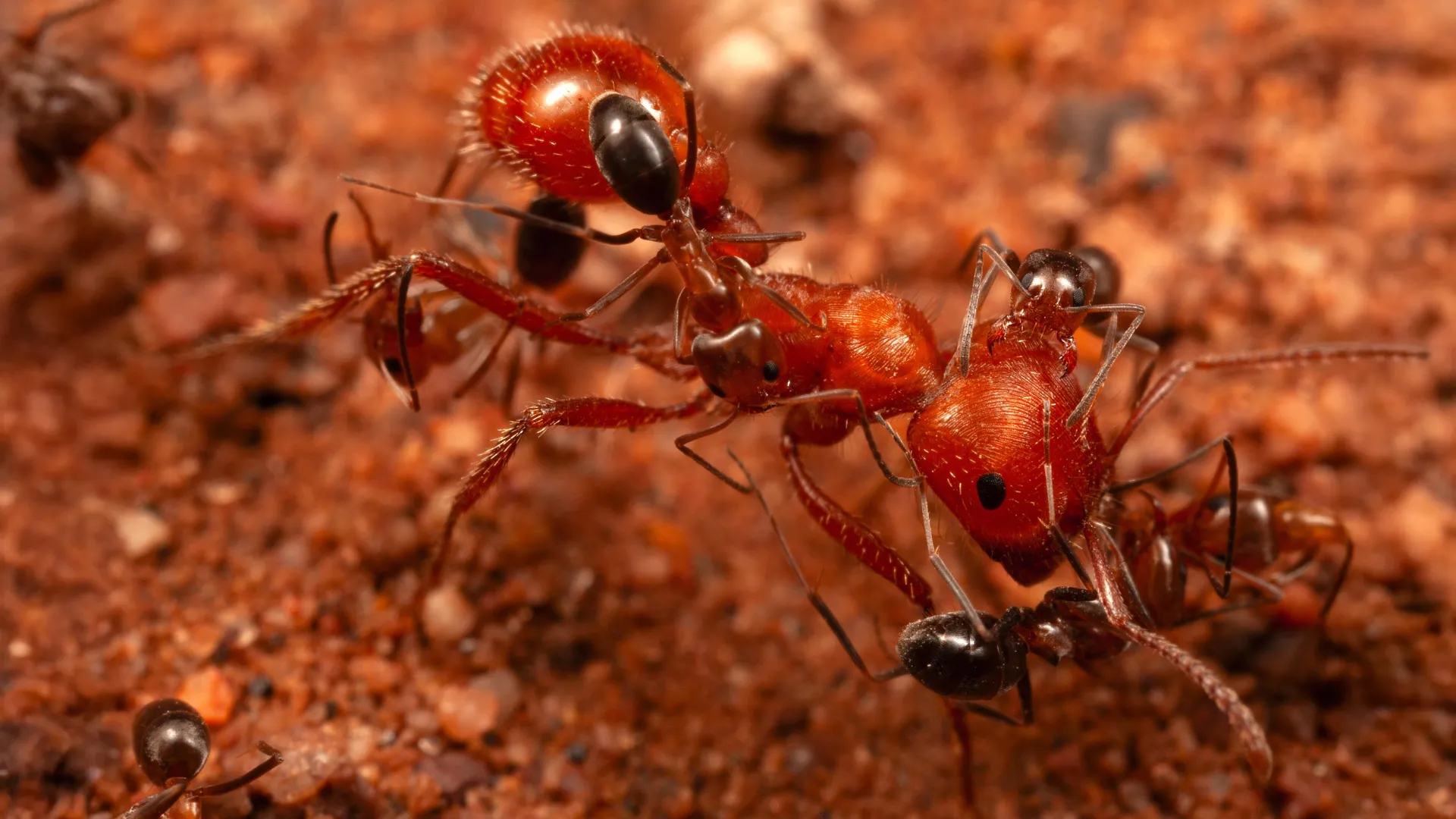
In the stark, sun-baked landscapes of southeastern Arizona, an extraordinary spectacle is unfolding at the fringes of ant nests, a behavior that challenges long-held assumptions about interspecies interactions within the insect world. Outside the humble abodes of small cone ants, their much larger harvester ant cousins stand in an almost startling display of apparent vulnerability. Their formidable, serrated jaws are agape, a posture that would typically signal aggression or defense. Yet, instead of an attack, a remarkable reversal occurs: the smaller cone ants ascend onto the bodies of the larger harvester ants, meticulously licking and nibbling across their exoskeletons. This unprecedented observation marks the first documented instance of one ant species providing a cleaning service to a significantly larger, unrelated ant species, drawing parallels to the well-established cleaner-fish phenomenon in marine ecosystems.
This groundbreaking discovery, detailed this week in the esteemed journal Ecology and Evolution, was brought to light by the keen observations of entomologist Mark Moffett, a distinguished research associate at the Smithsonian’s National Museum of Natural History. Moffett, whose career has been dedicated to unraveling the intricate social behaviors of ants and other complex organisms, likens this newfound ant interaction to the specialized roles observed in coral reefs and open oceans. "This new ant species is the insect equivalent of cleaner fish in the ocean," Moffett stated, emphasizing the extraordinary nature of the behavior. He further noted the surprising degree of trust involved, observing, "The potentially dangerous harvester ants even permit the visitors to groom between their open jaws."
A Serendipitous Encounter in the Chiricahua Mountains
The genesis of this significant discovery was not the result of a planned expedition or a targeted search for novel behaviors. Instead, it was a moment of quiet observation during a research visit to a field station nestled within Arizona’s rugged Chiricahua Mountains. Moffett, a seasoned observer of the natural world, was enjoying a morning coffee when his attention was drawn to a group of worker harvester ants, scientifically known as Pogonomyrmex barbatus. These ants are typically characterized by their constant, purposeful motion as they forage for seeds. However, on this particular morning, several individuals appeared unusually still, a deviation from their characteristic dynamism that piqued Moffett’s scientific curiosity.
Upon closer inspection with his camera’s zoom function, Moffett’s initial surprise turned to astonishment. The seemingly inert harvester ants were not merely resting; they were adorned with a multitude of tiny cone ants. Given the inherent territoriality and often aggressive nature of ant species, Moffett’s first instinct was to assume he was witnessing an act of aggression, perhaps an unusual form of predation or an attempt by the smaller ants to overwhelm their larger counterparts. However, the behavior that unfolded contradicted this initial hypothesis. "Given the usual tendencies of ants, I first assumed that I was observing aggression," Moffett recounted. "But the larger ants seemed to seek the attention of the smaller ants by first visiting their nests and then allowing the small ants to lick and nibble all over them." This reversal of expectation, where the larger, potentially dominant species actively solicited interaction from the smaller ones, underscored the unique and previously undocumented nature of the encounter.
Unraveling the Mechanics of Ant Grooming
Over the subsequent days, Moffett meticulously documented the interaction, observing at least 90 distinct instances of harvester ants engaging with the smaller cone ants. The cone ants involved belong to a species that has not yet been formally described, currently categorized within the genus Dorymyrmex. The consistency in the observed behavior provided a clear framework for understanding the process. A harvester ant, typically returning from foraging, would approach a cone ant nest. Upon reaching the nest entrance, the harvester ant would adopt a characteristic stance, standing tall with its mandibles (all worker ants are female) held open. This posture appeared to be a signal, an invitation for the cone ants to emerge.
Within approximately one minute of the harvester ant’s arrival and signaling, a cone ant would venture out and climb onto the larger ant’s body. In some cases, up to five cone ants would participate in the grooming session simultaneously, creating a miniature, bustling tableau on the harvester ant’s back and legs. The duration of these grooming sessions varied considerably, ranging from a brief 15 seconds to an impressive five minutes. During this time, the cone ants utilized their specialized mouthparts, which include a tongue-like structure known as a proboscis, to meticulously groom the harvester ant’s exoskeleton. Their delicate ministrations extended even to the interior of the harvester ant’s open jaws, an area particularly vulnerable and challenging to access. Throughout this process, the larger harvester ants remained remarkably still, exhibiting no signs of agitation or aggression. Once the grooming was complete, the harvester ant would typically dislodge the smaller ants with a forceful shake, occasionally resulting in the larger ant momentarily flipping onto its back before quickly regaining its footing and moving away.
A Marine Analogy in the Terrestrial Realm
The novelty of this ant-to-ant grooming behavior is underscored by its rarity within the insect kingdom. Moffett, with his extensive knowledge of ant behavior, stated unequivocally that he had "never seen or heard of this kind of behavior in ants or other insects." The closest parallel to this terrestrial grooming service is found in the vibrant and complex ecosystems of the ocean. Marine environments are replete with "cleaning stations," where smaller fish species congregate to remove parasites, dead skin, and debris from larger fish. These cleaner fish, some of which even venture into the mouths of formidable predators like groupers and sharks to perform their service, have long fascinated biologists. The cone ants’ behavior mirrors this established cleaner-fish dynamic with striking similarity, extending the principle of specialized mutualistic relationships into a new biological domain. The harvester ants, by presenting themselves for grooming, actively engage in a behavior that echoes the purposeful visits of larger marine animals to their designated cleaning partners.
Delving into the Reciprocal Benefits
While the observed behavior is undeniable, the precise ecological and evolutionary advantages for each species involved are still subjects of ongoing scientific investigation. Moffett posits that the cone ants likely derive a nutritional benefit from this service. He suggests they may be feeding on minute, energy-rich particles that they meticulously remove from the harvester ants’ bodies. These particles could potentially be fragments of seeds that the harvester ants collect, or perhaps other organic detritus and microorganisms that accumulate on their exoskeletons. The observation that the cone ants showed a clear preference for living harvester ants, ignoring dead specimens placed near their nests, strongly supports the notion that the interaction is driven by a dynamic biological exchange rather than a mere scavenging opportunity.
The benefits for the harvester ants, though less immediately apparent, are also likely significant. Harvester ants, like many social insects, engage in self-grooming and allogrooming (grooming of nestmates) to maintain hygiene, removing foreign particles, fungal spores, and potential parasites. However, the physical limitations of their own appendages and those of their nestmates may prevent them from effectively cleaning certain hard-to-reach areas of their exoskeletons. The smaller, more agile cone ants, with their specialized mouthparts and ability to navigate complex terrain, could be providing a crucial service by accessing these difficult areas. Future research aims to explore whether this symbiotic relationship leads to a reduction in parasitic loads or infections for the harvester ants, or if it plays a role in modulating the complex microbial communities (the microbiome) that inhabit their bodies. Understanding these potential benefits could shed light on the selective pressures that have driven the evolution of such a unique interspecies interaction.
A Testament to Nature’s Uncharted Territories
This remarkable discovery serves as a potent reminder of the vast expanse of biological knowledge that remains undiscovered, particularly within natural environments. Moffett’s work highlights the critical importance of meticulous observation and a willingness to question established paradigms. "All kinds of amazing discoveries are still there to be made outside of the lab," Moffett emphasized, reflecting on the serendipitous nature of his finding. He further elaborated on the methodology that led to this revelation: "Finding new species and behaviors in nature often requires us to pay close attention to the small things — including the ants."
The discovery of this novel ant grooming behavior in Arizona’s arid landscapes has significant implications for our understanding of animal communication, sociality, and the evolution of mutualistic relationships. It challenges the anthropocentric view that complex cooperative behaviors are solely the domain of larger, more complex organisms. The intricate dance between the imposing harvester ant and its diminutive cleaner ant underscores the nuanced and often surprising ways in which species interact and co-evolve. This finding also adds a new dimension to the study of ant ecology, suggesting that interspecific grooming may be a more widespread phenomenon than previously imagined, potentially existing in various forms across different ant species and geographical regions. Further research expeditions into similar arid environments may well uncover additional examples of this fascinating behavior, further enriching our understanding of the intricate web of life.
The broader scientific community has reacted with considerable interest. Dr. Anya Sharma, a leading ant behaviorist at the University of California, Berkeley, commented via email, "Moffett’s discovery is truly exceptional. It pushes the boundaries of what we thought possible in ant-to-ant interactions and provides a compelling terrestrial analogue to cleaner fish. The potential for reciprocal benefits, particularly in terms of hygiene and parasite removal for the harvester ants, warrants extensive further investigation. This is precisely the kind of observation that reminds us how much we still have to learn about the natural world, even about organisms we think we know well."
The implications extend beyond the realm of entomology. This discovery could inform broader ecological models, particularly those dealing with community dynamics and the evolution of cooperation. It prompts questions about whether similar, yet-undiscovered, symbiotic relationships exist between other insect species, or even between insects and other arthropods, where one species provides a service to another in exchange for resources or protection. The meticulous nature of the cone ants’ grooming, including their daring forays into the harvester ants’ open jaws, suggests a high degree of evolutionary adaptation and specialization. The specific chemical cues or visual signals that mediate this interaction are also fertile ground for future research, potentially revealing novel communication pathways within the insect world. As scientists continue to probe the mysteries of the desert’s tiny custodians, this remarkable symbiosis promises to unlock further secrets of nature’s enduring ingenuity.

