
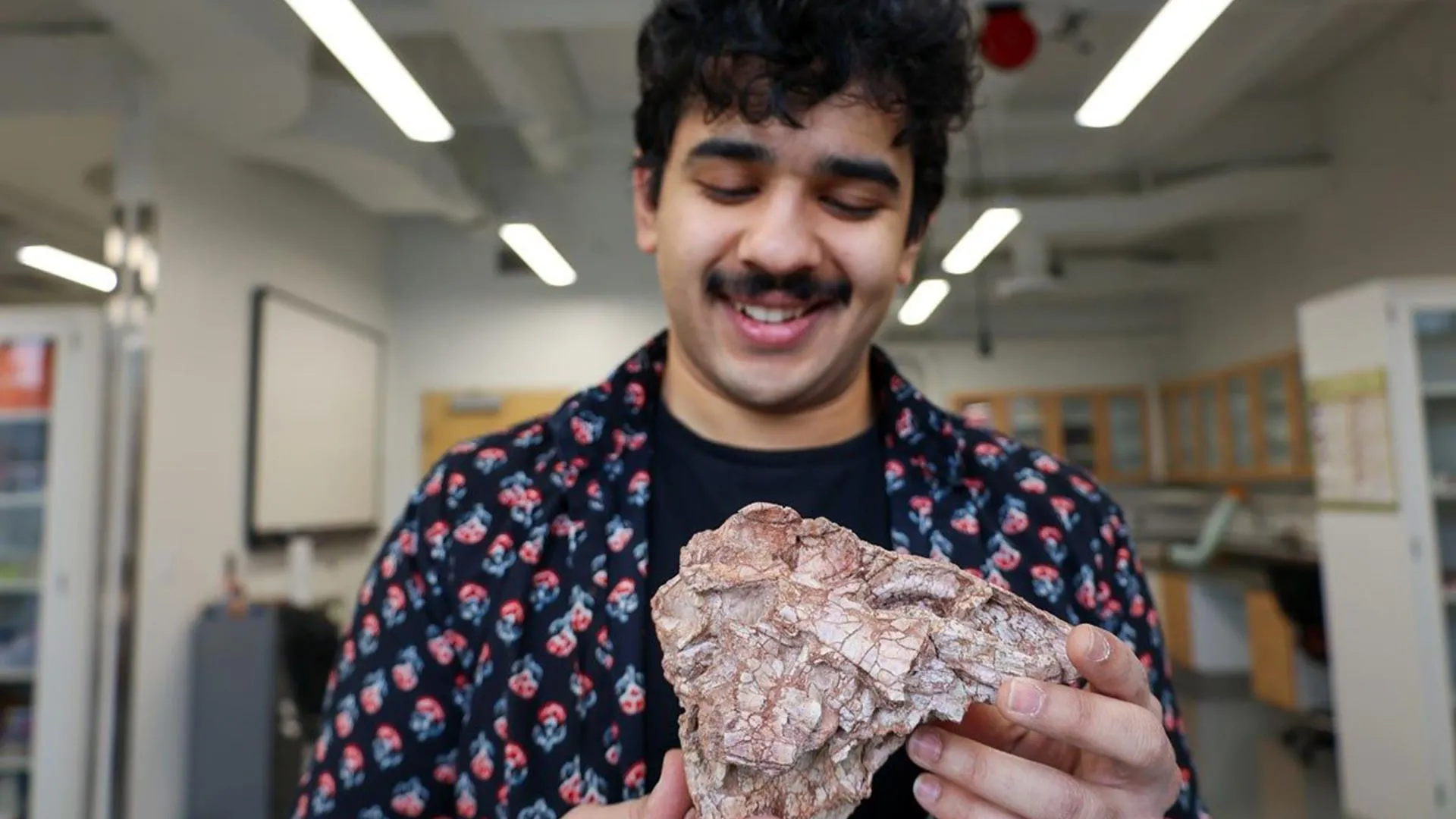
Inside a paleobiology lab at Virginia Tech, a seemingly unremarkable fossil, described by its undergraduate student researcher as "uniquely sucky" and "so bad," is poised to fundamentally alter our understanding of dinosaur evolution. Simba Srivastava, a senior geosciences major, spent two years meticulously reconstructing a heavily damaged skull of a carnivorous dinosaur, a creature that roamed the Earth over three times earlier than the iconic Tyrannosaurus Rex. His painstaking work, culminating in a publication in the esteemed journal Papers in Palaeontology, not only identifies a new species but also offers crucial new insights into the pivotal period when dinosaurs transitioned from relatively minor players to the undisputed rulers of the terrestrial landscape.
This groundbreaking research, typically the domain of seasoned paleontologists, was entrusted to Srivastava as a first-year student by his mentors, geobiologists Sterling Nesbitt and Michelle Stocker. Their proactive approach reflects a commitment at Virginia Tech to immerse undergraduate students in the full spectrum of paleontological research. "We want undergraduate researchers to experience the whole paleontological research process at Virginia Tech," explained Dr. Nesbitt. "Simba grabbed the project by the reins." This hands-on mentorship has yielded a discovery that challenges existing timelines and theories regarding dinosaur ascent.
Unearthing a Unique Specimen: The Journey of Ptychotherates bucculentus
The fossil’s journey to the Virginia Tech lab is a testament to serendipity and persistent scientific inquiry. It was initially unearthed in 1982 by a team from the Carnegie Museum of Natural History during an expedition to Ghost Ranch in New Mexico. For over three decades, the specimen languished, its potential obscured by its dilapidated condition. It was Dr. Nesbitt who, while reviewing collections, rediscovered the skull in a drawer, recognizing its potential significance and bringing it to Virginia Tech for in-depth study.
The challenges posed by the fossil’s state were immense. Its rough, pitted surface and severely crushed bones made traditional examination nearly impossible. However, leveraging cutting-edge technology, Srivastava employed computed tomography (CT) scanning. This non-invasive imaging technique allowed him to digitally dissect the fossil, separating individual bone fragments in a virtual environment. From this detailed digital model, a high-fidelity 3D-printed reconstruction of the skull was created. This process, akin to digital surgery, was instrumental in revealing the hidden anatomical details obscured by the fossil’s physical degradation.
The creature to which this skull belonged was a carnivorous dinosaur that predates the Late Jurassic apex predators by millions of years. Its existence pushes the timeline of complex dinosaurian evolution further back into the Triassic period, a crucial era in Earth’s history. The Triassic, which spanned approximately 252 million to 201 million years ago, was a period of intense evolutionary experimentation. At its onset, dinosaurs were not the dominant life forms. They co-existed and competed fiercely with a diverse array of other terrestrial vertebrates, including early archosaurs (the group that would eventually give rise to crocodiles and birds) and synapsids (the lineage leading to mammals).
The Rise to Dominance: Dinosaurs’ Post-Extinction Ascendancy
The narrative of dinosaur dominance is inextricably linked to a catastrophic event: the end-Triassic mass extinction. This global environmental crisis, one of the five major extinction events in Earth’s history, dramatically reshaped the biosphere. It wiped out a significant portion of the planet’s flora and fauna, including many of the dinosaur’s chief competitors. The fossil record indicates that in the aftermath of this extinction, the ecological niches left vacant by these vanished species were rapidly filled. Dinosaurs, already present and possessing certain advantageous traits, seized this opportunity to diversify and proliferate, eventually becoming the planet’s preeminent land animals.
Srivastava aptly describes this shift: "Dinosaurs go from being co-stars to the headliner." The end-Triassic period represents this dramatic turning point, a veritable audition for ecological supremacy where dinosaurs proved to be the most successful candidates. Fossils from this transitional phase are inherently rare, and well-preserved specimens from the very end of the Triassic are exceptionally scarce. This scarcity makes the damaged skull, despite its condition, an invaluable piece of the paleontological puzzle.
Remarkably, no other fossil specimen comparable to this one has been discovered, underscoring its unique status. Even in its distorted form, the skull yielded critical anatomical information. Researchers identified prominent cheekbones, a broad braincase, and what is believed to be a short, deep snout. These features are significant because they represent novel evolutionary developments that had not been previously observed in early dinosaur lineages. Their presence suggests that dinosaurian evolution was more complex and dynamic during the Triassic than previously appreciated, with adaptations emerging earlier than anticipated.
A New Species Emerges: Ptychotherates bucculentus
The distinctive morphology of the reconstructed skull led Srivastava and his team to identify it as belonging to a previously unknown species. The name chosen, Ptychotherates bucculentus, is a carefully crafted moniker derived from Greek and Latin, reflecting its key characteristics. "We landed on Ptychotherates bucculentus, which means ‘folded hunter with full cheeks’ in Latin," explained Srivastava. He also shared an amusing anecdote from a paleo-artist who described the creature’s appearance as "a murder muppet," a testament to its potentially unusual and striking visage.
Further analysis placed Ptychotherates bucculentus within the Herrerasauria, an early and foundational group of carnivorous dinosaurs. The specimen appears to represent one of the later-surviving members of this lineage. This classification is significant because it helps to map the diversification and eventual decline of specific dinosaur groups within the broader evolutionary narrative.
Rethinking the End-Triassic Extinction: A Broader Impact
The implications of this discovery extend beyond the identification of a new species. The geological context of the fossil provided another surprising revelation. The rock layers in which Ptychotherates bucculentus was found are believed to date to the immediate period preceding the end-Triassic mass extinction. The absence of any other known members of the Herrerasauria group from later geological strata suggests that this entire dinosaur lineage may have been among the casualties of this cataclysmic event.
"This forces us to reconsider the impact of the end-Triassic extinction as something that wiped out not just the competitors to dinosaurs, but some long-standing dinosaur lineages themselves," Srivastava stated, highlighting a significant revision to existing hypotheses. Instead of solely clearing the path for dinosaur diversification, the extinction event may have also pruned established dinosaur branches.
The geographical distribution of early dinosaurs also comes into sharper focus. Because herrerasaurians are not found in later Triassic deposits elsewhere, scientists speculate that the region now known as the American Southwest might have served as a final refuge for these dinosaurs. This suggests a potential localized survival followed by eventual extinction, a scenario that adds nuance to our understanding of biogeography during this pivotal period.
A Single Fossil, A Lost Lineage Preserved
Simba Srivastava’s "folded hunter" serves as a poignant reminder of the power of individual fossils to encapsulate vast swathes of evolutionary history. This single specimen, small enough to fit in his hands, represents the sole tangible evidence of a dinosaur lineage that persisted for an extended period, inhabited specific latitudes, and evolved a unique cranial morphology.
"This specimen, it fits in my hands, but it is the only proof that any of these dinosaurs lived this long, lived in these latitudes, the only proof that they evolved to have this skull shape," Srivastava emphasized. "All these billions of individuals that existed through time are spoken for by this one specimen." This profound statement underscores the immense responsibility and privilege that comes with paleontological discovery. Each fossil, no matter how fragmented or seemingly insignificant, is a crucial chapter in the grand, unfolding narrative of life on Earth, offering a voice to creatures long silenced by time. The work of Srivastava and his mentors at Virginia Tech has amplified one such voice, enriching our understanding of how dinosaurs conquered the world, one fossil at a time.

