
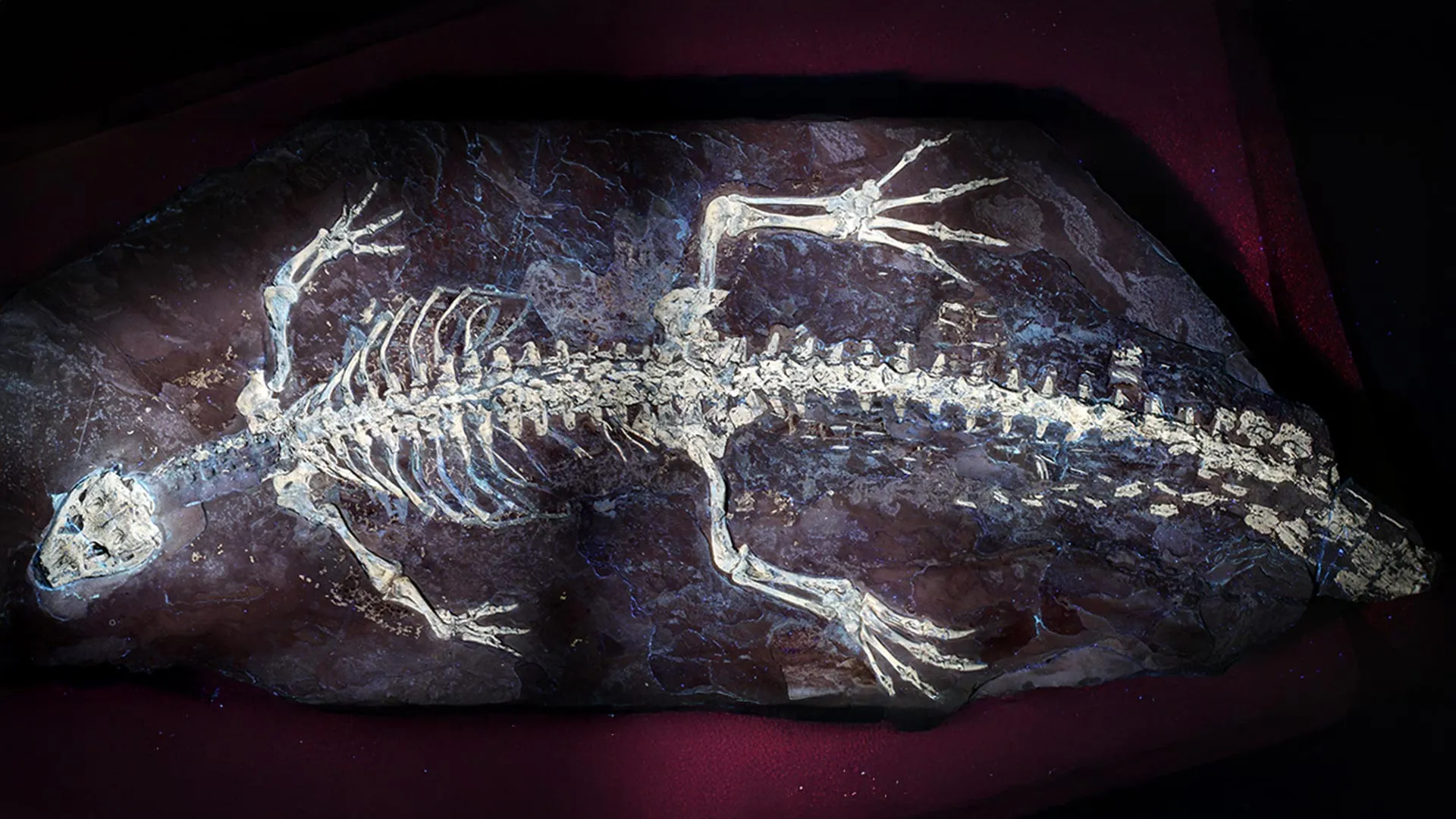
A remarkably preserved fossil from northeastern Spain is giving scientists a rare look at the skin, soft tissues, and possible coloration of an ancient crocodile relative that lived about 125 million years ago. This discovery, centered on the small crocodylomorph Montsecosuchus depereti, marks a significant milestone in vertebrate paleontology, providing the first detailed anatomical account of soft tissues in a Lower Cretaceous specimen from the Iberian Peninsula. Published in the Zoological Journal of the Linnean Society, the study utilizes advanced non-invasive imaging to peer through the veil of geological time, revealing that the roots of modern crocodilian biology are far deeper and more sophisticated than previously documented.
The Discovery and Scientific Context
The specimen, cataloged as MGB-512, was unearthed in the lithographic limestones of the Pedrera de Meià site, a geological treasure trove located in the province of Lleida, Catalonia. Though the fossil has been housed at the Museum of Natural Sciences of Barcelona for over a century—having been initially described in the 1990s—it was only through the recent intervention of paleontologists Oscar Castillo-Visa and Jesús Serrano that its true significance was realized.
As the research team compiled a comprehensive database of fossils from the Montsec region, they subjected the holotype to ultraviolet (UV) light. This technique exploits the differential fluorescence of fossilized organic material versus the surrounding sedimentary matrix. Under the harsh glare of UV lamps, hidden anatomical features that had been invisible to the naked eye for generations suddenly emerged from the rock. The result is a high-resolution view of a creature that occupied a coastal, karstic lake environment during the Early Cretaceous period.
A Chronology of a Fossilized Life
To understand the significance of this find, one must appreciate the environmental conditions of the Early Cretaceous. Approximately 125 million years ago, the region of the present-day Catalan Pre-Pyrenees was a humid, subtropical zone defined by shallow, nutrient-rich lakes. Montsecosuchus depereti was a small predator, measuring roughly 50 centimeters in length, well-adapted to these waters.
Following its death, the specimen underwent a process of rapid burial in fine-grained, anoxic lake sediments. This rapid entombment is the hallmark of a Konservat-Lagerstätte—a site of exceptional preservation. The lack of oxygen and the specific chemical composition of the limestone prevented the typical decay processes that destroy soft tissues, effectively "pickling" the skin, cartilage, and scales in a lithographic sarcophagus. For over 100 million years, these remains were compressed into the geological record, remaining dormant until their discovery in the early 20th century, and eventually yielding their secrets in the 2020s.
Anatomical Revelations: Skin and Sensory Systems
The UV analysis has provided the most detailed map of crocodylomorph integument ever produced for a fossil of this age. Researchers documented a complex array of epidermal scales that varied significantly in shape and size depending on their location on the body. This variability suggests a high degree of specialization in the creature’s skin, likely serving both as protection and as a platform for sensory input.
Perhaps most intriguing is the identification of potential sensory organs preserved within the scales. In modern crocodilians, specialized integumentary sensory organs (ISOs) are found across the skull and body, allowing the animals to detect minute changes in water pressure, temperature, and chemical composition—critical for hunting in murky or dark water. The fossil evidence suggests that Montsecosuchus possessed similar structures, though they were localized specifically to the neck, limbs, and the lateral edges of the trunk and tail. This distribution pattern provides a "missing link" in the evolutionary history of these organs, implying that sensory integration began in localized patches before expanding across the entire body in later lineages.
Respiratory Evolution and Physiological Adaptation
Beyond the surface, the UV imaging revealed evidence of a sophisticated respiratory system. The researchers identified cartilaginous structures within the thoracic cavity, indicating that Montsecosuchus possessed a well-developed lung and rib structure. This anatomy points to an efficient respiratory mechanism, one that mirrors the high-performance breathing systems seen in modern crocodiles.
This finding challenges the notion that early crocodylomorphs were primitive or sluggish. Instead, it supports the theory that by 125 million years ago, these animals were already highly specialized for a semi-aquatic existence. The thoracic anatomy suggests that the physiological foundation for the powerful, energy-efficient movement and sustained aerobic activity seen in today’s crocodilians was already firmly established in the Lower Cretaceous.
The Oldest Evidence of Camouflage?
The most visually striking discovery lies in the caudal region of the fossil. Under UV light, the scales of the tail exhibit distinct, alternating light and dark bands. The research team interprets this as potential evidence of original coloration, specifically a disruptive camouflage pattern.
If this interpretation holds, Montsecosuchus depereti would officially become the oldest known crocodylomorph to show preserved evidence of pigmentation. While the exact hues remain a mystery—as pigment cells degrade differently than skin structure—the presence of a pattern strongly suggests that these ancient reptiles used visual deception to evade predators or ambush prey, much like their modern descendants. "At the moment we cannot say for sure what color the crocodile’s tail was," noted co-author Albert G. Sellés, "but it would be expected that it was not so different from current species, which also show different coloration patterns."
Implications for the Catalan Fossil Record
The study underscores the global importance of the Pedrera de Meià site. As a Konservat-Lagerstätte, the site has yielded over 8,000 specimens, ranging from insects and crustaceans to the world’s first known angiosperm, Montsechia. The success of this project demonstrates that our understanding of the past is not limited by the quantity of new discoveries, but by the application of new technologies to existing museum collections.
The involvement of the Institut Català de Paleontologia Miquel Crusafont and the University of New England highlights a collaborative, multidisciplinary approach to paleontology. By integrating imaging technology with traditional comparative anatomy, the team has turned a century-old specimen into a primary source for understanding vertebrate evolution.
Scientific Legacy and Future Directions
The implications of this research extend far beyond a single species. By demonstrating that key features—such as advanced respiration and complex integumentary systems—were present 125 million years ago, the study forces a recalibration of the timeline for crocodylomorph evolution. It suggests that the "crocodilian body plan" was a highly successful evolutionary solution that reached near-modern efficiency very early in its history.
As the scientific community continues to digitize and re-examine historical collections, the success of the Montsecosuchus study serves as a call to action. Thousands of fossils sitting in drawers worldwide may currently be hiding similar soft-tissue secrets, waiting only for the application of non-invasive techniques like ultraviolet or multispectral imaging. The story of Montsecosuchus depereti is not just a look back at a small, ancient reptile; it is a testament to the fact that, in the world of paleontology, the most exciting discoveries are sometimes those that have been staring us in the face for over a hundred years.
This research, funded by a coalition of national and European scientific bodies including the Ministry of Science, Innovation and Universities, and the NextGenerationEU program, serves as a cornerstone for future studies in the Catalan Pyrenees. It reinforces the region’s status as a vital node in the global understanding of the Cretaceous world, ensuring that the legacy of Pedrera de Meià will continue to inform and inspire generations of researchers.

